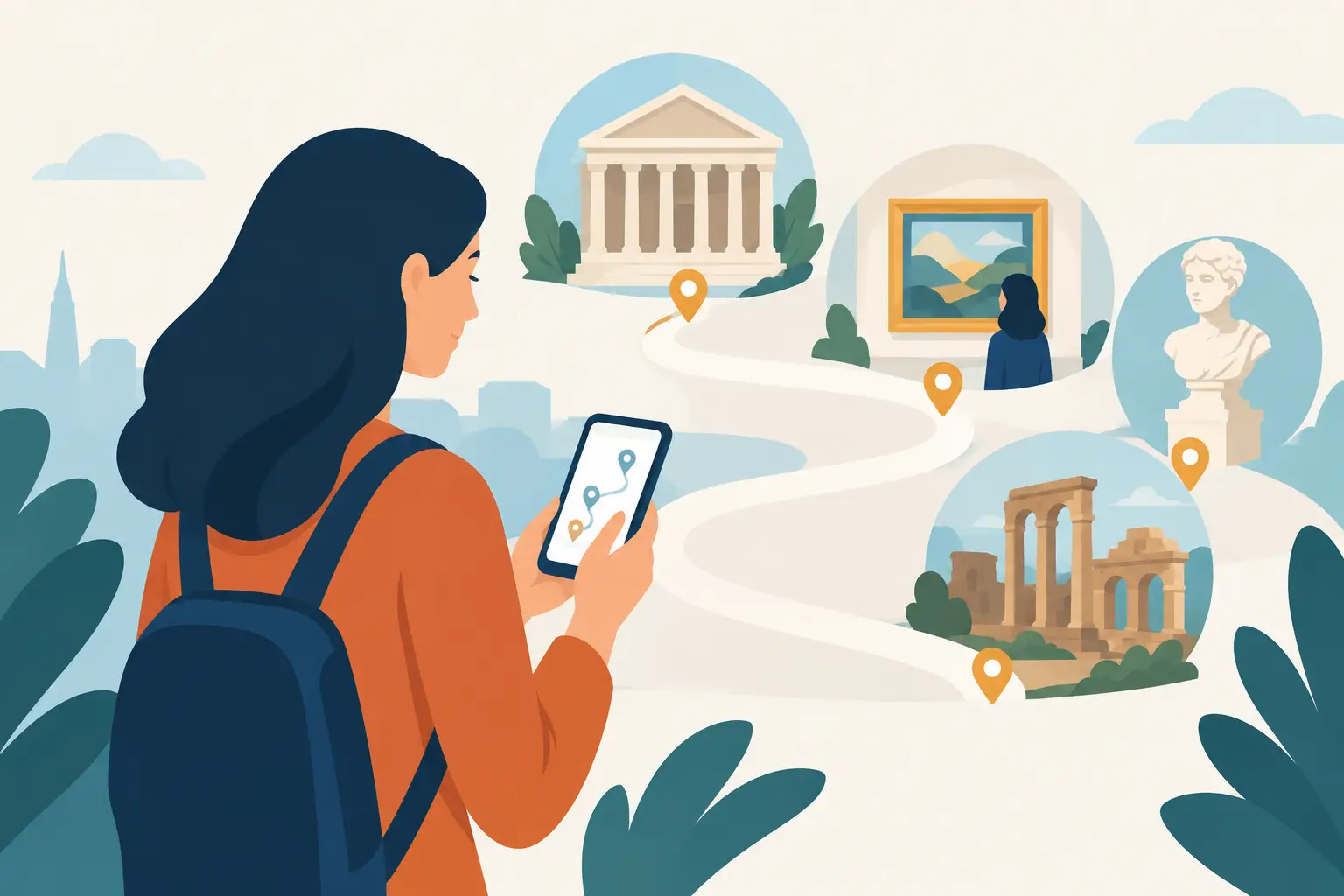
A visitor does not discover a cultural route only when they walk through a door or scan a QR code. Their experience starts much earlier: when they look for an idea for a day out, notice a sign in the town centre, visit a tourist office website or hear about a place from someone they know. Communicating a cultural route therefore means more than promoting a visit. It must make the cultural offering visible, understandable and appealing without oversimplifying what it seeks to convey.
For museums, heritage sites, local authorities and associations, the challenge is twofold. Of course, communication should attract visitors, but it should also give them the means to enter a story, a place or a collection. Effective communication prepares the visit, supports visitors' choices and extends the relationship after they leave.
Communicating a cultural route: thinking about the whole experience
A route is more than a sequence of stops. It is a planned progression, with a starting point, clear landmarks, content and an interpretive purpose. Its communication should reflect that coherence.
The first mistake is to present a route as a simple list of points of interest. A visitor does not merely choose a castle, an exhibition or a heritage trail: they choose an experience suited to the time available, their interests, their mobility and sometimes the make-up of their group. Practical information should therefore be treated as an integral part of interpretation, not as a secondary addition.
Before the visit, it should be possible to answer concrete questions clearly: How long is the route? Is it self-guided or guided? Who is it for? Can it be followed with a stroller, a wheelchair or young children? What equipment is needed? An imprecise answer can discourage an interested audience. Clear information, by contrast, builds trust and reduces the pressure on reception teams.
During the visit, communication becomes a matter of orientation. Visitors need to know where to start, how to move forward and what to expect at each stop. Afterwards, it can extend the discovery by recalling a memorable detail, highlighting other local resources or inviting visitors to return for another route.
Making the promise clear
Every cultural route deserves a simple promise, based on the experience it offers rather than on the organisation behind it. “Discover our heritage” is too broad to create a clear picture. “Follow in the footsteps of medieval builders in the old town” or “Listen to the stories of the people who shaped the industrial landscape” immediately provide an angle.
This promise does not need to be spectacular. It needs to be honest. Overly ambitious communication creates expectations that the route may not always meet, especially when visiting conditions are affected by the weather, visitor numbers or the accessibility of the site. It is better to highlight what makes the experience unique: a little-known local story, an unusual viewpoint, sound archives, a rarely seen collection or a perspective from local residents.
Clarity is particularly valuable for digital routes. Presenting an app or web app as a technical tool is not enough. Visitors need to understand its immediate benefits: listening at their own pace, choosing a language, following an itinerary, viewing archive images or using content offline. Technology then supports the tour instead of becoming another layer to explain.
Adapting the message to each audience
The same route may welcome families, individual visitors, school groups, local residents and international tourists. This does not mean multiplying disconnected messages. The aim is to keep one central promise while adapting the entry points.
Families look for an accessible and lively activity. Heritage enthusiasts want to know about the historical or scientific depth of the content. Visitors passing through often prioritise duration, location and ease of access. For international audiences, language availability and the freedom to visit independently can be decisive. These expectations should appear in the most appropriate media without locking people into rigid categories.
Guideius addresses every digital cultural mediation challenge
Create a multilingual smartphone audio guide that is easy to deploy, accessible and tailored to your museum, heritage site or destination.
Connecting communication, signage and interpretation
Communication quickly loses its effectiveness if it stops at social media, a poster or a presentation page. On site, signage is often the first medium visitors actually encounter. It should use the essential codes of the wider communication: the same name, vocabulary, visual cues and promise.
This continuity reduces hesitation. Someone who has spotted a route online should be able to identify it easily on site. A QR code, for example, is useful only when its function is explicit. Is it used to launch an audio guide, open a map, access a stop or choose a language? A short message in the right place prevents visitors from giving up.
The right balance depends on the setting. In a museum, signage can be discreet and integrated into the scenography. On an urban or countryside route, it must withstand the conditions on the ground and remain readable from a distance. At a busy site, it may be useful to offer several starting points or make accessible content available before arrival in order to make reception smoother.
Digital technology does not systematically replace physical media; it complements them. Direction signs, overview maps and safety information must remain available without a smartphone. Conversely, audio, multilingual content, images and quizzes can enrich the discovery without overloading panels. This complementarity is often more restrained, inclusive and sustainable than adding more and more systems.
Creating content that respects visitors' time
Good interpretation content does not try to say everything. It makes people want to look, listen and understand. This requires editorial work: prioritising information, choosing an angle for each stop and adapting the length of each format to the actual visiting conditions.
A text read while standing in a busy street does not have the same rhythm as content viewed at home. Audio listened to in a museum room should leave space for looking at the works. A two-minute clip can be more memorable than a ten-minute commentary, as long as it offers a genuine perspective.
Different formats also make it easier to accommodate different ways of visiting. An audio story may suit someone who prefers listening, while a transcript, subtitles, sign language or an image description meet other needs. Accessibility should be considered from the beginning, not at the end of the project. It improves the overall quality of the experience, including for visitors who do not think of themselves as having a specific need.
To keep the editorial approach consistent, teams can check four points before publishing:
- does the visitor immediately understand what this stop is about;
- does the content provide information, emotion or a precise way of interpreting what they see;
- is the language accessible without oversimplifying the subject;
- is the format suited to the location, the time available and the listening or reading conditions?
Measuring without reducing the visit to a number
Usage statistics can help improve the communication of a cultural route. They can reveal the most-used languages, the most-viewed stops, where visitors drop out and which routes are most popular. This information helps teams adjust content, signage and promotional activity on the basis of concrete observations.
However, the figures need to be interpreted carefully. A stop that is rarely heard is not necessarily uninteresting: it may be poorly signposted, located in an area with weak network coverage or too far from the natural flow of the route. Likewise, a high number of views alone does not measure the quality of the experience. Feedback from mediators, observations in the field and visitors' comments remain essential.
For public or publicly funded organisations, data governance is also a matter of trust. Collecting only useful information, explaining how it is used and choosing tools that respect visitors reinforces the consistency between accessibility commitments and digital practices.
Giving teams the means to act
A communication strategy only lasts if teams can support it over time. The chosen tools should therefore be simple to administer, allow content or a route to be updated without relying on scarce technical expertise, and adapt to seasonal or event-related changes.
This is where digital interpretation solutions show their value when they are designed for day-to-day work. With an approach such as Guideius, teams can offer multilingual audio tours on visitors' smartphones, reduce the need to manage dedicated hardware and continue enriching their offer over time. The priority is to choose a solution that serves the cultural project, not the other way round.
A well-communicated cultural route does more than increase attendance. It gives visitors an active role, lets them choose their own pace and leaves them with a lasting impression of what they have understood. Clarifying the promise is often the most useful first step; the rest of the communication can then be organised coherently, from the first sign visitors see to the memory they take away.
Would you like to apply these ideas to your site?
Guideius helps deploy multilingual audio tours with QR codes, GPS, offline mode, multimedia content and privacy-friendly analytics.