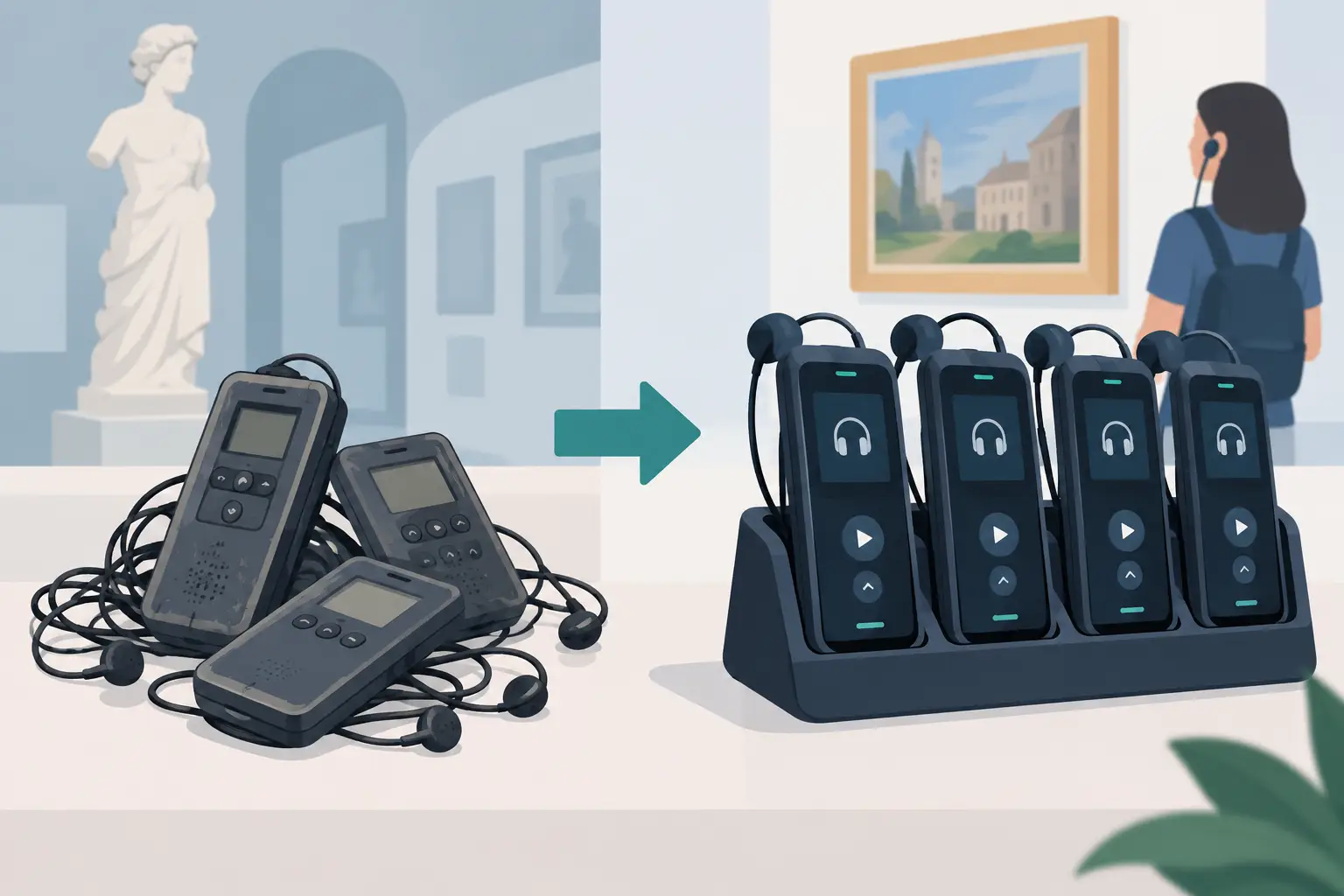
A breakdown at the counter, headsets to be disinfected, batteries that no longer last the day, a foreign visitor waiting for a version in their language: when these incidents are repeated, the question is no longer just technical. Knowing how to replace an aging fleet of audio guides means rethinking mediation, reception and team working time. For a museum, a monument or a tourist office, the right choice must improve the visiting experience without creating a new costly dependency.
Start by measuring the real cost of aging equipment
The purchase price of devices only tells part of the story. A traditional fleet also involves preparation, distribution, recovery and control time. Added to this is the replacement of batteries, cables, headsets, lost or damaged devices, as well as maintenance contracts that are sometimes difficult to anticipate.
These operations are particularly heavy on small teams. During periods of high attendance, reception must arbitrate between visitor orientation and equipment management. In open sites, the constraints are even more pronounced: limited autonomy, weather, distance from charging points and movement of devices between several locations.
Before launching a replacement, it is useful to take stock of the situation over a full season or, failing that, over several representative weeks. How many devices are actually distributed? How much time does the team spend each day managing them? What are the repair and renewal costs? What languages or features are visitors asking for but not being able to access? This data provides a concrete framework for the decision and avoids replacing one piece of equipment with another that would reproduce the same limits.
Why the smartphone changes the logic of audio guides
Switching to digital audio guide on smartphone is not about moving audio files to another medium. It changes the role of the establishment. Instead of managing a fleet of devices, the team provides a route accessible on the visitor's personal phone, generally by QR code or by an easy-to-enter address.
This approach greatly reduces handling at the counter. It also allows you to update content, correct information or add a language without having to physically intervene on each device. For visitors, access is more direct: they keep their phone, choose their language and move at their own pace.
However, this solution is not equally suited to all contexts. A poorly equipped public, a site welcoming school groups, an area without network coverage or a strong loan requirement must be taken into account from the start. The objective is not to impose the all-smartphone, but to build realistic mediation. In certain cases, keeping a few ready devices or dedicated tablets remains a relevant response to leave no one behind.
QR code, GPS and offline mode: choose according to the route
In a museum or a marked visiting location, the QR code is often the most readable solution. Placed at reception or near the works, it gives the visitor an immediate entry point into the tour. It also works very well when a visit includes several thematic choices or different reading levels.
On an urban circuit, a heritage trail or an extended territory, GPS triggering provides another quality of use. It accompanies the walk and can offer the right content in the right place, without multiplying the panels. However, it is necessary to define sufficiently precise trigger zones and provide for manual consultation: geolocation may vary depending on the telephone, the relief or urban density.
Offline mode is decisive when connectivity is weak or spotty. The visitor downloads the elements of the route before leaving, then consults the content without depending on the network. For a cultural structure, this function constitutes a guarantee of continuity, not simple technical comfort.
Guideius addresses every digital cultural mediation challenge
Create a multilingual smartphone audio guide that is easy to deploy, accessible and tailored to your museum, heritage site or destination.
How to replace an aging audio guide fleet without disrupting the season
The replacement should not be treated as a sudden changeover. A pilot phase, over a short route or during a period of moderate attendance, allows real usage to be observed. The questions asked at reception, the activation rate, connection difficulties and the time saved by the teams are more useful indicators than a theoretical demonstration.
The first step is to define the expected experience. Would you like to offer a self-guided tour, a family tour, a discovery in several languages, an accessible tour or several itineraries depending on the audience? This editorial reflection precedes the choice of the tool. A solution that is technically rich but difficult to administer risks remaining under-exploited.
Then comes the recovery of the content. Existing scripts often constitute a valuable basis, but they deserve to be reread for use on smartphones. A text designed for a touchscreen device can be enriched with images, maps, archives, subtitles or a quiz. It can also be divided into shorter sequences, adapted to the mobility and attention of the visitor.
The test phase must bring together varied profiles: reception staff, mediators, volunteers, visitors accustomed to digital technology, families, elderly people and, if possible, people affected by a disability. Their feedback reveals simple but decisive obstacles: poorly visible signage, instructions that are too long, text that is too small, insufficient volume or misunderstood triggering.
Finally, plan clear communication at the reception point. A well-formulated sentence, a visible QR code and reassuring support during the first weeks encourage adoption. Visitors do not need technical instructions: they must immediately understand what they will gain, for example a visit in their language, enriched content or freedom of navigation.
Put accessibility at the center of the project
Replacing a fleet of audio guides is an opportunity to make mediation more inclusive. Audio remains essential, but it alone does not meet all needs. Transcriptions, subtitles, described visuals, readable navigation, adapted contrasts and content in sign language can concretely broaden access to the visit.
Accessibility also concerns the conditions of use. A path must remain understandable without creating a mandatory account, without requiring unnecessary manipulations and without requiring a constant connection. Visitors must be able to easily return to the map, change language or find a step. These details often determine the perceived quality of the experience.
Particular attention should be paid to people who do not wish to use their telephone or do not have one. Inclusive mediation provides an alternative: one-off loan, printed support, human support or short version available at reception. Digital sobriety also consists of not eliminating other forms of transmission.
Evaluate a solution beyond its functionalities
A digital audio guide platform must be judged in terms of its daily operation. The simplicity of the administration interface is central: a cultural team must be able to modify a text, add media or monitor uses without systematically requesting a technical service provider.
Statistics are another useful criterion, provided they remain understandable and respectful of visitors. Knowing which stages are most visited, when routes are interrupted or which languages are most requested helps to improve the offer. However, data collection must remain proportionate, transparent and compliant with data protection obligations.
Also question the conditions for development: is maintenance included? Can we open a new route without starting the project again? Does the solution allow you to adopt your visual identity? Is the content easy to retrieve and maintain over time? For a community or an association, this ability to evolve often counts more than a spectacular function rarely used.
Guideius responds to this logic with an application and a web app designed for cultural teams: distribution by QR code and GPS, offline consultation, multimedia content, accessibility options and administration accessible to non-specialists. The challenge is to devote more time to stories, collections and visitors, rather than to maintaining physical assets.
Prepare a sustainable budget rather than a simple purchase
Comparing a subscription or digital service to the price of a device alone can give a misleading image. The relevant calculation integrates the total cost of ownership: initial purchase, storage, charging, cleaning, breakage, loss, renewal and time spent by the teams. We must also consider editorial costs, such as writing, translation, sound recording and updating content.
Digital transforms part of equipment expenses into service and content expenses. This development can be more predictable, especially if maintenance is integrated and pricing follows the size of the project. It also makes it possible to evolve the route in stages, without waiting for the complete renewal of a fleet.
Replacing aging audio guides is therefore less a question of devices than a choice of mediation. Based on the audiences, field constraints and the real capacity of your teams, you can build a system that is lighter to operate, more inclusive and more vibrant. The best project is the one that leaves visitors with the memory of a well-told place, and the teams with the opportunity to continue to bring it to life.
Would you like to apply these ideas to your site?
Guideius helps deploy multilingual audio tours with QR codes, GPS, offline mode, multimedia content and privacy-friendly analytics.