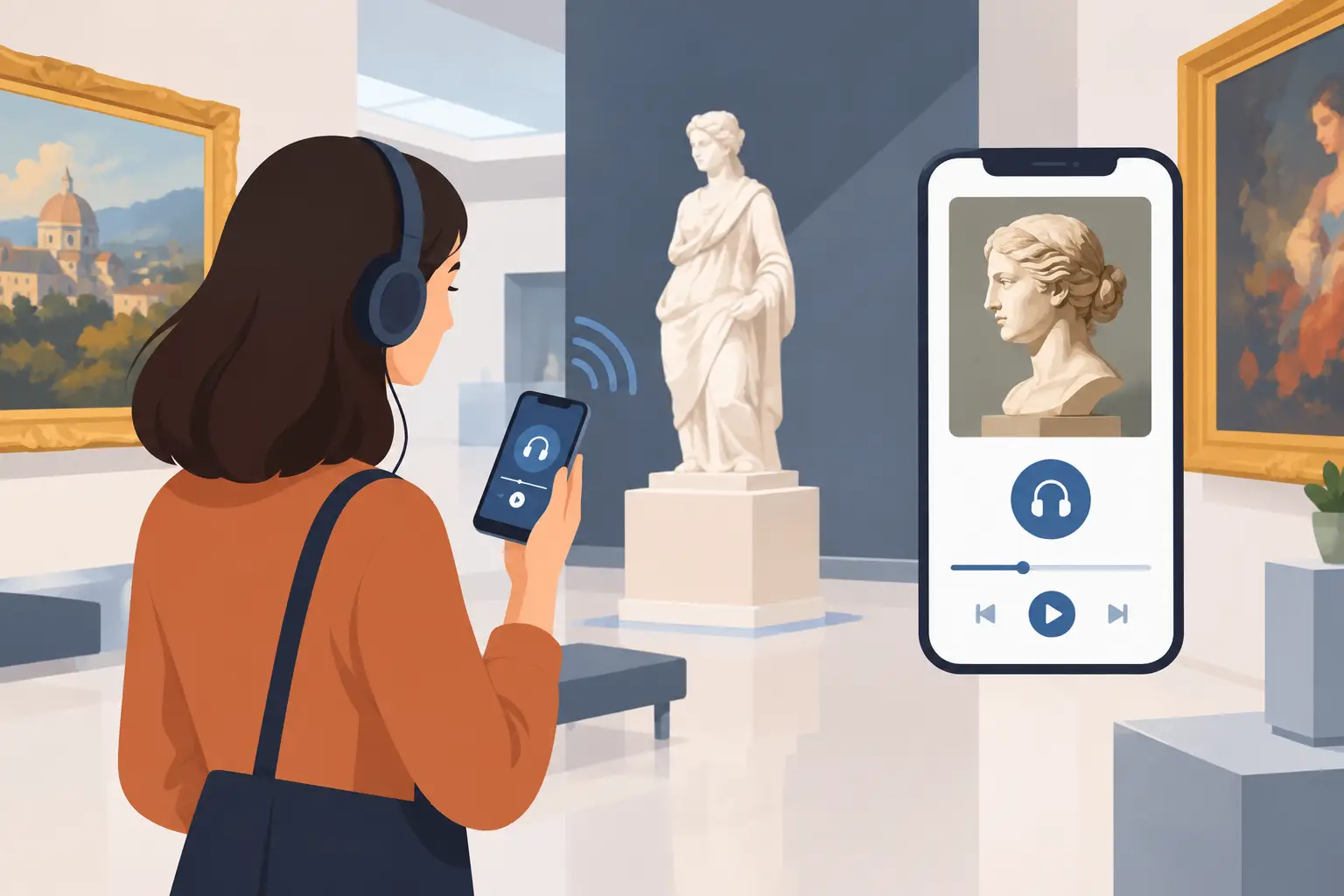
A museum audio tour app does more than replace a dedicated device with a smartphone. It changes how a venue prepares its visits, shares its content and welcomes people with different needs. For a small or medium-sized cultural organisation, the challenge is practical: offering high-quality interpretation without overloading reception staff or stretching the budget too far.
The right tool should support the cultural project first. It needs to be easy for visitors to start, straightforward for teams to manage and flexible enough to evolve with collections, exhibitions and tourist seasons.
What a museum audio tour app changes in practice
A traditional audio guide involves a familiar chain of tasks: buying devices, charging them, handing them out at reception, cleaning, maintenance, stock checks and dealing with faults. These tasks take time, create recurring costs and can limit the number of visitors equipped at busy times.
An audio tour app uses the visitor's own smartphone. A QR code at the entrance, on an exhibit label or beside a point of interest opens a route without borrowing equipment. Outdoors, GPS can suggest the right content in the right place. Visitors explore at their own pace, choose the stops they want to hear and, if the venue provides for it, return to some content after their visit.
The change also opens up editorial possibilities. Audio commentary can be offered in several languages alongside images, videos, transcripts or a quiz. The tour becomes a richer interpretation space without filling galleries with extra panels. Digital tools complement staff and guided tours, giving visitors another way to explore independently.
Start with visitor needs, rather than the specification sheet
Before comparing solutions, clarify what the tour needs to achieve. A municipal museum with permanent collections will have different expectations from a castle, an interpretation centre, a tourist office or an outdoor heritage trail.
Start with the audience. Do international visitors need several languages? Would families prefer a shorter or more playful route? Can people who are deaf or hard of hearing, blind or partially sighted, or who have reading difficulties access the content comfortably? Accessibility should shape formats, navigation and writing from the outset.
Next, consider the setting. Mobile reception may be patchy in a thick-walled monument, on a rural path or in a historic town centre. Offline access helps avoid interruptions and disappointment at the start of a visit. Outdoors, GPS triggering can make the tour easier to follow, but visitors must also be able to select a stop manually. Location accuracy varies with the surroundings.
Finally, consider how the team works. If content changes regularly, temporary exhibitions are planned or several people contribute, the management interface must remain usable without specialist knowledge. Even a feature-rich solution can slow updates down if it requires ongoing help from a provider.
The criteria that matter to cultural teams
Choosing an audio guide app is a commitment that can last several years. Beyond the appearance of the interface, the following criteria help assess whether a solution fits day-to-day needs:
- Visitor access: QR codes, direct links or GPS should keep the number of steps small and avoid compulsory account creation.
- Languages and content: the team should be able to publish, correct and enrich a tour without advanced technical skills.
- Offline use: this is crucial wherever indoor or outdoor mobile reception is unreliable.
- Accessibility: transcripts, readable text sizes, clear navigation and adapted content make the tour available to more people.
- Usage statistics: these should help teams understand routes, listening habits and language choices without turning visitors into data products.
- Budget control: maintenance, hosting, support and future development should be clearly understood from the start.
Personalisation also deserves attention. A lightweight web app may be enough for many projects and makes access easier. A white-label app becomes relevant when an institution wants the experience to reflect its visual identity or bring several sites together under one brand. The right level of customisation depends on the project, budget and resources available to maintain it.
Guideius addresses every digital cultural mediation challenge
Create a multilingual smartphone audio guide that is easy to deploy, accessible and tailored to your museum, heritage site or destination.
Design an audio tour people want to listen to
The quality of an audio guide is not determined by its number of tracks. A tour that is too long can be tiring, while overly descriptive commentary may simply repeat what visitors can already see. Audio works particularly well when it offers a perspective, a story, a hard-to-see detail or a personal voice.
For a general tour, tracks of one to three minutes are often a useful guide. Some works or places warrant more detail, but this should remain optional. Offering different levels meets different needs: essential commentary for everyone, with additional content for those who want to explore further.
Voice, pace and vocabulary matter as much as the script. Write for listening, with precise sentences and a clear progression. Avoid piling up dates or specialist terms without explaining them. Historical and scholarly accuracy can still be expressed in simple language.
Multimedia should serve a clear purpose too. An archive photograph can reveal how a building changed. A map can help visitors find their way through a town. A quiz can hold families' attention. Adding media without an editorial reason risks distracting visitors.
Make accessibility part of the shared visitor experience
An audio tour already allows people to explore at different speeds. Inclusion needs more: full transcripts, sufficient contrast and a readable interface, clear language, video subtitles and routes designed around mobility constraints wherever possible.
These choices help more than the people they are primarily intended for. A transcript can assist someone unable to use headphones, a parent accompanying a child, a visitor in a noisy setting or anyone who wants to reread information. Multilingual content also makes international visitors feel welcome.
Accessibility depends on coordination as well as technology. Interpretation, reception, communications and site management all have a role. Clear starting instructions, a recommendation to bring personal headphones and devices available to borrow for visitors without smartphones help prevent digital access from becoming a new barrier.
Use measurement to improve the tour responsibly
Usage statistics can offer valuable insights: how often tours are started, which languages are selected, the most popular stops, average listening time and completion rates. They may reveal a hard-to-find stop, a recording that is too long or a language version that needs clearer signage.
These insights should support interpretation. A museum does not need to track visitors individually to understand how its audio guide is used. Collecting only useful information, explaining it clearly and respecting personal data fits cultural institutions' commitment to trust, knowledge sharing and a considerate welcome.
Plan a realistic launch
A successful project often starts with a pilot tour. This might cover a selection of key works, a town-centre walk or a temporary exhibition. The first version allows teams to test content, signage, stop activation and the questions raised at reception before expanding the service.
Include real visitors in testing: regulars, first-time visitors, families, people less comfortable with digital tools and people with specific access needs. Their feedback reveals more than checks made solely behind a screen. Test different phones in actual visiting conditions, particularly where reception is weak.
Support matters for teams. A solution such as Guideius combines straightforward management with practical features: QR codes and GPS, offline access, multimedia content, statistics and accessibility options. The aim is to let cultural professionals focus on telling stories, sharing knowledge and bringing heritage to life.
A successful audio guide app stays in the background. Visitors remember what it helped them understand, imagine or see differently. That is how it earns its place in a museum or a heritage destination.
Would you like to apply these ideas to your site?
Guideius helps deploy multilingual audio tours with QR codes, GPS, offline mode, multimedia content and privacy-friendly analytics.