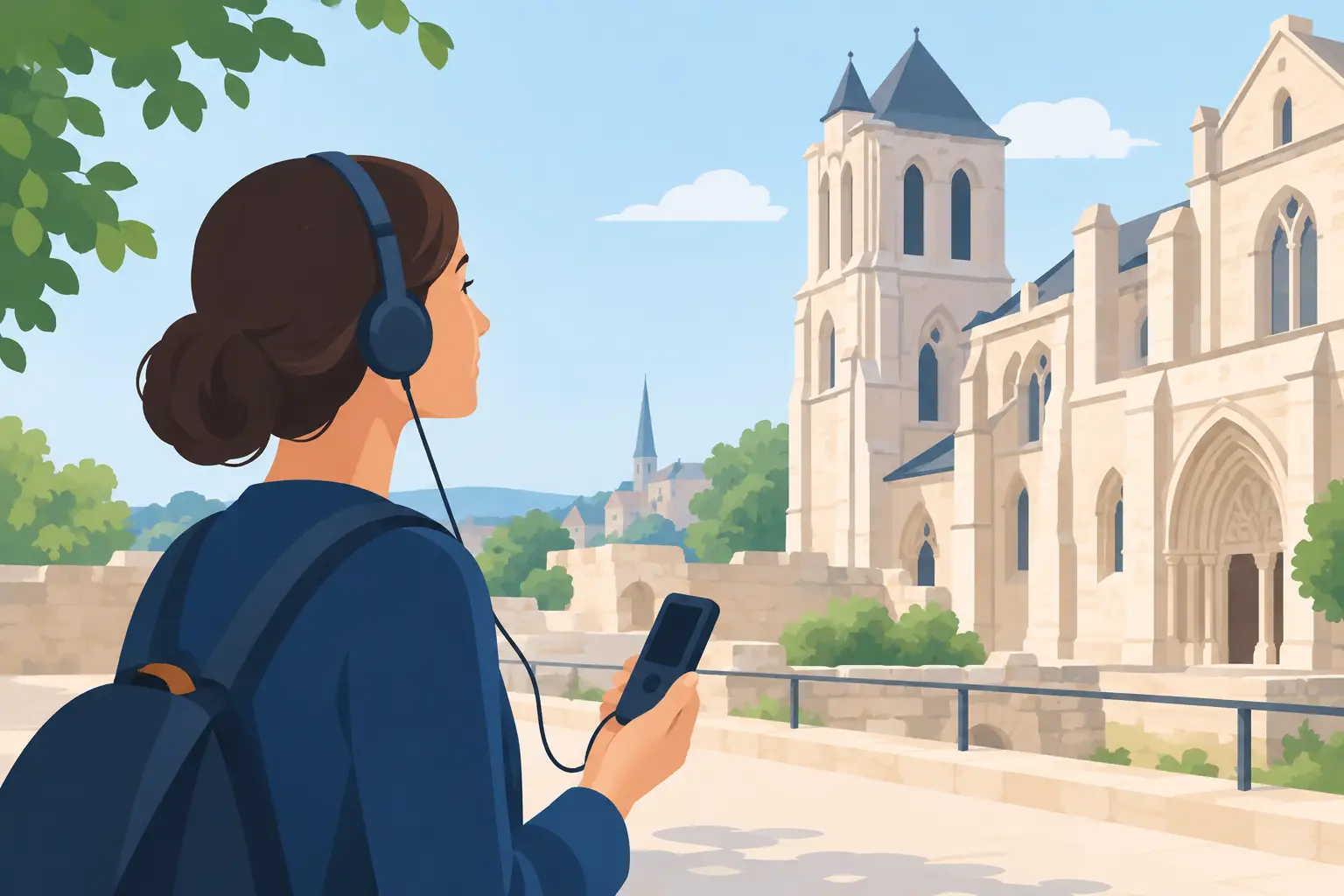
A successful audio guide is not measured by the number of tracks published, nor by the sophistication of its technology. It is measured at a very concrete moment: the one where a visitor stops in front of a detail, listens, looks again and understands why this place deserves their attention. Good heritage audio tour practices start from this reality. They consist of putting the technique at the service of clear, accessible mediation adapted to the real conditions of the visit.
For a local museum, a monument, an interpretation center or a tourist office, the challenge is twofold. We must offer a quality experience without creating an additional burden for the teams, or excluding visitors who are less comfortable with digital technology. This requires making consistent editorial, technical and operational choices from the start.
Start from the actual journey, not from the content catalog
The temptation is common: wanting to tell the whole story of a site. However, an audio tour is neither an exhaustive scientific inventory nor the sound transposition of a very long carte. It accompanies movement, glances, pauses and sometimes unforeseen events. The visitor remains standing, sharing his attention between his screen, his environment and the other people present.
Before writing any script, it is therefore useful to physically walk through the route. Where do visitors hesitate? Which points of view deserve explanation? Where does the mobile network become uncertain? Which spaces are noisy, narrow, exposed to the sun or difficult to access? These observations determine the duration of the sequences, the choice of triggers and the level of autonomy to be left to the audience.
A good route favors stops that have a specific function. Some provide landmarks, others reveal an architectural detail, explain a vanished use or provide a testimony. Each track must provide a reading angle that the visitor would not find alone. If it simply describes what is already obvious, it makes the experience heavier.
The number of steps depends on the location and time of visit. For a dense site, it is often better to offer a short main course, supplemented by optional content. This approach respects visitors in a hurry, families and curious audiences who wish to learn more. It also avoids confusing documentary richness and cognitive overload.
Writing for the ear and for the place
A text intended to be read is not automatically a good text to listen to. When speaking, long sentences, accumulated dates and overly abstract formulations quickly lose attention. Audio writing benefits from being direct, embodied and precise, without oversimplifying the historical subject.
An effective path begins by locating the attention: a visible element, a question, an old gesture or a concrete situation. She can then provide context, then return to what the person has in front of them. For example, rather than immediately announcing a succession of construction phases, we can invite people to observe the difference in stone between two parts of a wall and explain what it tells about the evolution of the building.
Duration matters. A one to two minute sequence is often easier to follow in a general course. Longer formats may be suitable for in-depth content, provided they are clearly identified as such. The right rhythm depends on the location: facing a panorama, listening can be more contemplative; in a busy room, it must go more to the essentials.
Voice and sound quality deserve the same attention as the text. Natural diction, clean recording and consistent volume make content more comfortable. Music or soundscapes can enrich the narration, but they must never mask the words or transform the heritage into a setting. Their use is relevant when it helps to understand an era, a profession, a practice or the atmosphere of a space.
Designing good heritage audio tour practices for everyone
Accessibility should not be added at the end of the project as an option. It improves the visit for a large number of people: hearing-impaired visitors, blind or visually impaired people, non-speaking audiences, families, seniors, people with reading difficulties or simply visitors tired from a day of discovery.
For audio content, this includes well-structured readable transcriptions, subtitles for videos, audio descriptions of essential visual elements and navigation compatible with support tools. Images, maps and archival documents must also be accompanied by useful alternative texts, not simple technical titles.
Multilingualism requires particular vigilance. Translating a French script word for word is rarely enough. Local references, puns and institutional formulations must be adapted to remain understandable. It is better to offer fewer languages, but truly proofread and natural versions, rather than a multiplication of approximate translations.
Accessibility also concerns uses. A clear interface, sufficiently visible buttons, a journey without compulsory account creation and simple instructions reduce abandonments. The visitor should not have to search for long how to get started, change language or find the next step.
Guideius addresses every digital cultural mediation challenge
Create a multilingual smartphone audio guide that is easy to deploy, accessible and tailored to your museum, heritage site or destination.
Choose discreet and reliable technology in the field
The personal smartphone facilitates the deployment of an audio tour, provided that the full complexity of the system is not burdened on the visitor. Access by QR code is relevant when entering or leaving a route. GPS can then trigger or suggest content outdoors. In a museum or monument, where geolocation is less precise, visual markers or codes placed near the works are often more reliable.
There is no universal device. The QR code gives the visitor control and works well on free routes, but requires careful signage. GPS triggering makes an urban or landscape stroll smoother, but can be affected by narrow streets, thick buildings or the weather. In many cases, combining several access modes is the most reassuring solution.
Offline mode is decisive in rural areas, monuments with thick walls and outdoor sites with little coverage. It prevents the quality of mediation from depending on network coverage. It is also prudent to inform visitors from the start about the use of headphones, possible downloading of the route and battery consumption.
Signage should not be neglected. An isolated QR code gives no reason to scan it. A short indication, placed in the right place, explains what the visitor will get and how to proceed. In a heritage place, its visual integration must remain respectful of the site: readable without becoming intrusive.
Provide sustainable administration for the team
An audio journey does not end the day it is put online. Schedules, prices, accessibility of a room, work, new discoveries or changes in uses may require updates. A useful solution is therefore one that the team can systematically administer without depending from a technical service provider.
From the design stage, it is recommended to designate an editorial referent and an operational referent, even when they are the same person. The first ensures the accuracy of the content and the tone of the mediation; the second checks access, QR codes, signage and public feedback. A short check-up routine before busy periods prevents many irritants.
Usage statistics have a concrete role here. They make it possible to identify the most consulted stages, those which are rarely opened, the languages chosen or moments of abandonment. They do not replace field observation, but they help to decide where to shorten a track, clarify an instruction or add an entry point. This collection must remain proportionate, transparent and respectful of visitor data.
Tools like Guideius make it possible to combine these requirements: broadcasting on smartphones, offline operation, multilingual content and administration designed for cultural teams who do not necessarily have a dedicated digital service. The challenge is not to add a technological layer, but to maintain control of the course and its developments.
Test with real visitors before publishing
The last step is often the one that reveals defects invisible from a desktop. Have people who know neither the place nor its history test the route: an individual visitor, a family, a senior person, a non-French-speaking audience if possible. Observe without immediately intervening. Do they know where to start? Do they understand when to look, walk or stop? Are they able to listen in real site conditions?
The most useful feedback is sometimes very simple: a step difficult to find, a voice too low, an ambiguous instruction or a track started too late. Correcting these details directly improves the experience and builds trust in the device.
A successful heritage audio tour gives the visitor space to look, feel and choose their pace. When it is designed with sobriety, precision and attention to uses, it does not replace the place: it gives it more voice.
Would you like to apply these ideas to your site?
Guideius helps deploy multilingual audio tours with QR codes, GPS, offline mode, multimedia content and privacy-friendly analytics.