Evaluating an audio guide web app should not be limited to the aesthetics of its interface or the number of advertised features. For a museum, heritage site or tourist office, the more useful question is concrete: will this solution genuinely help visitors understand the place while remaining easy for the team to manage?
The shift to an audio guide on a smartphone responds to strong public demand and an equally real constraint for cultural organisations: enriching the visit without purchasing, handing out, cleaning, charging and replacing a fleet of dedicated devices. But not all web apps deliver the same experience on site. An informed choice should consider real-world use, accessibility, reliability and how well the tool fits into the organisation’s daily work.
Evaluate an audio guide web app: start with the site’s reality
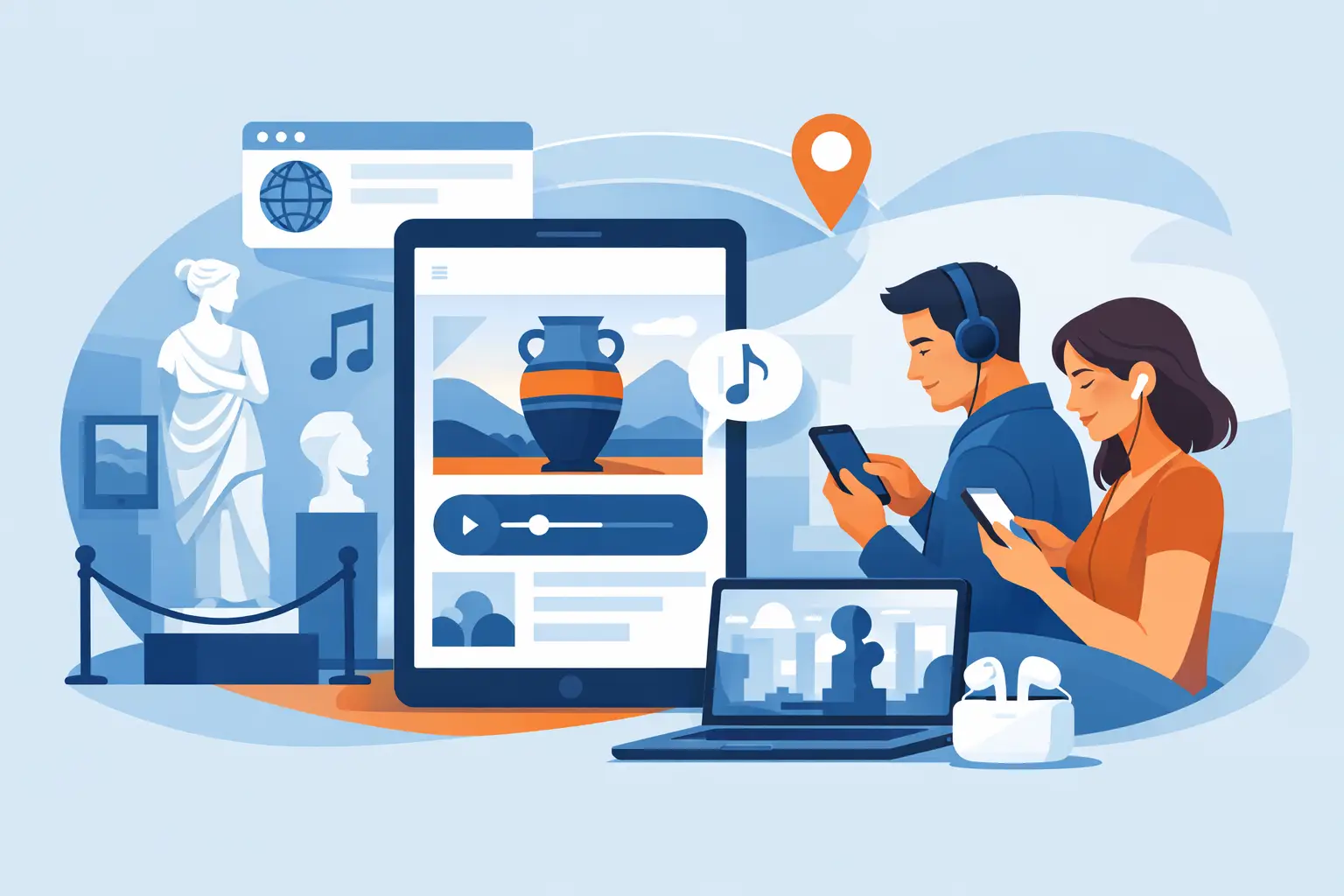
An audio guide web app is accessed through the visitor’s smartphone browser, usually via a QR code. It avoids the mandatory download of an app from an app store, a step that can discourage some people, especially during a short or spontaneous visit.
This approach offers an immediate operational advantage: visitors use their own devices and move at their own pace. The reception team can spend more time providing directions, advice and a welcome, rather than managing equipment. For a small organisation, that benefit can be decisive.
However, a personal smartphone does not solve everything. Some visitors have a low battery, an old phone, limited mobile data or little interest in digital technology. A suitable solution therefore does not replace a human welcome; it complements it with clear signage, very short instructions and, depending on the audience, a non-digital alternative or occasional assistance.
Evaluation should start with the actual conditions of the visit: network coverage on site, average tour length, visitors’ battery life, the proportion of international visitors, groups, security constraints and available staff. A very comprehensive tool can become counterproductive if it requires an organisation that the site cannot sustain over time.
The visitor experience starts before the first content
The first screen, the QR-code scan and access to the first piece of content largely determine whether visitors will use the tool. If the tour requires several steps, account creation or a hard-to-understand permission, some visitors will give up before hearing the first track.
A good web app gets straight to the point. Visitors should know where they are, choose their language, find the suggested tour and start listening without needing a manual. Content must remain readable outdoors, buttons must be easy to see and navigation should be predictable. This simplicity matters especially in busy places, for families and for visitors unfamiliar with digital tools.
How content is triggered deserves special attention. QR codes work well in museum galleries, on interpretation panels and at marked stops along a tour. They give visitors a tangible reference point and let them decide when to listen. GPS is useful for urban circuits, heritage trails or longer routes, where automation can enhance immersion.
These two options are not mutually exclusive. They suit different contexts and can complement each other. In a historic centre with narrow streets, for example, GPS accuracy can vary. Providing manual access or a backup QR code prevents visitors from getting stuck a few metres from a point of interest.
Offline mode: essential in many places
The promise of a smartphone tour quickly loses its value if audio files do not load properly. Thick walls, basements, rural areas and natural spaces often have patchy connectivity. A solution that lets visitors prepare or download content in advance protects the experience and reduces dependence on the mobile network.
It is important to check that this process is simple. Visitors need to know when content is available offline, and the team must be able to explain it in a few words. A good offline mode goes unnoticed when everything works, but becomes essential as soon as the network fails.
Guideius addresses every digital cultural mediation challenge
Create a multilingual smartphone audio guide that is easy to deploy, accessible and tailored to your museum, heritage site or destination.
Measure quality through real accessibility
Accessibility should not be treated as an option added at the end of a project. It is about making the story of the place accessible to everyone, whatever their digital habits, language, age or disability.
Multilingualism is often the first need identified. It should provide consistent navigation from one language to another rather than rely on a rough automatic translation. In a tourist area, offering a few languages that genuinely match the audiences welcomed is usually more useful than a long list of poorly maintained versions.
Content must also provide concrete answers to accessibility needs: audio transcripts, easy-to-read text, sufficient contrast, an appropriate font size, image descriptions and, where relevant, sign language or audio description. Every site has different priorities. The key is to plan these choices during editorial design, because they affect the format, budget and production schedule.
Accessibility also involves pacing. A dense five-minute commentary can fascinate an informed enthusiast but tire a family with children. Shorter formats, supplemented by optional in-depth details, better respect different ways of visiting. Quizzes, archive images and videos have their place when they serve a clear interpretation purpose, not when they add animation without a meaningful link to the site.
An administration that cultural teams can use
One of the most revealing criteria when evaluating an audio guide web app is whether the team can keep its tours up to date after publication. Opening hours change, exhibitions are temporary, texts need correcting, languages are added and itineraries evolve: cultural content is never completely fixed.
An administration interface designed for non-specialists helps preserve that autonomy. Teams should be able to edit a stop, import media, manage translations and publish updates without relying on a technical provider for every change. Support is still valuable, especially when the first tour is being created.
It is also worth checking what the offer includes. Maintenance, updates, hosting, support and feature development directly affect the project’s actual cost. Low entry prices can hide recurring fees or charges for even minor adjustments. Conversely, a clear package that includes maintenance makes budget planning easier, particularly for public and non-profit organisations.
Guideius follows this approach with a solution designed to give cultural teams an accessible administration interface without sacrificing the features they need on site.
Statistics should inform, not surveil
Usage data can help improve a tour: number of starts, chosen languages, most visited stops, average listening time and completion rate. These figures can reveal a hard-to-find point of interest, an overly long track or a language that is under-represented.
These indicators are useful only if they are easy to understand and respectful of visitors. For cultural organisations, data control and a measured approach to collection build trust. There is no need to profile every person to understand whether a tour works. Clearly explained aggregate statistics already provide useful insights.
Choose for your project, not for a sales demonstration
Before comparing offers, define a few simple scenarios: an international visitor arrives unprepared, a family follows the tour with a weak connection, an agent must change information the day before an event, or a visually impaired visitor needs adapted content. If the solution handles these situations clearly, it is more likely to work day after day.
Ask to test the tour on different phones and in the actual site conditions. A demonstration on a computer in a connected office reveals neither readability in direct sunlight, GPS quality nor the real time needed to help a first-time user.
The best audio guide web app is not the one that piles on effects. It is the one that makes heritage more accessible, respects the team’s time and gives visitors room to listen, look and understand. Starting with a well-edited, clearly signposted and genuinely manageable tour is often the best basis for sustainable digital interpretation.
Would you like to apply these ideas to your site?
Guideius helps deploy multilingual audio tours with QR codes, GPS, offline mode, multimedia content and privacy-friendly analytics.