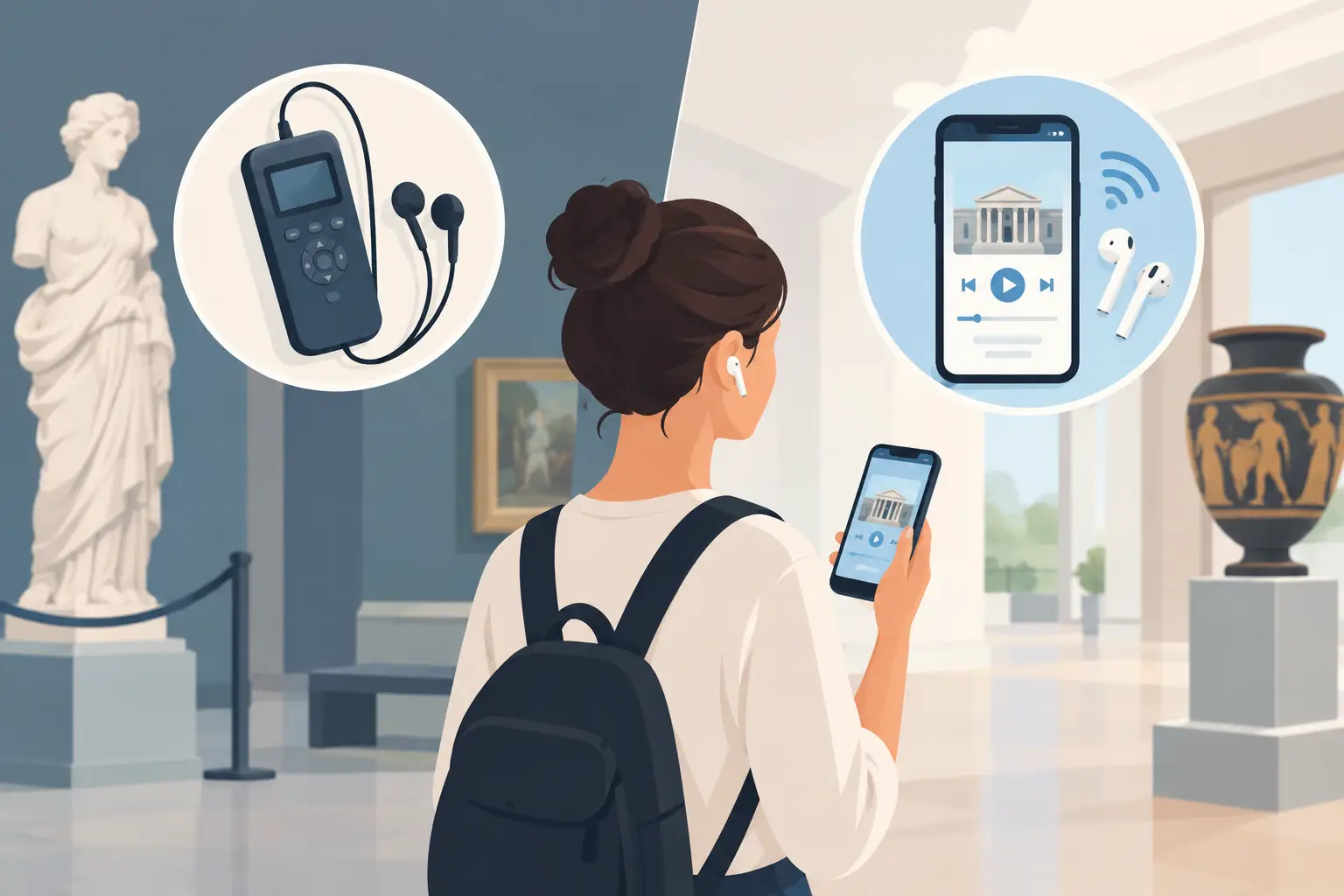
Running a fleet of audio guides involves more than the devices themselves. There are purchases, charging, headphones, loan procedures, cleaning, breakdowns and front-of-house staff time to consider. Comparing traditional and digital audio guides therefore means looking beyond the technology: the choice affects the quality of interpretation, how teams work and how easily a site can update its content.
For a museum, heritage site or tourist office, the right choice depends on visitor numbers, audiences, the setting and available staff. Digital technology is not automatically the answer in every situation. It does, however, change how interpretation is delivered, managed and measured.
Traditional vs digital audio guides: two approaches to a visit
A traditional audio guide uses a dedicated device handed to visitors at the start and returned at the exit. The workflow is familiar: enter a number, listen to a track and move to the next stop. This can reassure organisations used to providing physical devices, as well as visitors uncomfortable with smartphones.
A digital audio guide uses visitors' own phones through an app or web app. Access can be provided through a QR code, link, kiosk or geolocation. The same editorial care is needed, but delivery is more flexible: audio, images, text, video, quizzes and practical information can sit within one trail.
The main difference is operational. In one case, the institution manages a fleet of devices. In the other, it provides a service on visitors' equipment, while arranging support for people without a suitable phone or who prefer not to use one.
The real cost goes beyond the purchase
Traditional audio guides often involve a clear upfront investment: devices, charging stations, headphones, a distribution system and sometimes a maintenance contract. Costs continue over time, including replacement of lost or damaged equipment, disinfection, storage, daily charging and staff time at reception.
A large institution with a well-organised front-of-house service and steady visitor numbers may be able to absorb these demands. They weigh more heavily on a small organisation, a heritage site run by an association, a rural museum or a tourist office whose team already handles many tasks.
Digital delivery shifts investment towards content creation, trail configuration and a subscription to a publishing platform. It significantly reduces hardware spending and the work of issuing and collecting devices. Updates are also less costly: changing opening times, correcting information or adding a stop does not require gathering devices back in.
Examine the pricing model carefully, however. A suitable solution should have clear pricing, included maintenance and the capacity to accommodate seasonal demand. A low-cost tool can quickly lose its advantage if it is difficult to manage or charges for every change.
A more personal visitor experience, if it is well designed
Smartphones let visitors move at their own pace, replay a section, choose a short or in-depth trail and keep some resources after the visit. That independence is especially useful at sites where people explore freely, historic town centres, heritage trails and temporary exhibitions.
Digital delivery should not turn a visit into time spent staring at a screen. Artworks, landscapes and stories remain the focus. Good audio interpretation uses clear, engaging and well-paced passages. Extra images or text should add insight, not simply fill the display.
How content is triggered also matters. Discreet QR codes in a museum can open commentary at the right place. Outdoors, GPS helps exploration flow without searching for numbers. Where reception is unreliable, advance downloads and offline access are not minor extras: they keep the experience running.
Traditional audio guides retain advantages in certain situations. For tightly organised visits, groups following a fixed programme or sites where phone use is prohibited, a supplied device may remain the simplest choice. It can also suit institutions wanting an experience independent of visitors' personal equipment.
Guideius addresses every digital cultural mediation challenge
Create a multilingual smartphone audio guide that is easy to deploy, accessible and tailored to your museum, heritage site or destination.
Accessibility: look beyond the device
Choosing between dedicated devices and smartphones does not, by itself, address inclusion. Accessible trails depend on content, formats and access arrangements. Sound quality, playback speed, transcripts, contrast, text size and easy navigation matter as much as the equipment.
Digital formats offer useful options: synchronised text and subtitles, several languages, adjustable displays, sign language content and easy-to-read versions, depending on the project. They also make it easier to introduce further adaptations over time without replacing a whole fleet.
Inclusion means leaving nobody behind. Some visitors do not have a smartphone, have a flat battery, prefer not to scan a QR code or find digital interfaces difficult. A combination is often the most appropriate response: staff-led interpretation, essential printed material, clear signage and a few loan devices where needed.
This avoids a common mistake: confusing digital independence with leaving visitors to fend for themselves. Useful technology comes with support, is designed for varied needs and is explained clearly at reception.
What usage data means for cultural teams
With a traditional audio guide, an institution can count the devices issued. It is much harder to know which stops were actually listened to, where visitors leave a trail or which languages are most requested.
A digital solution can provide useful usage statistics: starts, listens by point of interest, average duration, language choices and progress through the trail. These insights can improve signage, rebalance a route and identify content that needs work.
Collection should remain proportionate and transparent. Cultural organisations, especially public institutions and publicly supported bodies, benefit from tools that respect personal data, favour anonymised metrics and avoid unnecessary accounts. Measuring use should not mean monitoring individual visitors.
Day-to-day content management also matters. Teams need to edit text, publish translations, temporarily disable stops and review feedback without specialist technical skills. Platforms designed for interpretation, such as Guideius, can make a difference here: the software should support the cultural project, not create dependence on a technical provider.
Choose according to your setting
Start with practical questions. Can staff issue, clean and charge devices every day? Do visitors generally have smartphones? Is the trail indoors, outdoors or in an area with weak reception? Will content change often, need several languages or include accessible formats?
If reducing logistics, updating content quickly and offering a richer multilingual experience are priorities, digital delivery is generally the better fit. It is particularly useful for self-guided trails, networks of sites and destinations promoting several points of interest within a controlled budget.
If visitors cannot rely on their own equipment, visits are tightly regulated, or an institution already has devices and the resources to manage them, traditional audio guides may still make sense. The point is not to label a format obsolete, but to assess its ongoing cost and ability to evolve honestly.
The most lasting choice often allows improvement without excluding anyone. Before choosing, test a trail with real visitors, observe where they struggle and listen to front-of-house staff. Those practical encounters are where the most appropriate form of interpretation emerges.
Would you like to apply these ideas to your site?
Guideius helps deploy multilingual audio tours with QR codes, GPS, offline mode, multimedia content and privacy-friendly analytics.