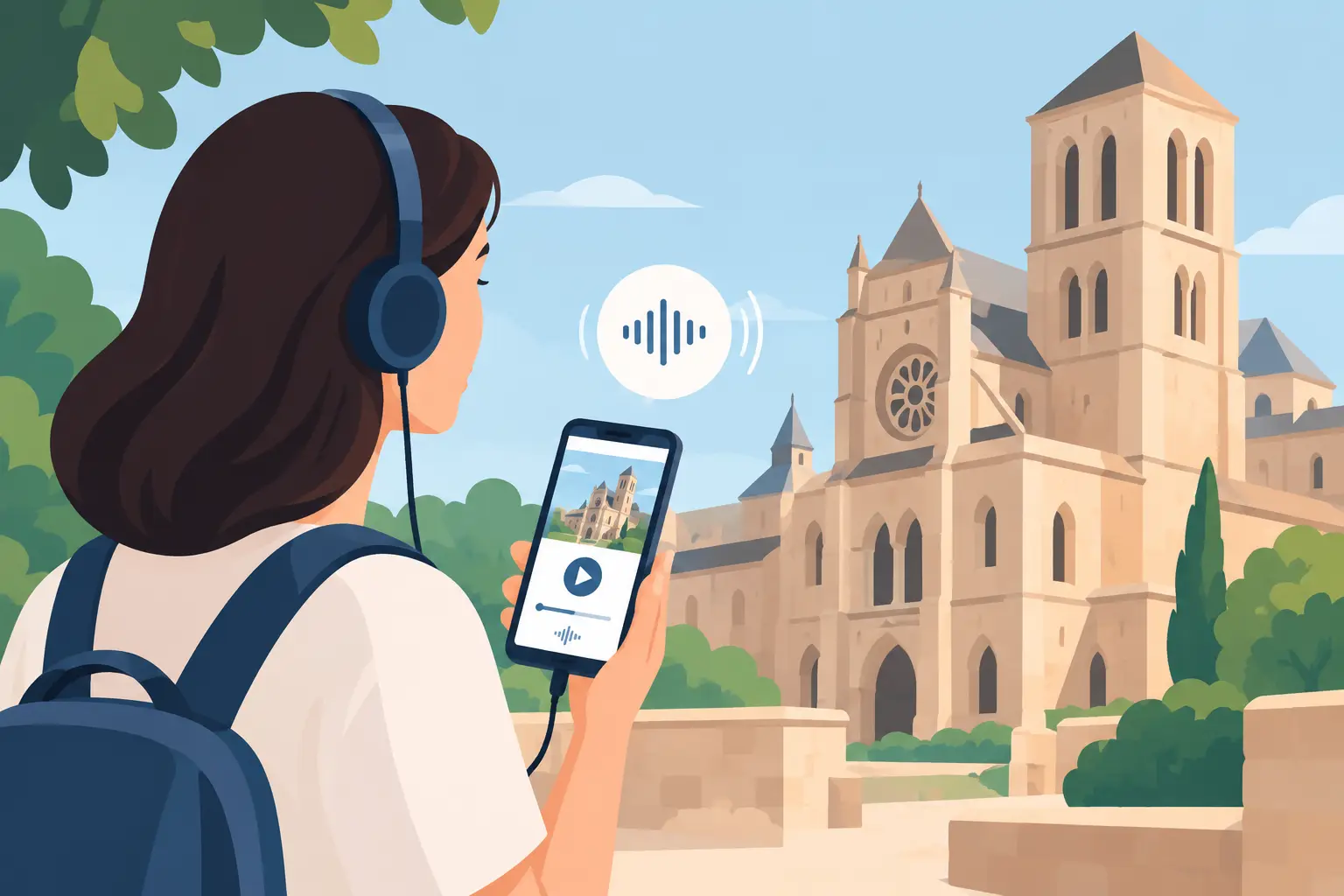
An audio guide for a heritage site is more than an exhibit label read aloud. It sets the pace of the visit, provides context where architecture, collections or landscapes cannot tell the whole story, and lets visitors choose how deeply they want to explore. For staff, it can also become a lasting interpretation tool that can be updated and evaluated, without the daily burden of handing out, charging and maintaining a fleet of devices.
The challenge is therefore not just technical. It is about designing an experience that suits the place, its stories and its visitors, then choosing a system that remains practical over time. A tour with extensive content but complicated management can become difficult to sustain. By contrast, a simple, clear tour with content activated at the right points can transform visitors' understanding of a site while keeping resources under control.
Why offer an audio guide at a heritage site?
A heritage site rarely reveals everything at first glance. A fortified enclosure bears traces of successive uses. An artist's home tells a personal story through its objects. A village, abbey or former industrial site may ask visitors to imagine what has disappeared. Audio can bring voices, atmospheres, past activities and stories to life without cluttering the physical space.
It also meets the varied needs of visitors. Some want to explore independently, others need content in their own language, and others prefer listening to reading. Offering different formats and levels of detail does not replace guided tours: it broadens access to the site, including at times when staff cannot provide a guide.
Using the visitor's smartphone makes a practical difference. Access via a QR code removes the need to lend out devices and manage the associated tasks. Visitors can start whenever they wish, move at their own pace and listen to a passage again. The organisation can focus its investment on what adds real value: content quality, accessibility and ongoing improvements to the tour.
The choices that shape the visitor experience
Start with the actual visitor route, not a list of exhibits
A good audio guide reflects the conditions on site. Before writing, walk the route at different times and note gathering points, noise, changes in level, distances, network coverage and places where visitors hesitate. This often reveals the most useful audio segments: an introduction at the entrance, an explanation beside a monument, directions after a junction or a conclusion that invites visitors to see the landscape differently.
Not every stop needs the same treatment. A site might offer a short, 30-minute tour alongside additional content for visitors who want to explore further. This prioritisation helps maintain attention. It also avoids giving every element the same level of detail, which can dilute the overall message.
The way content is activated should suit the setting. QR codes work particularly well in reception areas, on information panels or in rooms where visitors can take time to start a recording. GPS is useful along outdoor routes or across larger areas. Combining both approaches can provide more guidance in complex settings. Alternatives are still needed: location accuracy can be reduced near thick walls, beneath tree cover or in some urban spaces.
Write for listening and for the place
An audio guide script is not an information sheet read aloud. It should use direct sentences, introduce one idea at a time and allow purposeful pauses. A well-written, engagingly delivered two-minute segment will often have more impact than a six-minute commentary that tries to cover everything.
The script works best when it draws on what visitors can see at that moment. “Look at the different stone on the left” is more effective than a general description of the façade. The commentary can then offer historical or technical context, or invite a more personal response. Archive recordings, personal accounts, descriptions of past activities or music can enrich the story, provided they support it rather than overwhelm it.
Multilingual versions need particular care. Word-for-word translation is not always enough, especially when content relies on wordplay, local references or a strict running time. Every version should be fluent, accurate and understandable in its cultural context. Voices deserve the same attention: they should be clear, natural and in keeping with the site's identity.
Plan for accessibility from the outset
Accessibility should not be left until the end of the project. A full transcript of audio content, subtitles for videos, a readable interface, sufficient contrast and simple navigation benefit many visitors, not only those with disabilities.
It is also useful to offer content that suits different attention spans and support needs. An easy-to-understand version, shorter segments or a sensory route may be appropriate, depending on the site and its visitors. Involve the people concerned and relevant professionals from the design stage, rather than making assumptions about how they will use the guide.
Guideius addresses every digital cultural mediation challenge
Create a multilingual smartphone audio guide that is easy to deploy, accessible and tailored to your museum, heritage site or destination.
Choose a solution that fits the team's day-to-day needs
A tour's quality depends as much on how it is managed as on its content. Small and medium-sized organisations need a tool that staff can use without specialist technical skills: adding a stop, correcting a date, publishing another language or reviewing usage should not require extensive technical intervention.
Offline access matters wherever connectivity is unreliable. This is common in monuments, gardens, rural routes and buildings with thick walls. Visitors should be able to download the tour at reception or use it with a limited connection, without the experience stopping at the first point of interest.
Data needs the same care. Usage statistics help identify popular routes, language choices and points where attention drops. However, data collection should remain proportionate, transparent and respectful of visitors. For public bodies and publicly supported organisations, this ethical requirement is part of service quality.
A solution such as Guideius brings these functions together in an app or web app on visitors' smartphones, with QR code and GPS activation, multimedia content, offline use and management tools designed for on-site staff. The right choice is the one that fits the organisation's actual capacity to manage the service, its budget and its interpretation goals, rather than simply offering the longest list of rarely used features.
Prepare the launch without adding to the operational workload
The launch needs to account for practical details that make a difference. Clear signs at the entrance should explain how to get started in a few words. Reception staff should know the process and have a simple way to help someone without a smartphone or headphones, or who is less confident with digital tools. Test the tour in real conditions: noise, sunlight on the screen, poor connectivity and visitors who do not know the site.
On-site communication matters as much as the tool itself. A QR code without an explanation is often ignored. A clear invitation at the right moment can encourage visitors to try it: listen to the site's story, choose a language, follow a family route or explore a particular subject in more depth. The aim is not to promote digital technology at any cost, but to show its immediate value for the visit.
After launch, use data and staff feedback to make adjustments. If visitors rarely start a particular stop, its location or title may need reviewing. Popular content can inspire new segments. This ability to evolve is a key advantage of digital content over a fixed printed resource.
Measure success beyond the number of plays
The number of times recordings are started provides an initial indicator, but it is not enough on its own. A site may favour a short, deliberately selective tour that achieves its learning aims. Look at several indicators together: listening time, completed stops, language choices, qualitative feedback, questions at reception and interpretation staff's observations.
Finally, the audio guide should find the right place within the wider interpretation offer. It can prepare visitors for a guided tour, support independent exploration, enrich a temporary event or extend discovery after the visit. When it respects the site, visitors' pace and staff constraints, it does more than add another digital layer: it makes heritage more engaging, easier to understand and easier to share.
Would you like to apply these ideas to your site?
Guideius helps deploy multilingual audio tours with QR codes, GPS, offline mode, multimedia content and privacy-friendly analytics.