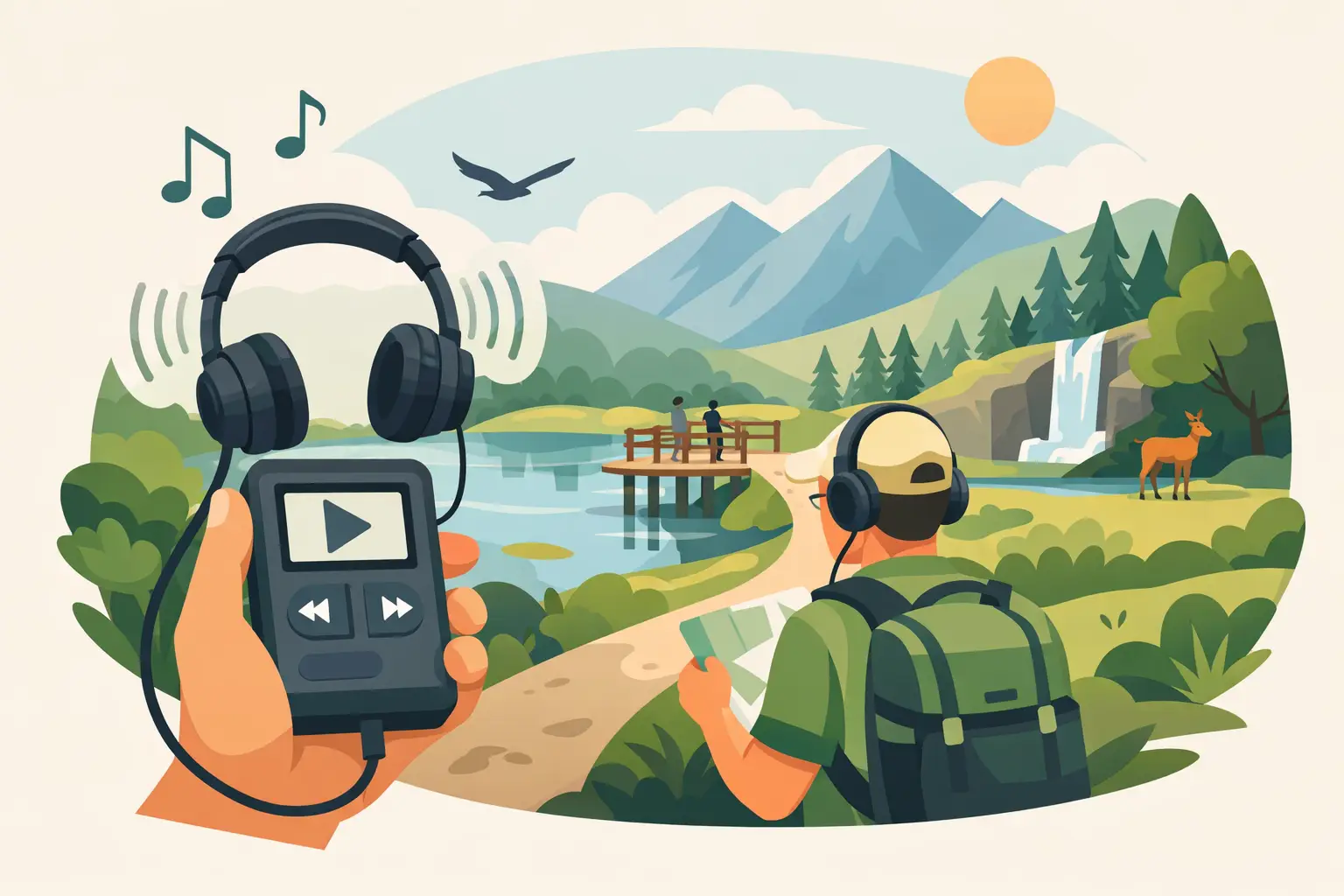
A marked trail is not always enough to make a landscape understood. In front of a wetland, an old quarry or a restored meadow, the visitor sees a setting. An audio guide for a natural park gives them the keys to understanding: the species that live there, the human uses that have shaped it, the fragilities to be respected and the actions that contribute to its preservation.
For managers of natural spaces, the challenge is not to add technology to the journey. This involves offering mediation that is fair, useful and adapted to real conditions on the ground: irregular mobile network, varied audiences, seasonality, limited teams and the imperative to protect the environment. A well-designed audio tour extends the work of the animators without seeking to replace it.
Why an audio guide for a natural park changes the visit
In a natural park, interpretation cannot rely solely on panels. These remain essential for orientation, safety instructions and immediately visible information. But they quickly reach their limits when it is necessary to tell the story of the evolution of a landscape, restore the sounds of a discreet species or explain why access to an area is temporarily limited.
Audio allows for more embodied mediation. The voice of a ranger, a naturalist, a resident or a farmer can connect scientific knowledge to the sensitive experience of place. A two-minute capsule, listened to in front of a panorama, often creates more attention than a dense text read from a distance.
The format also provides flexibility. Visitors move at their own pace, choose the content that interests them and can access several languages without multiplying printed media. For a community or a management structure, this allows content to evolve over the seasons, work, naturalist data or management orientations.
This freedom, however, has a counterpart: the audio guide must not encourage a visit with your eyes glued to the screen. The smartphone must remain a gateway to the territory, not become the central object of the experience. Short sequences, discreet triggering and regular invitations to observe or listen are essential.
Start from the field before choosing the technology
The best tour is not the one that accumulates features. It is the one that responds to a clear mediation intention. Before producing the first audio files, the team must identify what the visitor should understand, feel or do differently after their walk.
A trail can, for example, seek to raise awareness of the ordinary biodiversity of a peri-urban forest. Another can explain the links between pastoral management and openness of landscapes. On a coastline, the priority may be raising awareness of erosion, nesting or circulation in the dunes. These objectives determine the tone, steps and level of detail.
Choose listening points that make sense
An audio stop must be justified by what is happening at that specific location. It can be a point of view, a transition between two environments, a visible trace of human activity or a place where listening to birds provides real value. Conversely, multiplying the steps on a short route tires the attention and slows down walking unnecessarily.
It is often preferable to plan between six and ten really relevant sequences rather than a succession of comments. Each step benefits from including a concrete invitation: look up towards a ridge line, spot a plant, compare two sounds, observe the traces on the ground or respect a quiet zone.
Write for the ear and not for a brochure
A text intended for audio must be direct, precise and breathable. Long sentences, serial numbers and overly technical vocabulary make listening difficult, especially when walking or in the presence of wind. When scientific notions are necessary, they must be explained by example and placed in what the visitor has before his eyes.
Duration also matters. A sequence of 90 seconds to three minutes is suitable in most cases. Some topics deserve further discussion, but this can be offered as additional content rather than imposed on everyone. This logic respects families, active hikers as well as curious visitors who wish to take more time.
Guideius addresses every digital cultural mediation challenge
Create a multilingual smartphone audio guide that is easy to deploy, accessible and tailored to your museum, heritage site or destination.
Essential functions on an outdoor trail
A natural environment imposes particular constraints. The chosen solution must address them without complicating the team's work or creating frustration for the public.
Offline mode is decisive as soon as mobile coverage becomes uncertain. The visitor must be able to download the route before leaving or access the content without depending on a stable network. This precaution avoids cuts in the middle of an explanation and makes the visit more reliable in rural, wooded or steep areas.
Triggering by QR code and GPS serves two complementary uses. The QR code, installed at the start or on light signage, facilitates immediate access to the tour. The GPS can automatically suggest a stopover when the visitor arrives nearby. In sensitive areas, this function must be configured with discernment: it must never encourage people to leave the path or reveal the location of vulnerable species.
A simple map, visible progress and safety indications improve autonomy. They do not replace regulatory signage, but they help visitors understand where they are and what awaits them. Depending on the site, it may be useful to indicate the duration, altitude difference, closed periods, water points or difficult sections.
Multimedia content enriches audio when it remains at the service of observation. A comparative photo of a landscape before and after restoration, an illustration of a species or a short sound extract can clarify the point. They must remain light so as not to penalize downloading or exclude people with old equipment.
Make the tour truly accessible
Accessibility is not limited to providing an audio track. It involves thinking about the needs of people with disabilities, audiences unfamiliar with digital technology and visitors who do not master the local language.
readable transcriptions allow you to follow content in a noisy environment or for deaf and hard of hearing people. Clear navigation, careful contrasts, appropriate text size and compatibility with assistance tools enhance autonomy. For people with cognitive difficulties, simple instructions and structured content are often more effective than an abundance of information.
Multilingualism also contributes to quality territorial hospitality. It’s not just about translating word for word. Cultural references, precautionary instructions and units of measurement must be understood by the target audiences. It is better to offer a few carefully prepared languages than a large number of rough versions.
Finally, accessibility concerns the physical journey. If certain sectors are not passable by everyone, the audio guide can make this clear and promote alternatives: a short loop, an accessible observation point or a visit from the visitor centre. Informing does not exclude. This allows everyone to choose their experience with full knowledge of the facts.
Sustainable administration for teams
The success of an audio guide also depends on its ability to live after its launch. A natural park evolves: closure of a path after a storm, modification of regulations, relocation of a point of interest, new restoration campaign or arrival of a local partner. Teams must be able to update content without relying on lengthy and costly technical intervention.
An administration interface designed for non-specialists facilitates this continuity. It must allow you to modify text, replace an image, publish a new language or temporarily deactivate a step. The maintenance included in the offer and editorial support constitute concrete guarantees, particularly for small structures.
Usage statistics then provide useful benchmarks: number of starts, languages consulted, stages most listened to, completion rate or periods of attendance. This data is not intended to monitor visitors. They are used to improve the route, adjust the signage and identify the content that arouses the most interest, while respecting confidentiality and data control.
A solution like Guideius makes it possible to combine these functions in an application or customizable web app, without requiring the management of a fleet of audio guide boxes. This choice reduces the costs of purchasing, recharging, cleaning and material maintenance, while allowing the visitor to use your own smartphone.
Making audio a responsible mediation gesture
In a natural space, each content influences the way of moving around, looking and sometimes behaving. The audio guide must therefore transmit as much as it directs. It can explain a seasonal closure, remind you of the need to keep your dog on a leash, encourage the return of waste or invite silence near a breeding area.
Tone deserves special attention. Repeated injunctions risk become background noise, while a concrete explanation creates support. Saying that a detour protects a nesting place, or that calm allows a species to reproduce, gives meaning to the rule. Mediation then becomes a shared protection tool.
A good audio guide also leaves spaces of silence. After offering a reading key, he can invite the visitor to put their phone away for a few moments and listen to the wind, the water or the birds. This is perhaps where technology finds its rightful place: helping everyone to better encounter living things, then knowing how to fade away in front of them.
Would you like to apply these ideas to your site?
Guideius helps deploy multilingual audio tours with QR codes, GPS, offline mode, multimedia content and privacy-friendly analytics.