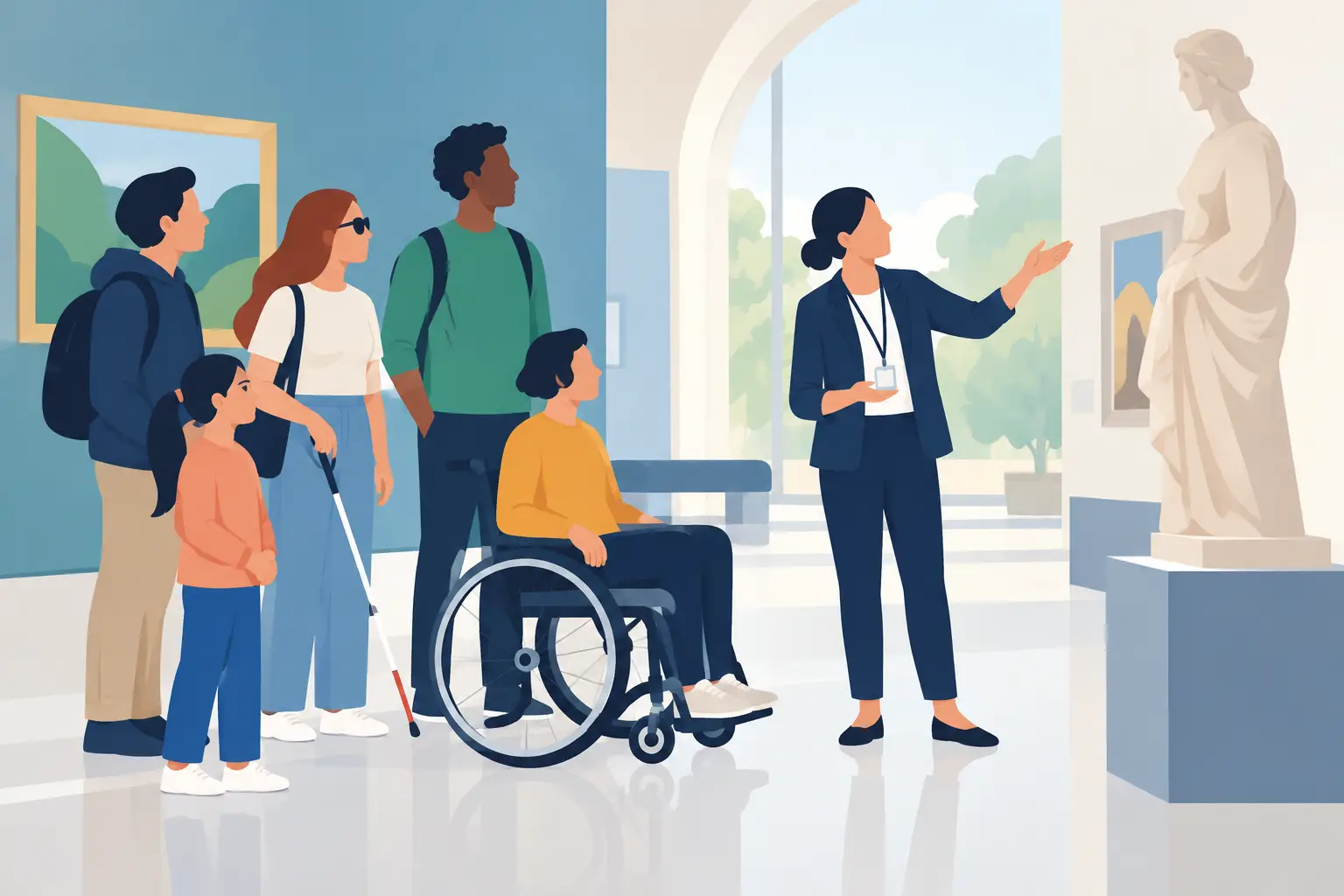
A staircase with no alternative, a video without subtitles, text that is too dense or a route that requires you to stay connected can be enough to exclude some visitors. Designing an inclusive visit does not mean adding a few adaptations at the end of the project. It means thinking from the outset about the diversity of ways of understanding, moving around, listening, reading and appropriating a place.
For a museum, a heritage site or a tourist office, the issue goes beyond regulatory compliance. Accessible mediation improves the experience of all audiences, strengthens the quality of reception and concretely translates a transmission mission. It also requires realistic choices: each structure has neither the same collections, nor the same budget, nor the same building or operating constraints.
An inclusive visit starts from real uses
Inclusion is not about a homogenous audience. A visually impaired person, a deaf or hard of hearing visitor, a family with a stroller, an elderly person, a tourist who does not speak French or a visitor with cognitive disorders do not encounter the same obstacles. The needs can also be temporary: fatigue, injury, noisy environment, weak mobile network or difficulty finding your way in an unfamiliar place.
This reality invites us to abandon a single path logic. It is not a question of creating a “normal” visit then a separate version for certain visitors. The objective is rather to offer several entry points to the same content: audio, readable text, visuals, sign language, transcription, clear language, plans and precise instructions. Everyone can choose the mode that suits them, without having to justify their need.
Physical accessibility remains essential, but it is not enough. A passable path does not guarantee understanding of an exhibition, any more than a ramp makes a story audible or intelligible. The quality of a visit depends as much on circulation as on mediation, the vocabulary used, the pace of consultation and the autonomy left to the visitor.
Start by diagnosing friction points
Before choosing a tool or producing new content, it is useful to observe the journey as it is experienced. From preparatory information to leaving the site, each step can create a difficulty: reservation, arrival, reception, signage, access to works, consultation of content and orientation to services.
Feedback from reception teams is valuable, as they know the repeated questions and areas where visitors are hesitant. However, they benefit from being supplemented by a scenario and, when possible, by the association of the people concerned. Testing a route with users allows you to identify obstacles that a theoretical audit easily misses: insufficient contrast, ambiguous instructions, QR code placed too high, too rapid commentary or absence of a bench over a long sequence.
The diagnosis must also consider the visit conditions. In a church, a fort, a garden or an ancient center, network coverage may be irregular. In a busy museum, noise and crowds modify the use of audio. A solution that is relevant on paper can become frustrating if it requires a constant connection, a mandatory headset or complex handling of the smartphone.
Prioritize rather than promise the impossible
Not all obstacles can be removed immediately, particularly in a listed monument or a site subject to strong architectural constraints. The key is to clearly document limitations, propose credible alternatives and plan for improvements.
An alternative route, a remote visit, content available before arrival or a precise description of non-accessible areas can make a concrete difference. Inclusion is also based on the reliability of the information: it is better to announce a difficulty and support the visitor's choice than to let them discover it on site.
Guideius addresses every digital cultural mediation challenge
Create a multilingual smartphone audio guide that is easy to deploy, accessible and tailored to your museum, heritage site or destination.
Make content accessible without impoverishing it
Adapting content does not mean oversimplifying it. Heritage deserves precision, nuance and depth. On the other hand, this richness must be offered in a form which leaves the visitor the possibility of progressing at their own pace.
An effective audio commentary uses short sentences, announces what will be observed and clearly distinguishes facts, interpretations and hypotheses. For a person who does not see the object, the description must help build a mental image: dimensions, materials, position, colors, significant details and relationship with space. This audio description does not replace historical commentary, it enriches it.
In writing, readability depends on contrast, character size, visual hierarchy and block length. A plain language text can be offered in addition to in-depth content, particularly to present essential ideas, instructions or historical context. Translations, for their part, must be conceived as true cultural mediations, and not as a simple word-for-word transposition.
Videos require synchronized and accurate subtitles, including audio information useful for understanding. Depending on the audience and the means available, interpretation in sign language can complete the system. These choices must be thought out from the writing stage: correcting a video or redoing a soundtrack after production costs more and often gives a less coherent result.
Digital can expand access, under certain conditions
A audio guide on smartphone makes it possible to make several formats available without multiplying the material supports. The visitor chooses their language, activates the transcription, consults an image or listens to a sequence again. For teams, content can evolve without reprinting all of the signage or renewing a dedicated fleet of devices.
But digital is only inclusive if it remains simple. Access should require few steps, buttons should be easily identifiable, and content should work with assistive technologies. Triggering by QR code can be very practical, provided that an alternative solution is provided for people who cannot scan it. Likewise, GPS is useful outdoors, but should not be the only way to access a stage.
Offline mode is particularly crucial for rural sites, old buildings and outdoor routes. It prevents the quality of the experience from depending on the mobile plan or network coverage. The possibility of preparing your visit or downloading content in advance also provides appreciable autonomy.
A platform like Guideius makes it possible to combine these requirements with administration adapted to cultural teams: multilingual courses, audio and visual content, access by QR code or GPS, offline consultation and accessibility features. The tool does not replace mediation work, but it can make its dissemination more flexible and more equitable, without imposing the daily management of specialized equipment.
Design with audiences, then improve over time
An inclusive visit is not validated once and for all. Uses change, content evolves and visitors reveal new needs. The consultation statistics can indicate the languages chosen, the most popular stages or course abandonments. However, they must be interpreted with caution: low usage can reveal a lack of interest, but also inconspicuous signage or poorly understood instructions.
Field observations and qualitative feedback remain essential. A short form, an exchange with mediators or a partnership with local associations can help distinguish what really works from what appears satisfactory on a dashboard. This approach takes time, but it avoids investing in rarely used functions while fundamental needs remain unmet.
Inclusion also concerns internal organization. Reception agents must know the alternatives available and know how to present them naturally. Content teams need shared editorial guidelines. Finally, service providers must be involved early enough to integrate accessibility into graphic, technical and budgetary choices.
Make accessibility a quality of visit
The most useful features are often those that make the journey more comfortable for everyone: clear information before arriving, a well-structured story, navigation without blocking, downloadable content and the freedom to choose your own pace. This approach avoids reducing accessibility to an administrative constraint or a check box.
Designing for diverse audiences requires you to look at your place more carefully. This leads to better explanation, better guidance and better reception. Every improvement, even modest, can enable a person to no longer remain on the threshold of cultural experience, but to take full part in it.
Would you like to apply these ideas to your site?
Guideius helps deploy multilingual audio tours with QR codes, GPS, offline mode, multimedia content and privacy-friendly analytics.