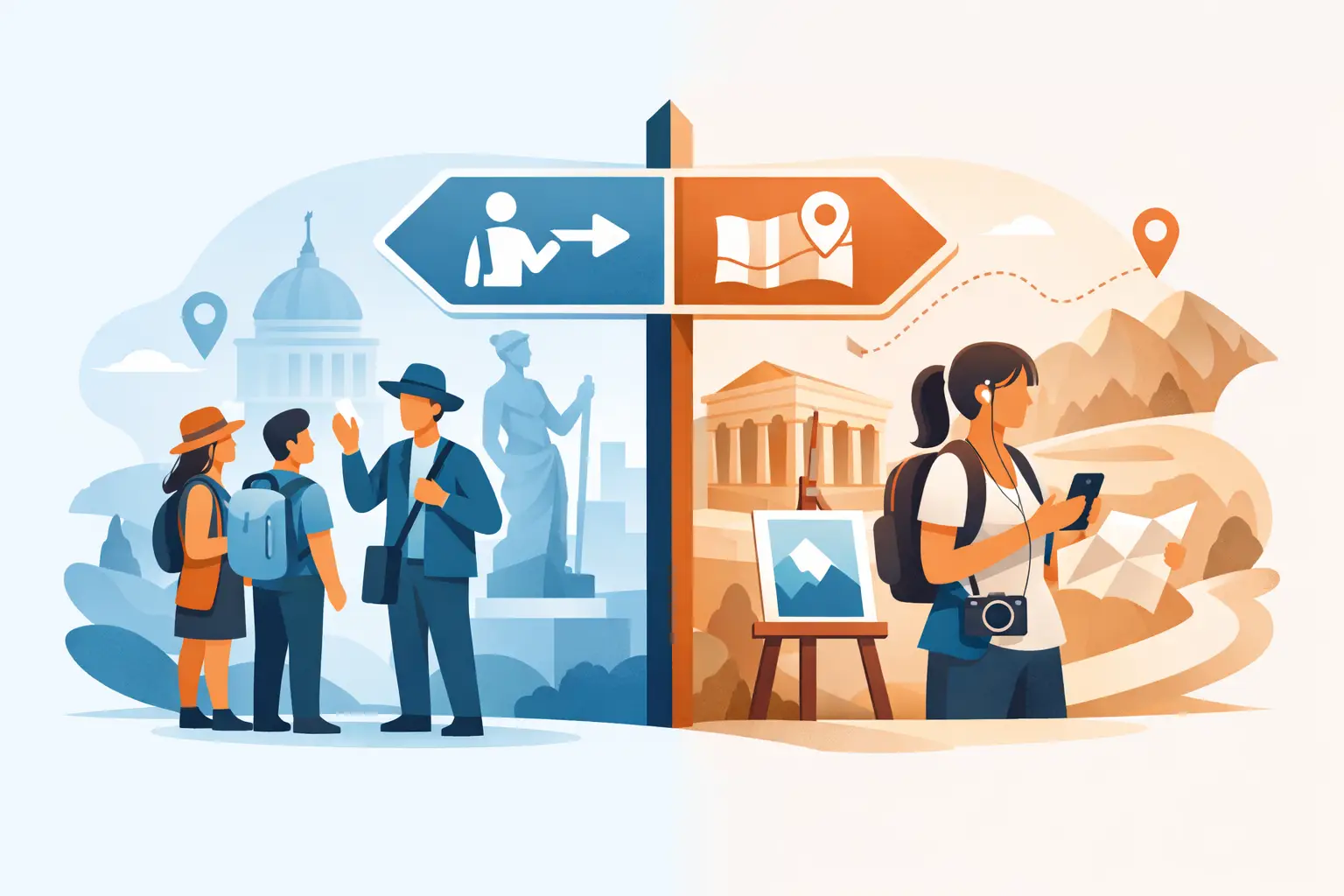
At the entrance to a museum, a monument or a heritage trail, the choice between guided or independent tour does not come down to a question of preference. It determines the way visitors access content, the daily organization of teams and the site’s ability to accommodate varied audiences. For a cultural structure, the challenge is not to designate a winning format, but to build mediation consistent with its project, its means and its ambitions.
The guided tour brings an irreplaceable human presence. The self-guided tour offers valuable freedom and expanded availability. Well thought out, they do not oppose each other: they can complement each other to enrich the experience, better distribute the workload and make the heritage more accessible.
Guided or independent tour: two different promises
The guided tour is based on exchange. The guide adapts his speech, answers questions, observes reactions and creates a direct link with the group. This capacity for interpretation is particularly valuable when dealing with complex, sensitive or unfamiliar subjects: local history, archaeology, memory, architecture, contemporary art or cultural landscapes.
It also meets a social expectation. For certain visitors, notably large groups, schoolchildren or people discovering a territory, being accompanied provides a reassuring framework. The guide can give rhythm to the journey, contextualize a detail that is difficult to read alone and spark a discussion. The quality of this encounter can have a lasting impact on a visit.
The autonomous format meets another expectation: that of choosing your own pace. The visitor can linger in front of a work, ignore a step that interests them less, start content again or take a break without having the feeling of slowing down a group. He visits when it suits him, including when no accompanied visit is scheduled.
A audio tour on smartphone also allows you to offer several reading levels. A curious adult, a family, a foreign visitor or a person with little time does not expect the same story. Multilingual content, archive images, short capsules, quizzes or transcriptions can respond to this diversity without making the physical journey heavier.
Human mediation remains essential
The development of digital tools does not make the guide superfluous. On the contrary, it can allow human presence to be reserved for moments when it produces the most value. A guided tour is often the best choice when a site wishes to convey in-depth expertise, welcome a group with a special need or create an event around a temporary exhibition.
In a place steeped in history, the guide does not only provide information. It connects sources, nuances interpretations, recounts restoration choices and links heritage to contemporary issues. This living word is difficult to reproduce in a standardized course, even with high-quality content.
For the teams, the guided tour also allows them to directly collect reactions from the public. Recurring questions reveal what is intriguing, what remains poorly understood or what deserves to be better reported. It is a useful material for developing reception, scenography and digital content.
But this format has its constraints. It depends on the slots available, the size of the groups, the skills mobilized and the reception conditions. In high season, a single guide cannot meet all requests. In small structures, the team must often simultaneously ensure reception, ticketing, surveillance and mediation. Offering only guided tours can then limit schedules, the number of visitors accompanied or the depth of service provided.
Autonomy is not the absence of mediation
A successful self-guided visit does not consist of leaving the visitor alone in the face of cartels or minimal signage. On the contrary, it requires precise editorial work. The route must be simple to join, easy to understand and sufficiently flexible to respect actual visitor behavior.
The first issue is orientation. From the start, visitors must know how to start their journey, where they are and what they can choose. QR codes can facilitate immediate access, while GPS triggering is particularly suitable for urban routes, gardens, paths or extensive heritage sites. In spaces where the network is patchy, offline mode prevents the quality of the experience from depending on mobile coverage.
The second issue is rhythm. Audio content lasting several minutes can be relevant to a major work, but it quickly becomes restrictive if it is systematic. Alternating short capsules, optional in-depth details and complementary media gives everyone the opportunity to go further without imposing the same visit time on everyone.
The third issue is narrative quality. The audio guide should not be the reading aloud of an institutional text. Oral, embodied and documented writing gives presence to the journey. It can make several voices heard: curator, resident, artisan, researcher, mediator or witness. This plurality is particularly fruitful for promoting a territory and avoiding a fixed narrative.
Guideius addresses every digital cultural mediation challenge
Create a multilingual smartphone audio guide that is easy to deploy, accessible and tailored to your museum, heritage site or destination.
Choose according to audiences, locations and resources
The right format depends first of all on the type of attendance. A museum welcoming many individual visitors, international tourists or irregular arrivals has an interest in ensuring mediation is continuously available. Conversely, a site which mainly receives reserved groups can make the guided tour its central experience, supplemented by some independent waiting or in-depth content.
The configuration of the place matters just as much. In a small museum with dense rooms, a guide can help structure the view and manage flow. On an outdoor course, a geolocated audio application offers more flexibility and limits the need to form groups at fixed times. In a busy monument, it can also reduce the concentration of visitors around a mediator.
Internal resources must be examined lucidly. Designing an autonomous course requires editorial time, scientific validations, recordings and field preparation. On the other hand, once deployed, it can be updated and distributed without the logistics of loaning, recharging, cleaning or maintaining a dedicated fleet of devices. For many small and medium-sized structures, the use of the visitor's smartphone constitutes a concrete lever for controlling operating costs.
The question of accessibility must arise from this reflection, and not at the end of the project. Transcriptions, adapted content, complementary visuals, readable navigation and several languages broaden the conditions of access to knowledge. Autonomy can strengthen inclusion, provided that the journey remains truly usable by people with different needs and levels of digital familiarity. A clear human welcome remains essential to support those who wish it.
The hybrid model, often the fairest
Opposing human mediation and digital tools head-on often leads to a decision that is too rigid. The hybrid model makes it possible to make each format a response to a specific use. The guided tour can become an appointment with high added value: thematic visit, meeting with a professional, family tour, visit in a foreign language or in-depth discovery of an exhibition.
The autonomous route ensures continuity of service before, between and after these appointments. It can accommodate individual visitors outside visiting hours, offer a short itinerary to people in a hurry and offer additional content to those who wish to extend their discovery. It also gives mediators a basis that they can enrich rather than replace.
This complementarity makes it easier to manage periods of high attendance. When the guided groups are full, visitors do not leave without a mediation solution. When a team is small, the site retains a capacity to transmit. And when a new audience is targeted, it becomes possible to create a specific route without reorganizing the entire tour offering.
The usage data, when collected in a transparent and respectful manner, provide additional insight. They make it possible to identify the most visited stages, the languages used, the average duration of a journey or content that is not widely used. This information is not intended to reduce the visit to figures. They help teams to adjust mediation as closely as possible to real practices.
Design an offer that leaves choice
Before choosing a system, it is useful to start with very concrete questions: which visitors do we not find enough of today? When is human support most useful? What stories should our site better hear? And what constraints really weigh on the team?
A solution like Guideius makes it possible to deploy multilingual audio tours on visitors' smartphones, with administration accessible to non-technical teams. The objective is not to digitize mediation for its own sake, but to give cultural structures the means to disseminate their content with simplicity, sobriety and attention to audiences.
The most relevant choice is often the one that leaves room for several ways of visiting. Some visitors will seek conversation with a guide; others will prefer to listen, read and progress at their own pace. Offering these two possibilities means recognizing that the transmission of heritage gains strength when it adapts to the people who come to encounter it.
Would you like to apply these ideas to your site?
Guideius helps deploy multilingual audio tours with QR codes, GPS, offline mode, multimedia content and privacy-friendly analytics.