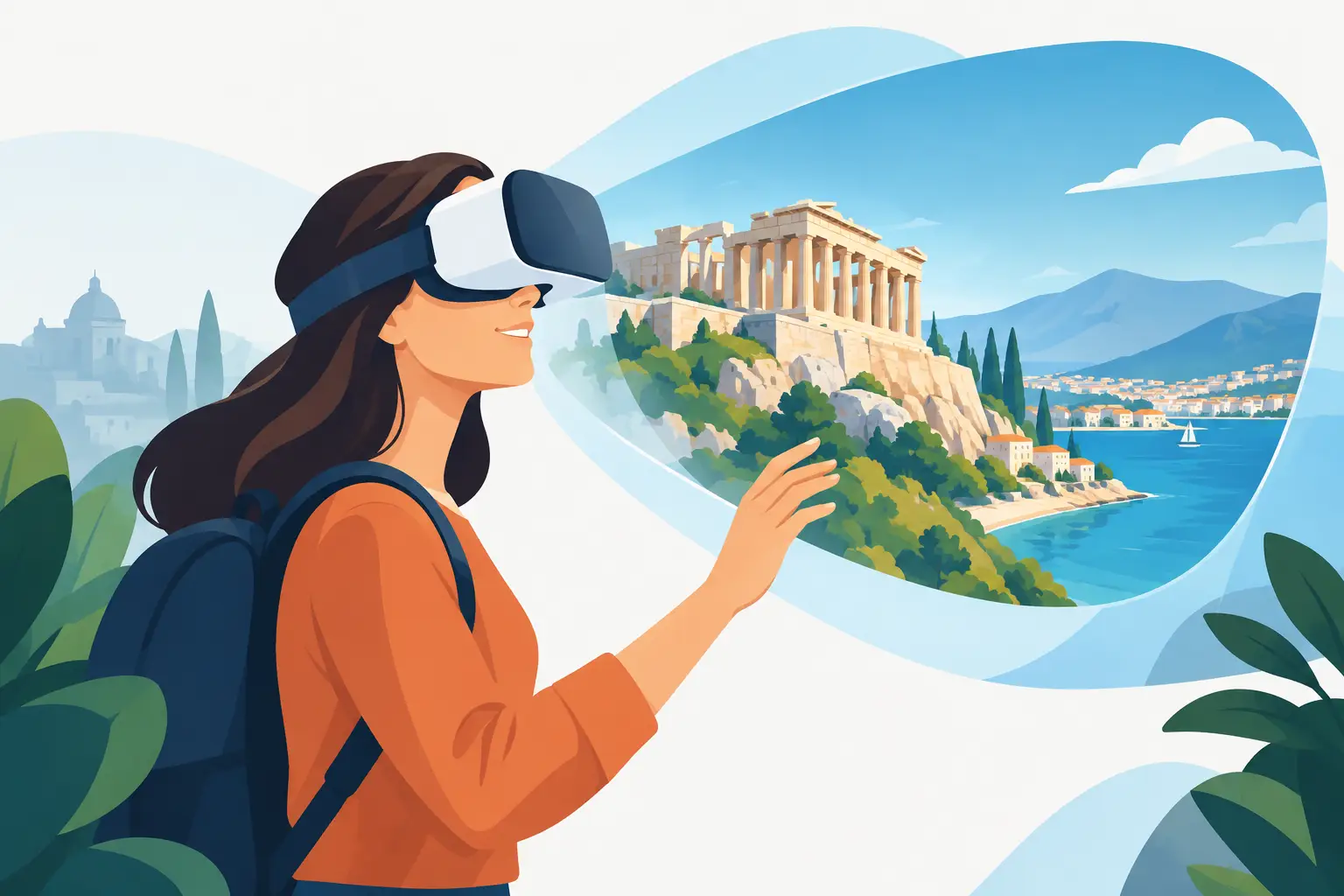
A visitor does not only remember a date, a cartel or a photographed monument. He remembers a voice heard at the right time, a detail he would not have paid attention to, the feeling of having understood a place from the inside. This is precisely where immersive tourism takes on its full meaning: not adding technology to impress, but creating the conditions for a more attentive relationship between a territory, its stories and its audiences.
For museums, heritage sites and tourist offices, the issue is concrete. The aim is to offer a richer experience without increasing the work of teams, excluding some visitors or making investments that are difficult to maintain. Successful immersion relies less on the accumulation of screens than on fair, accessible mediation adapted to the field.
Immersive tourism, an experience rather than equipment
Immersive tourism refers to a way of bringing a place to life by soliciting the attention, senses, imagination and participation of the visitor. A visit can become immersive thanks to audio narration, sound archives, an ancient image superimposed on a contemporary landscape, a local testimony, an observation game or a question that invites us to look differently.
This definition is intentionally broad. Immersion does not necessarily require a virtual reality headset, expensive scenography or a spectacular installation. In a chapel, an urban route, an artist's house or a village, a few well-located contents can have more impact than a complex device. The right tool is the one that serves the story of the place and the uses of visitors.
This approach also changes the public's position. He no longer only receives information organized in stages. He moves forward, chooses his pace, listens, observes and connects the elements together. A family can choose a fun route, an international visitor select their language, a visually impaired person benefit from an enriched description, while a regular visitor to the area discovers a little-known history.
Why immersion meets the expectations of cultural places
Visitors now expect a more personalized experience, but not necessarily more complex. They want to quickly understand what they see, be able to go deeper if they wish and maintain a form of autonomy. This expectation is particularly strong in outdoor routes and destinations where the visit takes place outside the usual reception times or areas.
For professionals, immersive tourism can meet several objectives at the same time: promote scientific content, renew the discovery of a site, make a tour available in several languages and better distribute visitor flows. It also allows us to give space to heritage that is difficult to exhibit: oral memory, know-how, landscapes, archaeological traces, photographic funds or stories from residents.
However, we must distinguish between immersion and distraction. A visual effect does not compensate for imprecise content. A very complete application can be discouraging if it is confusing to start or if it requires a heavy download. A successful experience leaves room for the place itself. It does not interrupt the visit at each step: it reveals its relief.
Audio, a particularly relevant lever
Audio has a valuable quality for heritage mediation: it accompanies the gaze without capturing it. A voice can describe a facade, make a lost atmosphere heard or introduce the testimony of a craftsman, while leaving the visitor free to contemplate their environment.
It also adapts to very varied contexts. In a museum, it complements the collections without cluttering the rooms. On a trail, it can be triggered near a point of interest. In an old center, it makes it possible to convey a dense history without multiplying signage. Combined with images, short texts or quizzes, it offers a rich experience with immediate handling.
Guideius addresses every digital cultural mediation challenge
Create a multilingual smartphone audio guide that is easy to deploy, accessible and tailored to your museum, heritage site or destination.
Design an immersive course from the ground
A useful project begins with a simple question: what perspective do we want to develop in the visitor? The answer is not always “tell the whole story”. A journey through the industrial history of a city can follow the thread of gestures and sounds of work. A natural site can favor seasonal transformations of the landscape. A local museum can give voice to the voices that connect objects to everyday life.
Before choosing a technology, it is best to identify the highlights of the visit. Where does the visitor hesitate? What elements are difficult to interpret without mediation? Which points of view are most conducive to listening? This field work avoids producing generic content and helps define a reasonable number of steps.
The narration must then remain readable. Each sequence benefits from carrying a main idea, with vocabulary adapted to the target audience. A precise anecdote, an audio archive or a well-asked question are often better than an overly long comment. For a family journey, the observation and game mechanics can support attention. For a specialist audience, additional content allows you to go further without slowing down the general visit.
Think about accessibility when writing
Accessibility is not an option added at the end of the project. It improves the quality of the experience for everyone. Easy-to-read texts, transcriptions, image descriptions, clear navigation, appropriate contrasts and attention to reading pace benefit audiences with very different needs.
Multilingualism must follow the same requirement. Translating word for word is not always enough, especially when the content relies on local references or language games. It is better to plan an editorial adaptation that maintains the clarity and intent of the story. In certain cases, it is more relevant to offer a short course in several languages than an exhaustive version that is difficult to maintain.
Sober, reliable and easy-to-administer technology
A digital device becomes truly useful when it reduces constraints instead of creating new ones. For many structures, the use of the visitor's smartphone avoids the purchase, loan, recharge and maintenance of a fleet of audio guides. Starting with a QR code limits friction at entry, while GPS can enrich an outdoor route when the context is suitable.
Connectivity remains a point of vigilance. In a monument with thick walls, a rural area or an extensive route, offline mode is not a secondary comfort: it conditions the continuity of the visit. Likewise, an interface must remain understandable for an audience unfamiliar with digital tools. Human support and explicit signage retain their importance.
For the teams, the administration must be up to date with the realities on the ground. Modifying a schedule, correcting information, adding a language or consulting usage should not require advanced technical skills. A solution like Guideius makes it possible to manage audio and multimedia tours from an interface designed for cultural professionals, while maintaining control of the content and the experience offered.
Digital sobriety also matters. It involves choosing useful formats, limiting decorative features, avoiding excessive data collection and favoring durable tools. The trust of visitors and institutions is also built on this coherence between innovation, responsibility and general interest.
Measuring usage without reducing visits to numbers
Usage data is valuable when it informs concrete decisions. Knowing which stages are most visited, when visitors interrupt a journey or which languages are used can help improve content, signage and the organization of the reception.
This information does not tell the whole story, however. A little-watched sequence can be misplaced, but it can also be aimed at a smaller audience. The statistics benefit from being cross-referenced with feedback from mediators, on-site observations and comments collected from visitors. The objective is not to make audiences stay longer on a screen, but to better understand what nourishes their experience.
Errors that weaken immersion
The first pitfall is confusing density and quality. A route of forty stops will not necessarily be more immersive than a ride of eight strong sequences. The second is to identically reproduce a classic guided tour on the phone. Digital technology offers the possibility of choosing, slowing down, relaunching content and offering several playback levels: it would be a shame to use it as a simple loudspeaker.
Finally, immersion should not isolate. In a lively place, it can encourage discussion between loved ones, direct you towards a mediator, make you want to continue with an exhibition or a local business. It takes on its full value when it strengthens territorial anchoring rather than replacing the meeting.
A relevant immersive journey does not seek to make people forget reality. It helps each visitor to inhabit it more fully, with their curiosity, their rhythm and their own way of remembering the place.
Would you like to apply these ideas to your site?
Guideius helps deploy multilingual audio tours with QR codes, GPS, offline mode, multimedia content and privacy-friendly analytics.