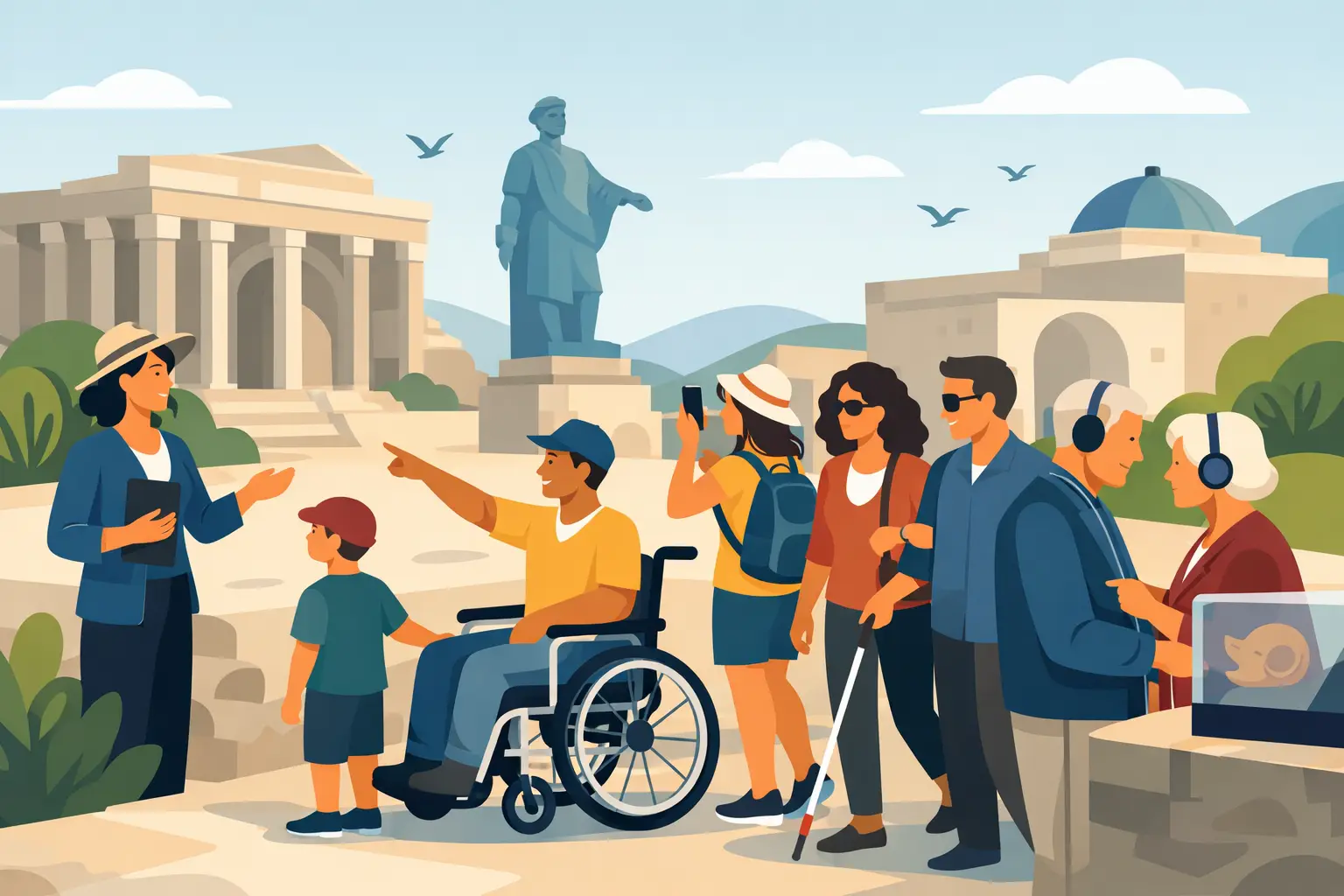
A hearing-impaired person watching an unsubtitled video, a family who does not know French facing a dense label, a visitor tired after a long tour or a person without a mobile network in a village: these situations are not special cases. They reveal the ordinary obstacles that prevent part of the public from fully enjoying a place. Making a heritage visit more inclusive involves anticipating them from the design stage, rather than trying to correct them once the tour is under way.
For a museum, a monument, an archaeological site or a tourist office, the issue goes beyond respecting an obligation. Truly accessible mediation improves the understanding, autonomy and comfort of all visitors. It also reinforces the primary mission of cultural organisations: transmitting stories, knowledge and heritage without reserving this experience for an audience already familiar with cultural codes or digital technology.
Making a heritage visit more inclusive: starting from real visitor needs
Inclusion is not just about adding a wheelchair pictogram or an English version of a leaflet. It requires recognizing the diversity of ways of visiting. Some audiences need more readable information, others need a freer pace, content in their language, an alternative to audio or help finding their way around.
The first step is therefore to observe the actual route. Where do visitors hesitate? Where does noise make it difficult to listen? Which spaces are physically inaccessible, and what alternatives can we offer? The reception teams, guides, mediators and local associations often have very concrete answers. Associating them with this inventory avoids designing a theoretical accessibility, disconnected from on-site reality.
It is useful to distinguish three complementary dimensions. Physical accessibility concerns pathways, seating, signage and security. Content accessibility concerns languages, clarity of texts, subtitles, transcriptions and adapted formats. Finally, digital accessibility concerns the ease of use of the tool, compatibility with personal equipment and the availability of content despite a limited connection.
No single solution meets all of these needs. On the other hand, a route designed with several entry points allows everyone to choose the one that suits them.
Design content that gives visitors a choice
Good mediation content should not impose just one way of learning. Audio is valuable for establishing an atmosphere, telling an anecdote or accompanying a look. But it must be able to be supplemented by text, images, maps or videos when relevant.
Provide alternatives to each format
For each audio track, a transcription improves access for deaf or hard of hearing people, but also for visitors who prefer to read, who visit in a noisy environment or who wish to find information after their visit. Subtitles are required for videos. An audio description can enrich the visit of blind or visually impaired people, particularly when a visual work, an architecture or a landscape constitutes the heart of the interpretation.
Language matters just as much. Offering multilingual courses is not just about welcoming tourists. It’s a way of allowing foreign visitors, allophone residents or multilingual families to take ownership of a territory. It is better to offer a few languages, with a translation truly adapted to the cultural context, than to multiply approximate versions.
French that is easy to read and understand can also be a useful option. It is not a question of impoverishing the subject, but of prioritizing the information, using direct sentences and explaining implicit references. This approach benefits people with comprehension difficulties, young audiences and anyone new to a complex subject.
Give a flexible pace to the visit
A heritage trail is often designed according to the logic of the place: a succession of rooms, stages or points of interest. However, the pace of visitors varies greatly. One person may only have twenty minutes, another may need regular breaks, or a family may look for shorter, fun content.
Planning an essential route, made up of a few essential steps, then optional in-depth details is a simple and effective response. Clearly displayed times help everyone to organize their visit. Short content, two to three minutes, makes it easier to listen while standing and limits cognitive fatigue. Quizzes can create engagement, provided they remain optional and do not turn the visit into an evaluation.
Guideius addresses every digital cultural mediation challenge
Create a multilingual smartphone audio guide that is easy to deploy, accessible and tailored to your museum, heritage site or destination.
Make digital a tool for autonomy, not a new barrier
The smartphone can broaden access to mediation, provided that it does not transfer all the complexity of the device to the visitor. An inclusive experience begins before the first content: the entry point must be visible, the instructions understandable and the route accessible without unnecessary account creation.
QR codes are practical at the entrance or in front of a work, but they must be accompanied by a clear indication and a backup solution for people who are uncomfortable using their phone. A short URL displayed legibly, help from the reception team or concise printed guide can make the difference. Digital technology must never become an exclusive condition of access to the story of the place.
Offline mode is particularly decisive in rural sites, outdoors, in old buildings or in spaces where the network is unstable. Downloading the content before departure helps make the experience safer and avoids the frustration of an interrupted journey. Triggering by GPS can enrich urban walks or local circuits, while the QR code remains more precise in a museum or monument.
Ergonomics deserves the same attention as content. Sufficiently visible buttons, limited navigation, readable contrasts and a clear hierarchy reduce difficulties for people who are visually impaired, elderly or unfamiliar with digital interfaces. Advanced features are only useful if they remain discreet and easy to use.
Connecting digital accessibility to on-site reception
An inclusive visit does not just happen on a screen. If a room is inaccessible, digital content can offer a detailed presentation, a capture or an alternative view. If a viewpoint requires a difficult walk, a narrated panoramic image can preserve part of the experience. This does not replace physical accessibility work when possible, but it limits exclusion when the building imposes heritage or technical constraints.
The signage must use the same benchmarks as the digital route: stage names, colors, numbers or consistent pictograms. This continuity reassures visitors and reduces requests for orientation. Rest areas, information on sanitary facilities, height differences and durations also contribute to autonomy.
The reception teams play a central role. A short training allows them to present the available alternatives without presuming people's needs. The objective is not to ask the visitor to justify themselves, but to simply say: “Several formats are available, we can help you choose.”
Measure to improve without excluding
Inclusion is built over time. Usage data from a digital tour can indicate which languages are most consulted, when visitors leave the visit or which content attracts the most attention. This information helps to adjust the offer, particularly in structures which have little time and resources to produce new content.
However, they are not enough to understand the obstacles encountered. Content that is rarely listened to may be poorly flagged, too long, poorly suited to the location or difficult to launch. Qualitative feedback, collected from visitors and community partners, is essential. A brief questionnaire, a one-off observation or an exchange with test groups often makes it possible to identify very concrete improvements.
Data collection must remain proportionate and transparent. Measuring usage does not require tracking people individually or monetizing their behavior. For public and cultural actors, ethical mediation is also based on trust: data limited to what is useful to improve the experience, and clear information on their use.
A realistic approach for small structures
Accessibility can seem difficult to finance when managing a site with a small team. The right approach is to prioritize. Starting with the most popular steps, transcribing existing content, improving practical information and offering two or three relevant languages already produces a concrete effect. It is often more effective to make a first tour genuinely easy to use than to launch numerous unfinished formats.
A solution like Guideius brings together audio, texts, multimedia content, languages and offline use in a single tour that can be administered by non-technical teams. The point is not to digitize for the sake of digitizing, but to have a scalable tool: content can be corrected, enriched and adapted based on feedback from the field, without renewing a dedicated equipment fleet.
Inclusivity is not measured by the number of features displayed. It is recognized when a visitor, whatever their age, language, disability or digital comfort, can understand where to go, choose their format and feel that they belong in the place. It is on this condition that heritage ceases to only be preserved and begins to be fully shared.
Would you like to apply these ideas to your site?
Guideius helps deploy multilingual audio tours with QR codes, GPS, offline mode, multimedia content and privacy-friendly analytics.