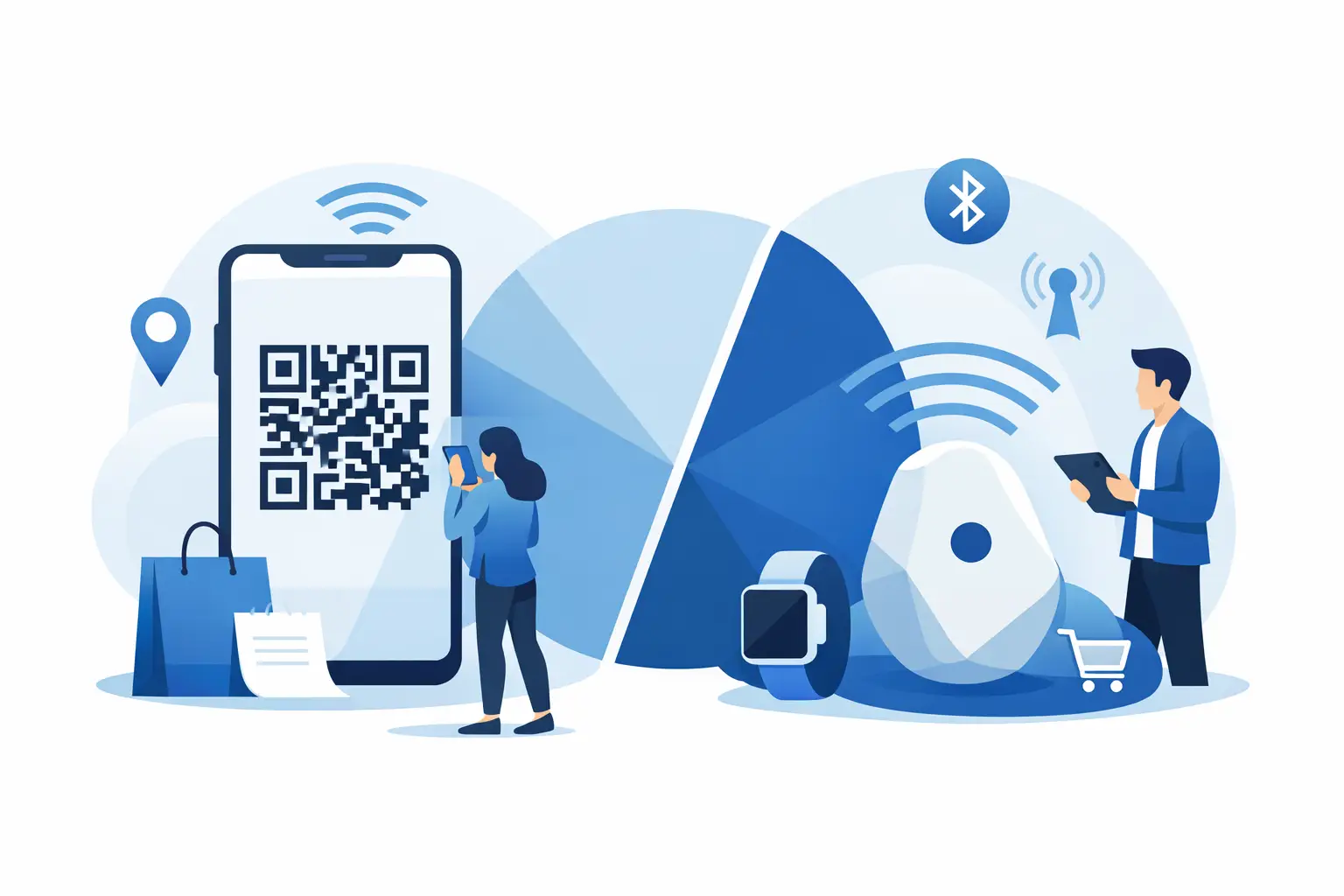
A visitor stops in front of a work, a vestige or the porch of a church. Should their phone scan a visible landmark, automatically detect a proximity signal, or do both depending on the context? The debate between QR codes versus Bluetooth beacons is not just a technical choice. It influences the budget, the daily work of the teams, the accessibility of the route and the relationship that the public has with the places.
For museums, heritage sites and tourist offices, the right answer is therefore not universal. It depends on the configuration of the spaces, the level of autonomy sought for visitors and the resources that the structure can devote to maintenance. Reliable triggering is always better than technology that is impressive but difficult to operate in the field.
QR codes versus Bluetooth beacons: two visit logics
The QR code is based on a voluntary gesture. The visitor opens their smartphone camera or a web app, scans the code and accesses the associated content. The principle is simple, known to the general public and immediately understandable, provided that the signage is well placed and legible.
The Bluetooth beacon, often called a beacon, works differently. It emits a low-power signal detected by compatible smartphones. When a visitor enters a defined area, the application can offer or automatically launch the corresponding content. It’s a logic of proximity: the experience is triggered because the person is close to a point of interest.
On paper, the tag may seem smoother. In reality, it requires more technical conditions: Bluetooth activated, authorizations granted to the application, variable settings depending on the phone models, installation and tracking of beacons. The QR code requires additional action from the visitor, but its operation is more transparent and less dependent on the digital environment.
The QR code: a simple and manageable solution
In a cultural journey, the QR code has a decisive advantage: it does not require a battery, electronic maintenance or radio settings. A plate, a label, an adhesive or a printed support may be sufficient. For a small structure, this simplicity greatly reduces the deployment burden and the risk of service interruption.
The initial cost is also easier to anticipate. You do not have to buy equipment, replace it when it ages or regularly check its charge level. If content evolves, the team modifies the route in its administration tool without having to intervene on each physical point, provided that the code refers to a stable address.
The QR code also has educational value. It leaves the visitor the choice to activate content. This intention is particularly relevant in front of works or in dense places, where everyone wants to move at their own pace. An informed amateur can delve deeper into a subject, while a family can select only the steps that interest them.
This solution, however, has its limits. The code must be visible, sufficiently contrasted and protected from damage. In an outdoor environment, rain, sun, graffiti or poorly positioned signage can reduce its readability. We must also think about visitors who do not know the scanning gesture or who do not have a recent smartphone.
A inclusive mediation therefore does not consist of putting a code on a wall. It involves clear instructions, legible characters, a suitable installation height and, if necessary, a human or printed alternative. Digital technology must complete the welcome, not create a new barrier.
Bluetooth beacons: relevant in specific cases
Bluetooth beacons respond well to certain uses. In a busy museum, they can help deliver the right content without requiring the visitor to search for a landmark. In an immersive exhibition, they contribute to a more continuous narrative: the smartphone recognizes the passage through a room and suggests the next step.
They are also interesting when you want to limit the visual impact of the signage. In a listed monument, a restored room or a sensitive heritage landscape, it may be preferable not to multiply printed materials. The beacon remains discreet, even if it must still be installed in a location compatible with the coverage sought.
But automation is never absolute. Bluetooth range varies depending on walls, windows, visitor flows and phone position. Two nearby points of interest can generate ambiguous detections. In a narrow gallery or a room with several works, the system must be finely calibrated so as not to present an inappropriate commentary.
The teams must also integrate an operational reality: a beacon is a piece of equipment. It requires an inventory, secure installation, periodic inspection and battery replacement. In a network of several sites or on an extended outdoor route, this maintenance becomes a position in its own right. The cost of purchase is only part of the equation.
Finally, Bluetooth triggering depends on the visitor's choices on their phone. Some people turn off Bluetooth to save battery or protect their peace of mind. Others deny permissions requested by an application. The route must remain usable in these situations, without transforming a technical adjustment into an obstacle to discovery.
Guideius addresses every digital cultural mediation challenge
Create a multilingual smartphone audio guide that is easy to deploy, accessible and tailored to your museum, heritage site or destination.
What impact on the visitor experience?
The right trigger is one that remains understandable. The QR code makes the action visible: the visitor knows why content is opening and can easily find the desired step. This predictability is valuable for audiences unfamiliar with digital technology, but also for school groups, international visitors and people who want to maintain control of their visit.
The Bluetooth beacon can reduce handling and provide a sense of continuity. It is suitable when a linear story is desired, for example in a scenography or a route where the steps must be followed in a precise order. It can also be used to trigger a discreet notification, rather than immediate audio, to give the visitor a choice.
In both cases, the quality of the experience depends above all on the content and its context. An excellent comment, available in several languages, downloadable offline and accompanied by accessible media, will provide more value than a sophisticated trigger with no real intention of mediation.
Costs, maintenance and digital sobriety
For many cultural structures, the QR code is the most consistent choice with a sober approach. It limits the purchase of equipment, avoids batteries and reduces maintenance trips. It also makes it possible to quickly deploy a temporary route, a summer exhibition or a heritage walk without tying up a significant budget.
Bluetooth beacons can justify their investment if they meet a concrete need: a particular scenography, a strong requirement for triggering by proximity or a heritage constraint which makes visible signage difficult. They should not be retained just because they appear more innovative.
The issue of data also deserves special attention. A mediation solution must favor statistics useful for improving the journeys - steps consulted, languages chosen, listening duration - without trying to unnecessarily follow people. This requirement of proportionality is essential for public establishments, communities and all stakeholders attached to a relationship of trust with their visitors.
A hybrid approach is often the most reliable
Strictly contrasting the two technologies can lead to a false choice. In many projects, the QR code constitutes the main entry point, while the GPS accompanies the exterior routes and beacons are reserved for a few areas where they provide real use value.
A urban circuit, for example, can use GPS to locate visitors on a route, QR codes on buildings or interpretation panels, then a beacon in a closed place where the signage must remain very discreet. This combination avoids relying on a single technology for the entire experience.
It is also a way to make the visit more secure. If Bluetooth is not activated, the QR code remains available. If the mobile connection is weak, content downloaded in advance allows you to continue the journey. Solutions like Guideius are designed to articulate these modalities without burdening teams with administration.
Questions to ask yourself before deciding
Before choosing, it is useful to observe the field rather than starting from the technology. Are the spaces interior or exterior? Are the points of interest far away or very close together? Can the signage be installed freely? Who will check the equipment each month? Will visitors download an app or access a web app instead?
It is also necessary to consider real uses. A family trail, a temporary exhibition and an interpretation center do not require the same level of automation. Testing a few steps with visitors, including digitally distant audiences, often helps identify friction before full deployment.
The best system is one that leaves culture at the forefront. When technology is simple to administer, accessible to the public and adapted to the constraints of the location, it stops getting noticed. It becomes what it should be: discreet support to better listen, understand and transmit.
Would you like to apply these ideas to your site?
Guideius helps deploy multilingual audio tours with QR codes, GPS, offline mode, multimedia content and privacy-friendly analytics.