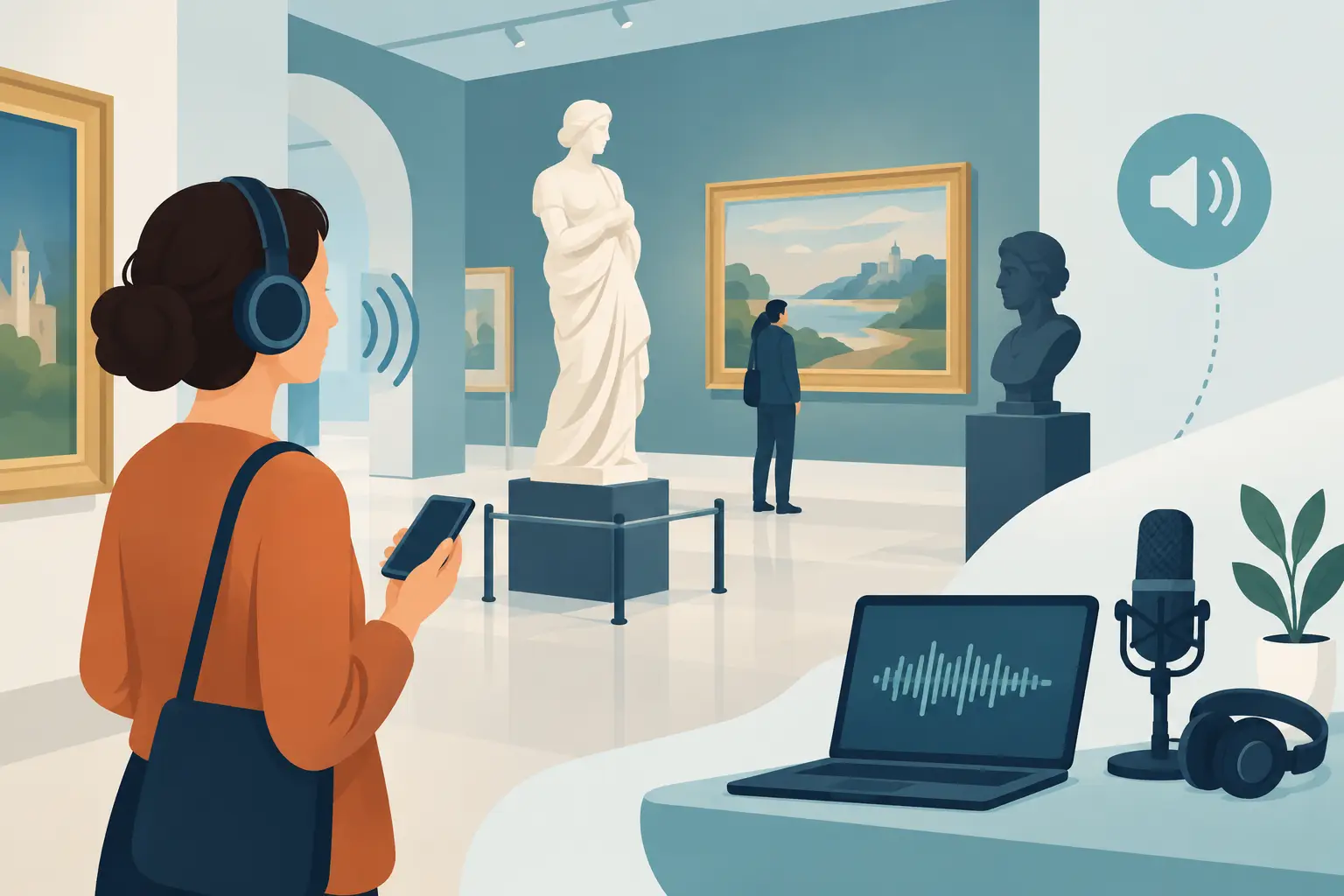
A visitor stops in front of a display case. They have a few seconds to decide whether to listen, read the label or continue on their way. Preparing audio content for a museum is therefore not about recording an exhibition text: it is about creating an encounter, at the right moment, with a work, a place or a story. Sound quality matters, but the success of a tour depends first on precise editorial choices and preparation suited to the realities of the visit.
For cultural teams, the challenge is twofold. They must share reliable knowledge without making the visit cumbersome, while producing content that is easy to manage, update and adapt to several languages. A clear method avoids expensive recordings that quickly become outdated or commentaries that are so long that nobody listens to them all the way through.
Prepare a museum’s audio content from the actual visitor route
Before writing, explore the museum as a visitor would. The planned route and the path visitors actually take do not always coincide. A room may be noisy, a work may be difficult to approach at busy times, and an outdoor area may have a poor connection. These factors determine the length, pace and activation method of the tracks.
Start by identifying the moments that genuinely call for audio mediation. Not everything needs a commentary. A good tour gives priority to emblematic works, objects whose context changes the way they are seen, details that are difficult to perceive and stories that give the visit a sense of coherence. This editorial selection is also an exercise in restraint: a smaller number of well-designed tracks is often more effective than a long series of commentaries.
Each piece of content should have a clear purpose. Is it meant to help visitors observe a technique, bring a witness’s voice to life, explain a historical period, guide their movement or connect several objects? A track that tries to do everything quickly becomes confusing. Defining a simple promise for each stop makes the writing and the scholarly review easier.
Build a framework that leaves visitors free to explore
An audio tour should not turn the visit into a single-file procession. Plan a core set of essential content that can be accessed in a flexible order, followed by optional in-depth material for curious visitors. This structure accommodates very different visiting rhythms: a family passing through will not listen in the same way as an enthusiastic amateur or a school group.
For each stop, a preparation sheet is useful. It can specify the title, the mediation objective, the target duration, documentary sources, elements to describe, rights to check, target audience and necessary adaptations. This document becomes a shared reference for collections, visitor engagement, management and any external providers.
Write for the ear, not for the label
A text intended to be read can support long sentences and many references. When it is heard, attention is more fragile. Sentences should be short, vocabulary concrete and information clearly prioritised. One strong idea per paragraph is usually enough to maintain understanding.
The opening of a track is decisive. It can start with a visible detail, a question or a specific scene: “Look at the character’s left hand”, “Imagine this object in a nineteenth-century kitchen”, “In front of you, the stone still bears the marks of the tool”. This entry point immediately gives visitors an action to perform or an image to remember.
Description remains essential, especially for people with low vision or for anyone who cannot get close to the object. It should not, however, be a simple list. Describing means guiding the eye: first situating the whole, then drawing attention to a detail and finally explaining what that detail reveals. This progression combines observation and interpretation without imposing an abstract discourse.
A duration of 60 to 90 seconds suits many stops. Complex subjects may justify two or three minutes, provided the content is genuinely well paced. Beyond that, it is often better to split the subject between a main track and an optional supplement. There is no universal ideal duration: a chapel, an archaeological landscape and a natural-science collection do not require the same pace.
Find the right voice
The voice carries an important part of a tour’s identity. A professional voice-over can provide comfort and consistency, especially for a multilingual or large-scale tour. The voice of a mediator, local resident, craftsperson or researcher can also create a strong sense of proximity when it genuinely serves the story.
The choice depends on the project. A personal voice can be particularly effective for telling a local memory, but it needs editorial and technical support to remain clear. Conversely, an institutional voice that is too neutral can smooth away a place’s distinctive character. The aim is not to dramatise every commentary, but to find a vocal presence that fits the collections and the audiences.
Before recording, ask someone who did not write the script to read it aloud. Repetitions, too many dates and sentences that are difficult to say become obvious immediately. Allow time for a final scholarly review as well: correcting a script after recording costs more than validating it beforehand.
Guideius addresses every digital cultural mediation challenge
Create a multilingual smartphone audio guide that is easy to deploy, accessible and tailored to your museum, heritage site or destination.
Plan for accessibility from the start
Accessibility is not something to add at the end of the project. It often improves the experience for every visitor. Clear sentences, explicit navigation, useful visual descriptions and controlled durations make the tour more welcoming, regardless of how familiar visitors are with the museum.
For blind and visually impaired people, some tracks can offer more detailed audio description, with precise spatial landmarks. Deaf and hard-of-hearing visitors need a transcript for each piece of content and subtitles for video media. Visitors who find information difficult to process also benefit from direct language, repeatable structures and routes that are easy to resume.
Linguistic accessibility deserves the same attention. Translating a French script word for word rarely makes for good listening. Each version should be adapted to its language, culture and duration. It is also important to distinguish essential translations from languages that will genuinely meet visitor demand. A relevant multilingual offer is built from observed audiences, not from a theoretical list.
Plan delivery on smartphones and on site
Even the best content loses its value if it is difficult to start. Visitors must quickly understand where to access the tour, how to choose a language and how to find a track again after an interruption. Discreet but visible signage, QR codes placed in the right locations and short instructions reduce requests for help at reception.
The activation method must fit the location. QR codes are particularly suitable for rooms, display cases and specific stops. GPS works better for historic town centres, gardens, large archaeological sites and territory-wide trails. In these cases, test the trigger zones on site and always provide a manual access option: geolocation varies with devices, weather and the surrounding buildings.
Connectivity is another point to watch. In a monument with thick walls, a rural area or a basement, pre-downloading and offline mode make the experience more reliable. Audio files must remain easy to understand while keeping a reasonable file size. Here too, technical restraint serves the visitor: well-compressed, easily accessible content limits frustration and data consumption.
A solution such as Guideius allows teams to manage these tours without maintaining a dedicated fleet of audio devices, while combining QR-code and GPS access, multilingual content and offline consultation. For a small or medium-sized organisation, this means focusing effort on mediation rather than hardware maintenance.
Test, measure and improve the audio content
Never publish a tour without testing it in real conditions. Share it with people who know the museum and with others who are discovering it. Observe their movements, the time spent at each stop, moments of hesitation and the content they abandon. The most useful feedback is not always about the text: it often reveals a problem with wayfinding, signage or the order of the visit.
Usage statistics then provide valuable information. They show which languages are used most, which tracks are listened to most, where visitors stop listening and which routes they actually follow. These data do not replace conversations with visitors, but they help prioritise improvements and support decisions with partners or funders.
Plan an update process from the outset. A new acquisition, a room change, revised scholarly information or building work can make a commentary obsolete. A simple management tool and minimal internal documentation enable the team to stay in control over time.
The most successful audio content does not try to say everything. It creates the conditions for deeper attention, gives visitors the keys to look for themselves and leaves enough space for the place to continue speaking.
Would you like to apply these ideas to your site?
Guideius helps deploy multilingual audio tours with QR codes, GPS, offline mode, multimedia content and privacy-friendly analytics.