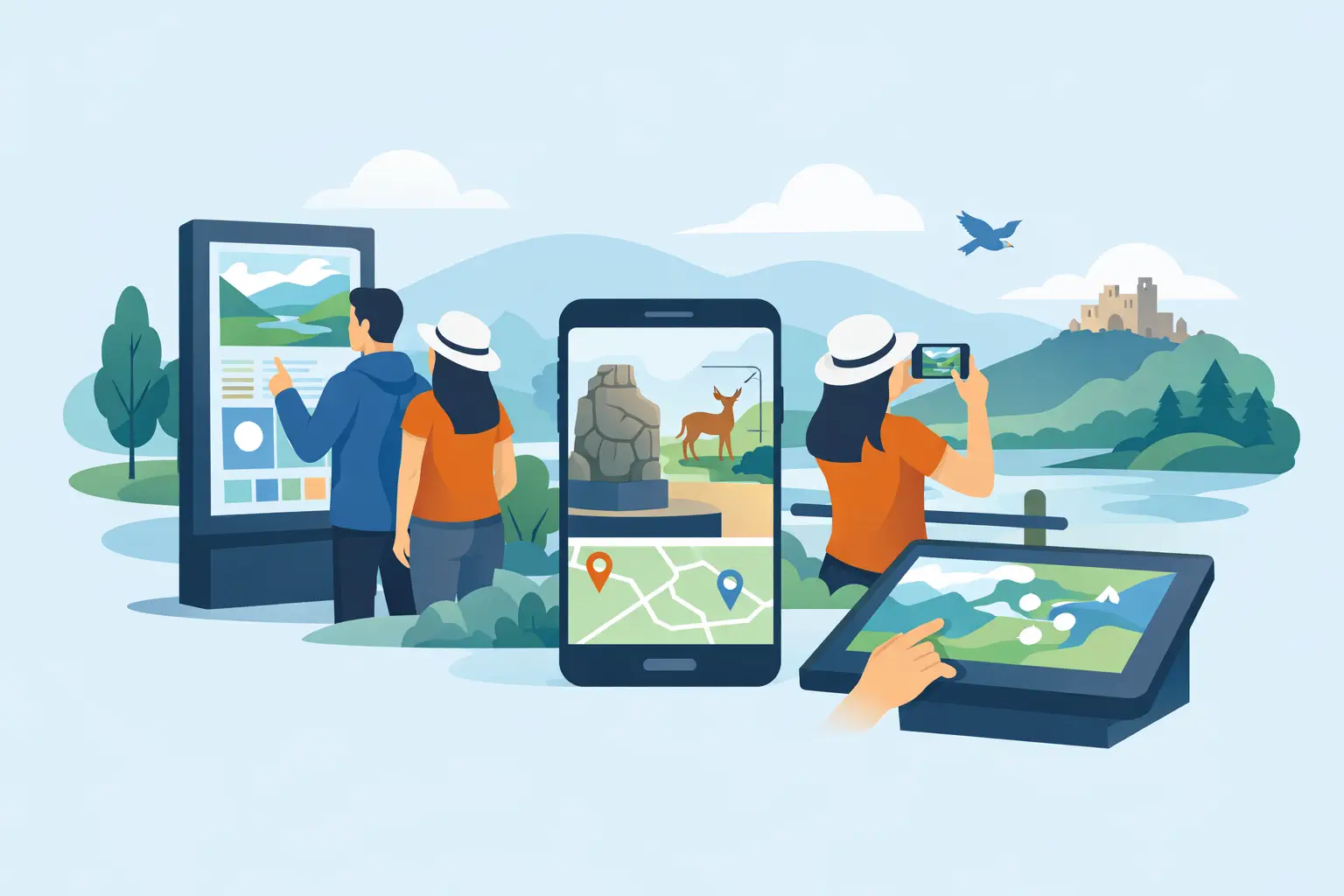
A visitor stops in front of a facade, an old landmark or a landscape whose history he does not know. A plate of a few lines gives a reference, but it can neither restore the voices, nor show the archives, nor adapt to its language or its needs. The digital interpretation route responds to this very concrete situation: it allows us to tell more, without physically weighing down the site or complicating the work of the teams.
For a museum, a monument, a heritage village or a tourist office, the challenge is not to add digital technology at all costs. It’s about creating a mediation that really helps to understand, orient and memorize. Well designed, a digital tour becomes a discreet extension of the visit, serving the collections, local stories and the autonomy of visitors.
What is a digital interpretation tour?
A digital interpretation route is a discovery route enriched by content accessible on a smartphone or tablet. At each stage, the visitor can consult an audio commentary, text, archive image, video, map, quiz or content adapted to a specific audience.
Interpretation is not just about conveying factual information. It puts the observed elements into context: why is this architecture unique? How was this landscape shaped? Who did this object belong to, and what use was made of it? Digital technology provides the space necessary to articulate these stories without transforming each space into a dense panel or expensive material device.
The route can be triggered by a QR code placed near a point of interest, by geolocation as part of an outdoor walk, or by free navigation on a map. Each choice responds to a context. The QR code is simple and precise in a closed site or near an object. GPS is particularly suitable for urban circuits, heritage trails and regional discoveries. In areas with low network coverage, downloading content beforehand is decisive to preserve the continuity of the experience.
Why this format responds to the realities of cultural sites
Small and medium-sized structures often have to reconcile a strong ambition for mediation with limited budgets, teams and technical constraints. Hardware audio guides meet certain needs, but involve purchasing, lending, cleaning, recharging, tracking devices and renewing them. A journey on the visitor's phone limits these constraints while broadening the editorial possibilities.
This approach does not mean that all visitors should be left to their own devices. Reception, signage and human mediation retain an essential place. Digital technology can free up time for discussions, guided tours and support for people who need it. It does not replace the relationship: it takes care of some of the repetitive information and leaves more room for lively interpretation.
The format also adapts to the rhythm of the visit. Some visitors follow the entire route, others select three stages as a family, and still others view only one piece of content. This freedom is particularly relevant in open spaces, old centers or exhibitions where time constraints vary greatly.
More lively content, without dilution of the subject
Adding media does not guarantee a better experience. A succession of long videos, visual effects or notifications quickly distracts attention from the location. The objective remains to make people look, listen and understand the heritage, not to keep the visitor on their screen.
Audio formats are often particularly effective: they accompany the gaze, are suitable for walking and make embodied narration possible. An old photograph can reveal the evolution of a place. A map helps to understand the transformations of a neighborhood. A testimony, read by the right voice, can bring out a local memory with a force that the text alone does not always have.
Editorial consistency matters more than quantity. Better eight well-written steps, with a clear progression and reasonable durations, than twenty contents whose added value is uncertain. Each point of interest must answer a simple question: what does it contribute to understanding the route?
Guideius addresses every digital cultural mediation challenge
Create a multilingual smartphone audio guide that is easy to deploy, accessible and tailored to your museum, heritage site or destination.
Design a useful digital interpretation route
Technology comes after the mediation project. Before choosing the features, the teams benefit from defining the priority audience, the message to be transmitted and the actual visit conditions. A route intended for families, for example, will not use the same rhythm, the same vocabulary or the same interactions as a circuit intended for lovers of industrial heritage.
Starting from the field and the story
The first step is to physically walk through the site. It is necessary to observe the viewpoints, the noise zones, the narrow passages, the walking times, the quality of the network and the places where visitors hesitate. These elements determine both the final quality and the scientific content.
Next comes the construction of the narrative thread. A good course is not limited to adding notices. It offers a guiding idea: the water which structured a city, the trades which shaped a district, the traces of a conflict, the transformations of an agricultural landscape. This thread helps to choose the steps and avoid the catalog effect.
The contents must be reread with a double requirement: historical rigor and clarity of use. Information that is accurate but too specialized can discourage part of the public. Conversely, excessive simplification impoverishes the point. The right level depends on the place, its visitors and the objective set by the structure.
Plan for accessibility when writing
Accessibility should not be treated as an option added at the end of the project. Structured texts, described images, subtitles, audio transcriptions, readable contrasts and understandable navigation benefit many audiences, well beyond just people with disabilities.
Versions in easy-to-read language, content in sign language, routes adapted to young audiences or indications on the physical accessibility of the site may be relevant depending on the means available. It is not always possible to produce all variants immediately. The main thing is to prioritize needs, plan a scalable solution and not make the journey inaccessible through avoidable choices.
Multilingualism requires the same attention. An automated translation that is not proofread can alter heritage nuances and give the impression of negligence. It is better to offer fewer languages, with adapted and validated content, than to multiply approximate versions.
Functions to prioritize for sustainable management
The quality of a course also depends on its ability to last over time. Schedules, practical information, photographs, seasonal content or historical corrections must be able to be updated without mobilizing a service provider for each modification. Clear administration is therefore a central selection criterion, particularly for teams that do not have a dedicated digital service.
Offline mode is also essential for many sites. In an old building with thick walls, on a rural path or in a saturated tourist area, an unstable connection should not interrupt the visit. The visitor must be able to prepare or download their route simply, then use it without depending on the network.
Usage statistics provide another concrete benefit. They make it possible to identify the most visited stages, the average listening time, the languages used or the moments when visitors leave the route. This data does not replace the qualitative feedback collected on site, but it helps to adjust the content and objectify the mediation choices. Their collection must remain proportionate, transparent and respectful of privacy.
Solutions like Guideius are designed to bring together these functions in an interface accessible to cultural teams: triggering by QR code or GPS, multilingual audio, multimedia content, offline, accessibility tools and usage monitoring. The point is not to multiply the options, but to be able to choose those that really serve the project.
Avoid errors that weaken the experience
The first pitfall is designing the course from an office, without testing in the field. A poorly placed QR code, an imprecise GPS point or a six-minute comment in a noisy area can be enough to discourage visitors. Tests with varied profiles allow these details to be corrected before launch.
The second is to underestimate the reception. Simple but explicit signage, a phrase spoken at the entrance and visible help to get started make a clear difference. Visitors must know in a few seconds what they can do, with which device and under what connection conditions.
Finally, a digital journey must not become fixed after its publication. Seasons, temporary exhibitions, visitor feedback and evolving knowledge create opportunities for improvement. Providing a regular review of the content allows you to maintain mediation that is fair, current and useful.
A successful journey is not measured by the number of screens viewed. It is recognized when the visitor looks up, understands better what surrounds him and leaves with the desire to tell the story of the place in turn.
Would you like to apply these ideas to your site?
Guideius helps deploy multilingual audio tours with QR codes, GPS, offline mode, multimedia content and privacy-friendly analytics.