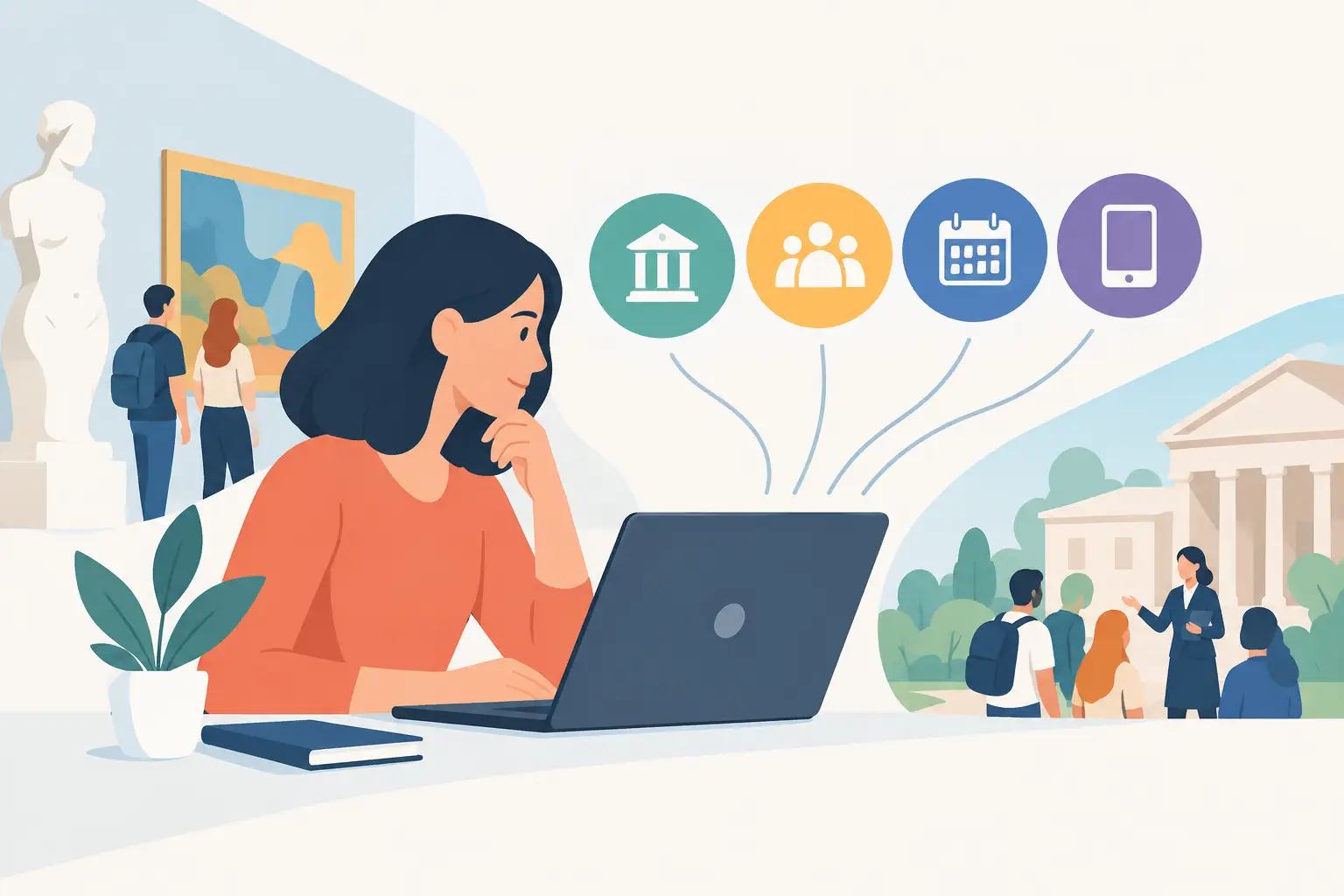
A visitor scans a QR code in front of a work, listens to a commentary in their language, activates subtitles or continues their journey offline. For the team, no fleet of boxes to load, distribute, disinfect and repair. This is the concrete promise of a well-chosen cultural mediation software: making content more accessible without burdening daily operations.
For a museum, a heritage site or a tourist office, the subject is not limited to “digitizing a visit”. It is about transmitting, guiding, including and promoting a territory, with often limited human resources. The right tool must therefore serve the cultural project before multiplying the functions.
What is cultural mediation software used for?
Cultural mediation software makes it possible to design, distribute and administer content intended for visitors. This content may take the form of audio tracks, texts, images, videos, maps, quizzes or content adapted to different audiences. They are generally accessible from the visitor's smartphone, via an application, a web app, a QR code or a geolocated trigger.
Its role goes beyond the simple distribution of an audio guide. It can accompany a visit to a room, structure a heritage walk in an old center, extend the experience of a temporary exhibition or provide guidance to independent visitors. In all cases, the tool becomes the interface between a mediation intention and an experience actually lived in the field.
This choice has concrete consequences. An overly complex system consumes training time and weakens the autonomy of teams. A system that is too closed limits editorial developments. Conversely, a solution designed for cultural uses makes it possible to keep the journeys alive over time, without systematically depending on a technical service provider.
The essential criteria for choosing cultural mediation software
The best solution is not the one with the greatest number of options. It is the one that responds to the precise constraints of the place, the habits of visitors and the abilities of the team to produce and maintain the routes.
An immediate visitor experience
A visitor should not have to create an account, search extensively for content or download a cumbersome application before even starting their visit. Access by QR code responds well to this need for simplicity, particularly in interior spaces. Geolocation takes on its full meaning for urban routes, gardens, roaming or large outdoor sites.
These two modes are not opposed. They can complement each other depending on the configuration of the course. A QR code placed near an object or panel gives the visitor direct control. GPS facilitates discovery on the move, provided that the trigger zones are carefully configured and that the experience remains understandable if the precision varies.
Offline mode deserves special attention. In an abbey with thick walls, in a rural area or in the heart of an ancient monument, network coverage is never guaranteed. Planning to download the route in advance prevents a promise of mediation from turning into a blank screen.
An administration accessible to teams
Not all cultural structures have a full-time digital manager. Relevant software must therefore offer a clear administration interface: creating a step, modifying a text, replacing a visual, publishing a new language or consulting usage data must be operations that can be controlled by the business teams.
Autonomy does not mean isolation. When launching a project, editorial and technical support remains valuable for choosing the right course format, organizing content and testing uses on site. But, once the system is in place, the institution must be able to adjust its practical information, its news or its seasonal mediations without cumbersome procedures.
Before choosing, it is useful to request an administration-oriented demonstration, not just a visitor-side presentation. Who can modify content? How long does it take to publish a correction? Are access rights differentiated? These details determine the actual adoption of the solution.
Accessibility designed from the start
Accessibility should not be treated as an option added at the end of the project. It concerns people with disabilities, but also families, non-speaking audiences, visitors unfamiliar with digital tools and people who simply wish to choose their way of discovering a place.
Transcriptions, subtitles, readable navigation, adapted contrasts, sign language content or audio descriptions can make a decisive difference. The simplicity of the instructions is just as important: an accessible route is one that does not discourage anyone from getting to grips with it.
We also need to think about editorial accessibility. A three-minute commentary may be fascinating for some visitors and too dense for others. Offering several reading levels, short formats and children’s content helps broaden the audience without impoverishing the scientific content.
Multilingualism at the service of reception
Automatic translation can help, but it does not replace cultural adaptation and human proofreading, particularly for heritage content. Proper names, historical references, tone of the story and safety instructions require precision.
The software must make it easier to manage multiple languages without creating administrative confusion. It is preferable to be able to monitor the progress of each version, identify missing content and offer the visitor a language selection upon entering the course. For tourist sites, this function directly contributes to the quality of the welcome and the understanding of local stories.
Useful statistics, without excessive monitoring
The usage data can inform mediation decisions: which stages are the most consulted? When do visitors leave the course? Which languages are most in demand? These indicators help to adjust a route, shorten a sequence or better indicate a point of interest.
The challenge is to collect aggregated and relevant data, without transforming the visit into a tracking device. For public or parapublic institutions, transparency in data management and respect for privacy are criteria of trust. A dashboard is only valuable if it produces actionable and proportionate lessons.
Guideius addresses every digital cultural mediation challenge
Create a multilingual smartphone audio guide that is easy to deploy, accessible and tailored to your museum, heritage site or destination.
Avoiding the false choice between functional wealth and sobriety
Faced with a very large offer, it is tempting to choose the most spectacular solution: augmented reality, immersive effects, complex gamified courses, very personalized interfaces. These options may be relevant for certain projects, particularly when supported by a solid editorial line and a sustainable production budget.
However, they are not essential for every site. A well-written audio tour enhanced with some visuals, a clear map, and a well-placed quiz can provide a memorable experience. The quality of mediation is based primarily on the story, the voice, the rhythm and the relevance of the information offered.
Digital sobriety here constitutes a choice of consistency. Limiting the use of dedicated equipment reduces purchases, transport, storage, batteries to replace and maintenance operations. Using the visitor's smartphone does not exempt you from providing alternatives for people who are not equipped or uncomfortable with digital technology. This involves clear signage, an attentive human welcome and, depending on the location, some targeted loan solutions.
Prepare the project before comparing solutions
A digital mediation project gains in quality when it begins with field questions. When is the most relevant time to offer the course? At reception, in front of each point of interest, before a hike? Which audiences do we want to better support? What editorial resources already exist and which need to be created?
It is also helpful to define a realistic perimeter. It is better to launch a course of eight to twelve coherent steps, perfectly tested, than a system of fifty points whose content remains uneven. The routes can then evolve with visitor feedback, the seasons and programming projects.
The budget must be looked at over the entire lifespan of the device. Added to the price of the solution are the creation or adaptation of content, translations, voice recording, signage and the time spent by the team. Conversely, it is necessary to integrate the savings linked to the absence of audio guides: purchase of equipment, breakage, recharging, cleaning, inventory and renewal.
Guideius is part of this pragmatic approach, with a solution designed to deploy multilingual audio courses, accessible and manageable without advanced technical expertise. The QR code, GPS, offline and multimedia content are not isolated arguments: they serve to adapt mediation to the realities of each place.
A good project does not seek to obscure the site behind the screen. It helps the visitor to look more, to listen differently and to feel justified in the face of heritage. It is this course that must guide the choice of the tool, then each editorial decision that follows.
Would you like to apply these ideas to your site?
Guideius helps deploy multilingual audio tours with QR codes, GPS, offline mode, multimedia content and privacy-friendly analytics.