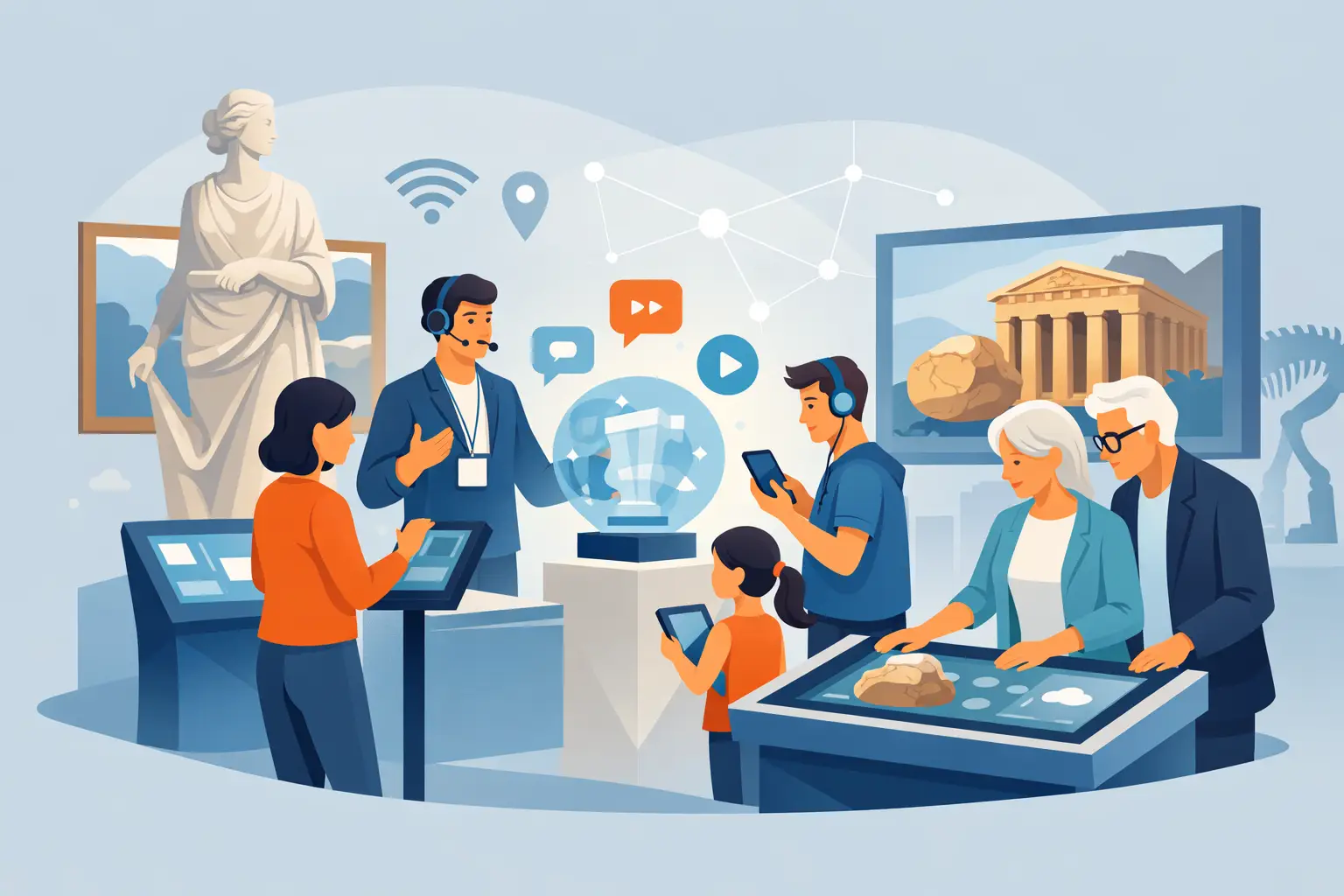
A digital device does not make a visit more interesting by its presence alone. In a museum, it must help the public to look at, understand and connect the works to a story. This digital mediation guide for museums offers a concrete method for building a useful, accessible and realistic route for teams, without adding a layer of technical complexity to an already busy daily life.
The right question is therefore not which technology to choose first. It is as follows: at what point during the visit does digital mediation provide value that the label, signage, reception staff or guided tour cannot provide alone? It is from this response that the project takes on its coherence.
Start from the visit experience, not the tool
An audio guide on a smartphone, a web app or an enriched tour do not replace human mediation. They extend access to content, give visitors more autonomy and allow reading levels to be adapted. Well designed, digital technology leaves room for observation: it does not impose a screen between the visitor and the collections.
Before comparing solutions, formulate a clear objective. Would you like to accompany a first visit? Better make the history of a building known? Offer content in several languages? Give access to stories that don’t find their place in theaters? Reduce the management of a aging audio guide stock? A project can meet several of these needs, but one of them must guide the decisions.
The type of journey then arises from the context. A fine arts museum can favor a short selection of essential works, with embodied narratives and controlled listening times. An outdoor heritage site will need GPS guidance, offline operation and content suitable for walking. A writer's house or a local museum can focus on the voices of residents, sound archives and testimonies.
Design a route that respects the visitor’s time
Duration is a choice of mediation. An exhaustive tour can be discouraging, especially when the visitor comes for an hour or is accompanying children. Conversely, content that is too brief risks reducing complex collections to a succession of anecdotes. You have to find the right level of density depending on the audience and the time available.
An effective approach is to create a main course of 30 to 45 minutes, supplemented by à la carte content. The visitor can follow an editorialized selection, then delve deeper into the works or spaces that catch their attention. This organization is particularly suitable for small and medium-sized structures: it allows you to start with a controlled project, then enrich it based on observed uses.
Each step must have a function. It can provide a key to reading, restore a historical context, make a testimony heard, compare a detail to an archive or invite us to observe a specific element. If she just repeats the cartel, she doesn't add much. Digital technology is particularly relevant when it restores what is absent from the space: a sound, a language, an archive image, a reconstruction or the words of a specialist.
The tone matters as much as the substance. Oral, precise and lively writing makes listening easier. Short sentences do not mean oversimplifying: they allow demanding knowledge to be transmitted without tiring the audience. A good script also assumes areas of uncertainty, attribution debates or developments in research. It is a respectful way of sharing knowledge.
Provide several entrance doors
Visitors come neither with the same benchmarks nor with the same expectations. Offering several reading levels makes it possible to accommodate a family, an informed amateur, a school group or a passing visitor without standardizing the experience. This can take the form of a discovery trail, a family format, in-depth content or multilingual versions.
This plurality must remain sustainable. Better two clearly differentiated paths, truly maintained and reread, than a multiplication of formats that are rarely updated. The challenge is not to produce everything immediately, but to organize the content so that it can evolve.
Guideius addresses every digital cultural mediation challenge
Create a multilingual smartphone audio guide that is easy to deploy, accessible and tailored to your museum, heritage site or destination.
Integrate accessibility when writing
Accessibility should not come at the end of the project as a technical option. It influences content, uses and reception on site. Transcriptions of audio tracks, readable texts, sufficient contrast, subtitles for videos and simple navigation benefit many visitors, including those who do not identify as disabled.
For people who are hard of hearing, transcription provides access to content and facilitates consultation in a noisy space. For blind or visually impaired people, audio description and adapted spatial indications can make works and places more accessible. For non-speaking visitors, clear wording and quality translation are more valuable than an accumulation of features.
Accessibility also comes into play in the physical journey. A QR code placed too low, instruction text that is too small or a zone without network can render a device unusable. The route must be tested in real visit conditions, with different equipment and, when possible, with people involved. Their feedback often reveals obstacles invisible to the project team.
Choose a solution adapted to the realities on the ground
The choice of a technology must be guided by the capacity of the establishment to deploy it and bring it to life. A very complete solution is not necessarily the best if it requires rare skills, heavy maintenance or regular renewal of equipment. For many organizations, the model without dedicated equipment is both an economical and environmentally friendly choice: visitors use their own smartphone, while the team avoids the burden of loaning, cleaning, recharging and replacing devices.
Triggering by QR code is well suited to museum rooms and clearly identified stops. GPS is useful for urban routes, gardens and large sites. The two approaches can be complementary, provided that the visitor immediately understands how to get started and find their way.
Offline mode is crucial in buildings with thick walls, rural sites or poorly covered outdoor spaces. It prevents the quality of visit from depending on the mobile plan or the current connection. Likewise, a accessible administration interface for non-technical teams allows you to correct a text, add a language or update a schedule without launching a new project.
Usage data deserves particular attention. Knowing which steps are listened to, where visitors drop off the journey, or which languages are used most can guide improvements. However, these statistics must remain proportionate, transparent and respectful of privacy. Cultural mediation does not need to follow individuals to learn from attendance.
Organize the project with a simple method
A digital mediation project often brings together conservation, mediation, communication, reception, management and production partners. The risk is to want to decide everything at once. A progressive method limits delays and protects editorial quality.
Start with an inventory: audiences welcomed, existing routes, network constraints, necessary languages, editorial resources available and time that the team can devote to updates. Then define a realistic initial scope, then write a tour guide before recording. This document specifies the stages, the messages to be transmitted, the media used and the duration of each sequence.
The testing phase should not be symbolic. Have visitors who are unfamiliar with the site try the course, observe their hesitations and listen to their questions. Do they understand how to start the visit? Are their headphones necessary? Does content remain audible in busy areas? These details determine the actual adoption of the device.
Guideius is part of this pragmatic deployment logic: offering multilingual audio courses on smartphones, enriched according to needs, while giving teams simple administration and benchmarks to manage their offer.
Bringing the course to life after its launch
Going online is not the end of the project. A temporary exhibition, a new acquisition, the correction of information or the arrival of a new audience can justify an evolution. Planning this life cycle from the start prevents the course from becoming obsolete after a few seasons.
Designate a referent person, even if several departments contribute to the content. She does not need to be a digital specialist, but must be able to centralize feedback, verify information and plan updates. A regular assessment, for example at the end of the high season, makes it possible to compare usage data with reception observations and visitor comments.
Successful digital mediation remains discreet in the best sense of the word: it does not seek to demonstrate the technology, but to make the visit freer, more inclusive and more memorable. When it is thought of on the scale of the establishment's resources and the reality on the ground, it becomes a sustainable transmission tool rather than just another piece of equipment to manage.
Would you like to apply these ideas to your site?
Guideius helps deploy multilingual audio tours with QR codes, GPS, offline mode, multimedia content and privacy-friendly analytics.