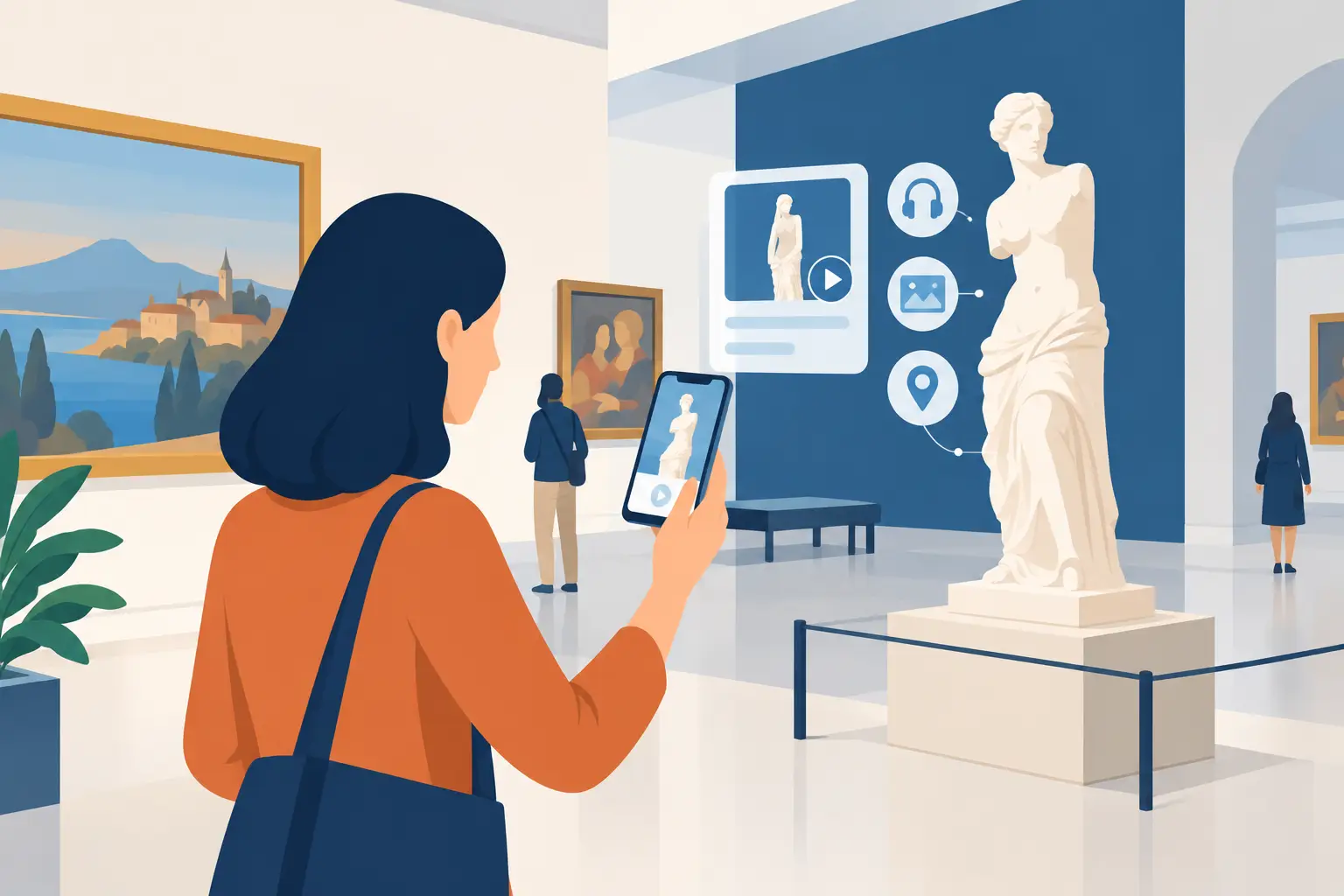
A mobile route is not just about placing a QR code at the entrance to a room or at the start of a circuit. For the visitor, access must be immediate, the content useful and the use natural. For the team, the solution must remain administrable without technical expertise or hardware to maintain. This mobile mediation deployment guide offers a concrete method for transforming a mediation intention into a truly used cultural experience.
Start from a visit objective, not from a tool
The first decision concerns neither the application nor the audio format. It consists of defining the role of the route in the proposed experience. Would you like to give reading keys to independent visitors, accompany an external tour, facilitate the discovery of a site poorly staffed by reception staff or offer content in several languages? These objectives may complement each other, but they do not produce the same journey.
A regional museum can, for example, favor short comments to make a collection more accessible to occasional visitors. An extensive heritage site should instead help you find your way, pace your walk and anticipate areas of low network coverage. A tourist office will often seek to connect several places, businesses or panoramas without imposing a too rigid itinerary.
This step avoids a common pitfall: digitizing the entirety of an existing speech without taking into account uses on smartphones. Mobile mediation complements signage, guided tours and printed materials. It is not intended to replace them all. Its interest lies in what it can provide at the right time: a voice, an archive image, a translation, a geolocated marker or content adapted to a specific audience.
Build the mobile mediation deployment guide
Define a realistic and editorialized route
Start by mapping out points of interest. On a short journey, six to ten well-chosen steps are often more effective than an exhaustive succession of instructions. Each stop must answer a simple question: what will the person understand, feel or observe more after this content?
Audio remains particularly suitable for the visit, because it frees the gaze and accompanies the movement. It benefits from being written orally: direct sentences, precise vocabulary, breathing and controlled duration. Depending on the context, a one to three minute sequence provides a good balance of depth and attention. Longer content finds its place when it is clearly announced and offered as in-depth information.
Variety also matters. An old photograph can shed light on the transformation of a landscape, while a testimony gives a human presence to a place. A quiz may be suitable for a family visit, provided it serves the purpose rather than distracting from the heritage. The challenge is not to add features, but to give the visitor several ways to enter the story being told.
Choosing the right trigger mode
The QR code is relevant when the visitor is in front of a specific object, panel or facade. It provides a clear guideline and leaves everyone free to choose the content they view. Its signage must be visible, understandable and placed at an accessible height. An isolated code, without indication of the proposed benefit, is of little incentive. Wording like “Hear the story of this place” creates a more explicit expectation.
GPS is better suited to outdoor routes, urban routes and sites where you want to trigger a discovery when approaching a remarkable point. However, trigger distances must be tested in the field. On a dense street, near an imposing building or under plant cover, accuracy may vary. A combination of QR code and GPS often provides the most useful flexibility: the GPS guides, the QR code confirms access to the right content.
The choice also depends on the desired autonomy. A well-marked circuit reassures visitors unfamiliar with digital technology. A free route is more suitable for an exhibition or an old center where everyone can compose their visit. In both cases, a short entry instruction is essential: how to start, how to activate the sound and how to continue the visit.
Plan connectivity before the big day
The experience should not depend on ideal mobile coverage. Thick walls, basements, rural areas and some natural spaces make the connection uncertain. An offline mode, allowing the route to be loaded before departure, makes the visit more secure and limits frustration. It is particularly useful for long outdoor journeys and international audiences who do not always have mobile data.
Before opening, carry out a complete test with several phones, different operating systems and a headset. Check loading times, text readability, sound level and geolocation behavior. Also take the route in real conditions: rain, sun, crowds, ambient noise or low light times. The most costly defects are not always technical. A QR code that is too discreet or text that is illegible outdoors is enough to slow down adoption.
Guideius addresses every digital cultural mediation challenge
Create a multilingual smartphone audio guide that is easy to deploy, accessible and tailored to your museum, heritage site or destination.
Make accessibility a design choice
Accessibility should not occur at the end of the project as a marginal adaptation. It improves the quality of use for all visitors. transcriptions accompanying the audios serve people who are deaf or hard of hearing, but also visitors who prefer to read or are in a noisy environment. Useful image descriptions ensure that people with visual impairments are not excluded.
Clarity of navigation is just as crucial. Self-explanatory buttons, a simple visual hierarchy, sufficient contrasts and comfortable character sizes reduce obstacles. For certain places, it is relevant to offer an easy-to-read route, content in sign language or a version suitable for families. Everything does not have to be deployed simultaneously: the main thing is to include these priorities in a realistic trajectory, based on the audiences welcomed.
Multilingualism deserves the same editorial attention. Translating a French text word for word does not guarantee quality mediation. Local references, puns and levels of detail should be appropriate. It is better to offer two well-developed languages than a multiplication of versions that are difficult to maintain.
Organize the team and commissioning
Reliable deployment relies on a clear division of responsibilities. One person manages the project and arbitrates the editorial choices. The reception agents know the first answers to provide: where to access the course, do I need to download something, how to use a personal headset? Mediation teams can flag recurring questions, which become valuable avenues for improvement.
Plan a pilot phase, even if short. Invite a few regular visitors, volunteers, partners or people who are not comfortable with digital technology. Observe them without overinterpreting their feedback: do they find the starting point? Do they understand the benefit of the course? Do they know how to return to the map or take the next step? This observation often reveals simple and decisive adjustments.
On-site communication plays a direct role in the usage rate. The reception must present the course as a service, not as a technical constraint. A clear sentence is enough: “Your phone accompanies you during the visit, in French and in several languages. » On an external site, indicate the duration, possible walking level and the possibility of downloading the content before departure.
A solution like Guideius brings together these needs in an environment that can be managed by cultural teams: audio tours, QR codes, GPS, multimedia content, offline mode and usage monitoring. However, the real criterion remains the adequacy between the activated functionalities and your mediation project.
Measure to improve, without monitoring
The usage statistics have a specific function: to understand how the course lives on the ground. The number of starts, the languages chosen, the most listened to stages, the average consultation time or abandonments can inform editorial and operational decisions. A very popular step perhaps deserves additional content. Another, systematically ignored, may be poorly reported, poorly located or simply less relevant.
This data must be collected with sobriety and transparency. Cultural structures, particularly when they are part of the public service, have an interest in favoring useful indicators without seeking to monitor visitors individually. Data control is not only a regulatory requirement: it contributes to the trust placed in the system.
Don’t wait for a complete overhaul to intervene. Modifying a teaser, shortening an audio, moving a medium or adding instructions can significantly improve the experience. Mobile mediation has this advantage: it can evolve with public feedback, the seasons, a new exhibition or the living history of a territory.
A good course cannot be recognized by the amount of technology it uses. It is recognized at the moment when a visitor, in front of a work, a stone or a landscape, understands that he has been expected and accompanied without ever being directed by force.
Would you like to apply these ideas to your site?
Guideius helps deploy multilingual audio tours with QR codes, GPS, offline mode, multimedia content and privacy-friendly analytics.