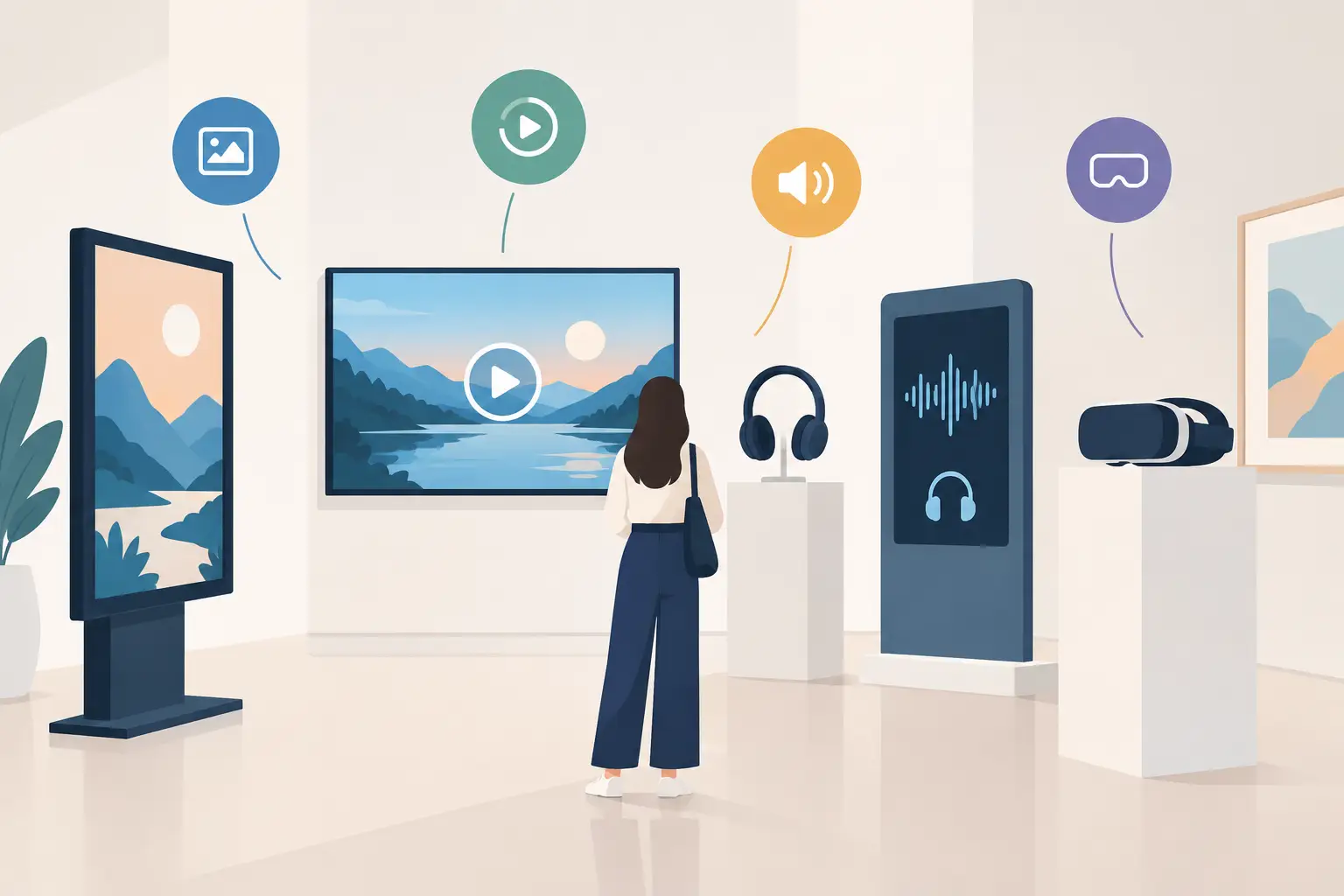
A screen placed in the middle of a room does not, on its own, create a visitor experience. Multimedia formats for exhibitions must above all serve a mediation intention: make a story clearer, provide access to a fragile work, restore an atmosphere or allow each visitor to advance at their own pace. For cultural teams, the right choice is the one that enriches the journey without burdening daily operations.
The decisive criterion is therefore not technical sophistication. This is the usefulness of the format for a specific audience, in a given location, with controlled human and financial resources. Audio, image, video, interactivity or 3D reconstruction can all have their place, provided they are thought of as transmission tools and not as demonstration effects.
The preferred multimedia formats for exhibitions
Each medium has its own strength. Combining them can strengthen a journey, but the accumulation often produces the opposite effect: cognitive fatigue, excessive downtime, difficulty in maintenance and loss of the narrative thread. It is better to choose few formats and use them consistently.
Audio, to accompany without looking away
Audio remains one of the most effective formats in a museum, a monument or an urban tour. It lets the visitor observe, move around and build their personal relationship with the objects. A voice, a soundscape or a testimony can restore what a label cannot always transmit: a professional gesture, a memory, a local pronunciation, the sensitive context of an era.
Its operational interest is just as concrete. Broadcast on the visitor's smartphone, it avoids the purchase, loan, recharge and maintenance of a fleet of audio guides. Short trails, structured around a strong idea, are particularly suitable for occasional visitors and families. More in-depth additions may remain available for audiences who wish to extend the discovery.
The enriched image, to reveal the invisible
An archive photograph, an enlarged detail, an old map or a before-and-after comparison helps put a work or a territory into perspective. This format is particularly relevant when collections have evolved, a building has disappeared or a landscape has been transformed.
The image must nevertheless remain readable on a small screen. A very detailed photograph deserves a zoom tool, while a complex document should be accompanied by a precise caption. Without contextualization, an image gallery can quickly become decorative. With a clear editorial intention, it becomes a real gateway to understanding.
Video, to show a movement or a word
Video is justified when it shows what cannot be observed on site: restoration of an object, operation of a machine, traditional dance, interview with a resident or aerial view of a site. It brings an embodied dimension, but requires particular attention to the consultation context.
In a quiet room, a video broadcast over a loudspeaker disturbs other visitors. On a smartphone, it consumes more data and battery, especially if the connection is limited. Short sequences, subtitled and downloadable offline, better respond to realities on the ground. It is often better to produce several clips of less than two minutes than a long film that few people will watch until the end.
Interactive content, to encourage participation in a measured way
Quizzes, observation questions, choice of route or interactive timelines can stimulate attention. They are useful for school groups, families and visitors who appreciate a fun approach. They also make it possible to verify that an essential message has been understood, without transforming the visit into an evaluation.
Interactivity, however, requires immediate instructions and very simple navigation. If the visitor must understand an interface before understanding the cultural content, the device fails to fulfill its role. A quiz of three questions well linked to the works encountered will have more impact than a complex game designed independently of the actual course.
3D and augmented reality, to meet a specific need
3D reconstructions are valuable when they make a vanished state intelligible: a destroyed fortification, the original volume of a church, the polychromy of a sculpture or the organization of an archaeological site. They can also facilitate access to objects that are impossible to handle or displayed behind a window.
However, these formats have a higher design cost and involve regular updates. They are not necessary for all exhibitions. Before investing, we must be able to simply answer this question: what will the visitor understand thanks to this reconstruction that they would not understand otherwise?
Guideius addresses every digital cultural mediation challenge
Create a multilingual smartphone audio guide that is easy to deploy, accessible and tailored to your museum, heritage site or destination.
Start from the visit route, not the technology
The choice of multimedia formats for exhibition begins with the analysis of visiting situations. An open-air heritage site, a dense temporary exhibition and a local museum impose neither the same uses nor the same constraints. Noise, light, average visit duration, audience age, network coverage and the presence of mediators directly modify the relevance of each medium.
It is useful to define, for each stage of the journey, a dominant function. Is it a question of welcoming, guiding, explaining, moving, observing or extending the visit? Audio is particularly suited to interpreting a place. The comparative image helps visualize a transformation. The video highlights know-how. The text remains essential for factual information accessible in a few seconds.
This method avoids producing redundant content. If the cartel already tells the complete story of an object, the audio can provide the words of a curator, a craftsman or a witness. If a model explains the volumes of a building, the screen can show its evolution over time. Each media must provide complementary reading.
Design for accessibility from the ground up
Accessibility should not be a late addition. It improves the quality of use for all visitors, including those who discover the site in noise, with a child, in another language or with little time to spare.
For audio content, a verbatim transcription is essential. The videos benefit from being subtitled and, depending on the project, supplemented with an audio description or a translation into sign language. Images should have a useful description, beyond just the file name. A readable interface, sufficient contrasts, comfortably sized buttons and predictable navigation reduce the most common obstacles.
Multilingualism deserves the same editorial requirement. Translating word for word is not always enough: certain local references, certain puns or certain historical landmarks require adaptation. Courses in language that are easy to read and understand, or short versions in several languages, can broaden access without unnecessarily multiplying content.
Anticipate real deployment conditions
A relevant format on paper can become restrictive if it depends on an unstable connection, fragile equipment or technical skills lacking in the team. The offline mode is therefore decisive in monuments with thick walls, rural sites and outdoor routes. Triggering by QR code or GPS must be tested on site, at different times of the day and with several phone models.
Editorial sustainability is as important as the initial posting. Content must be able to be corrected, translated or enriched without restarting costly development. A platform managed by non-technical teams allows you to keep the route alive, add a temporary event or modify practical information with autonomy. Guideius responds to this logic by combining audio tours, multimedia content, smartphone access and administration designed for cultural structures.
Finally, usage statistics can guide adjustments. The number of consultations, the language selected, the most listened to stages or the abandonment of the route provide useful information. They do not replace the observation of visitors or the feedback of mediators, but they help to identify content that is too long, signage that is not very visible or a step that is insufficiently attractive.
A good multimedia device does not seek to occupy every silence. It respects the place, supports the gaze and leaves the visitor the necessary space to have their own encounter with the heritage.
Would you like to apply these ideas to your site?
Guideius helps deploy multilingual audio tours with QR codes, GPS, offline mode, multimedia content and privacy-friendly analytics.