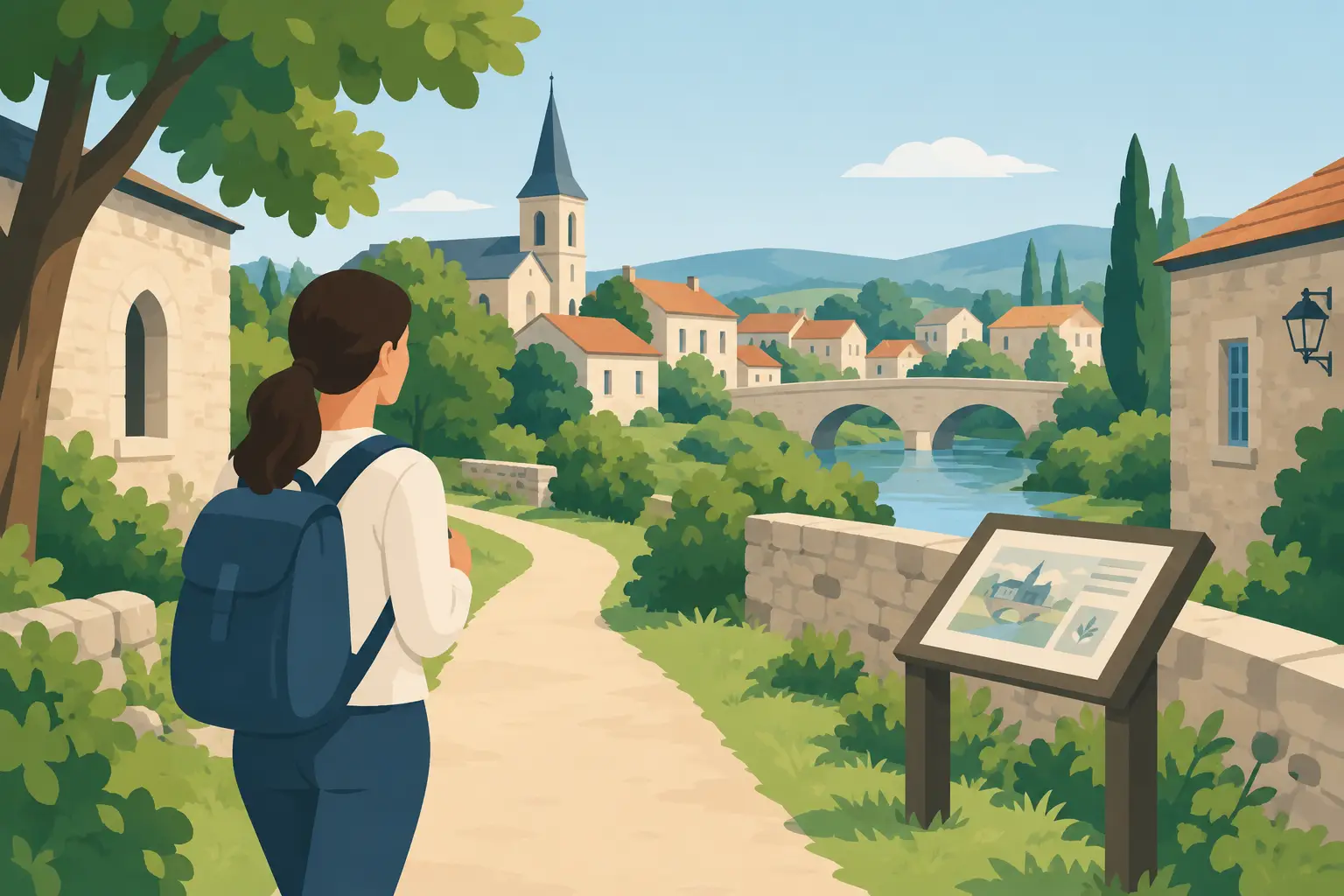
A heritage trail is not just a succession of desks in front of monuments. It provides landmarks, connects sometimes ordinary places and allows residents and visitors alike to understand what has shaped a territory. This example of a heritage trail shows how a small town can transform a 1.8 km walk into a real mediation experience, without adding to the work of its teams.
The case presented is fictitious, but is based on frequent realities: an old town center, a river, the traces of a disappeared artisanal activity and a desire to better distribute visitors outside the two best-known sites. The objective is not to tell everything. It is to bring out a coherent story, accessible to varied audiences and sustainably manageable.
An example of a heritage trail anchored in its territory
Let's imagine the town of Valmont-sur-Rive, 3,500 inhabitants. Its heritage is discreet: an old market hall, a restored wash house, weavers' houses, an abandoned mill and a footbridge over the river. Taken separately, these elements may seem modest. Together, they tell the story of three centuries of economic life, water work and social transformations.
The route, entitled “Along the water and the trades”, begins in front of the tourist office and ends near the mill. It has eight stages, lasting 55 minutes on foot. This format is suitable for a family outing, an individual visit or a discovery offered by the TOURIST OFFICE. A short 25-minute version is provided for visitors in a hurry or groups with time constraints.
The narrative thread is simple: how did the river organize village life? Each stop provides a different answer. The market evokes exchanges, the houses speak of domestic workshops, the washhouse gives space to the long invisible gestures of the washerwomen, and the mill opens up onto contemporary industrial and environmental issues. This progression avoids the catalog effect, common when each point of interest is designed independently.
Design the course before choosing the technology
The quality of a path first comes into play in the mediation choices. Before writing a text or recording an audio track, the municipal team brings together the culture, tourism and roads services, a local association and a few residents. This step makes it possible to cross-reference knowledge, but also to identify local constraints: flood zone, narrow sidewalks, seasonal work, opening hours or difficult access for certain audiences.
On-site identification is essential. A historically interesting stop is not automatically a good tour stop. The visitor must be able to stop without putting themselves in danger, look at what the commentary describes and easily find the next point. In Valmont-sur-Rive, the old factory could have constituted a central stopover. It is ultimately told from the footbridge, which offers a clear view and a safer space.
For each stop, the team defines a clear intention. It’s not just about answering the question “what do we see?” ", but also "what should the visitor understand or feel? ". A step-by-step sheet then brings together the location, the main idea, the sources used, the visuals available, the public concerned and the points of vigilance. This method facilitates scientific validations and limits late corrections.
Eight steps, eight gateways
An effective audio course alternates approaches. In Valmont-sur-Rive, certain tracks are based on archives, others on a soundscape or the reconstructed testimony of an ancient profession. The content remains short, generally between one minute thirty and three minutes. Beyond that, attention declines, especially when the visit is done standing up, outside or with children.
The eight steps follow a story logic:
- the office square locates the village and gives departure instructions;
- the market hall sounds like market day at the end of the 19th century;
- a weaver's facade explains the organization of work at home;
- the washhouse places women at the center of daily history;
- the quay tells of the floods and the developments of the river;
- the footbridge reveals the productive landscape;
- the surroundings of the mill evoke the transition from craftsmanship to industry;
- the communal garden links this past to current uses of water and biodiversity.
This choice creates a welcome variety, without giving in to overkill. A sound archive only has value if it sheds light on the place. A quiz should not interrupt the visit to keep the visitor busy, but should help them observe. For example, after the step on weavers, a question asks you to identify the large workshop windows on the facades. The device transforms an architectural detail into a clue for reading the landscape.
Guideius addresses every digital cultural mediation challenge
Create a multilingual smartphone audio guide that is easy to deploy, accessible and tailored to your museum, heritage site or destination.
A digital experience designed for the field
Digital technology is particularly relevant when it reduces constraints rather than adding them. In this example, a discreet QR code placed at the start gives access to the route on the visitor's smartphone. QR codes at important stops provide a backup solution, while GPS triggering can automatically offer content while walking.
This complementarity is useful. GPS makes the experience smooth in open spaces, but may lack precision in an old center or under plant cover. The QR code is reliable and immediately understandable, provided it is well placed, contrasted and maintained. The best choice therefore depends on the configuration of the site, the attendance and the level of autonomy expected of the public.
Offline mode deserves special attention. On many rural or wilderness routes, mobile coverage is patchy. Allowing the route to be downloaded at the start avoids cuts and reassures visitors. This also limits requests to reception, where teams do not always have time to explain connection difficulties one by one.
A solution such as Guideius brings together these uses in the same journey: audio, short texts, archive images, geolocation, quizzes and offline consultation. For a small structure, the interest lies as much in the simplicity of administration as in the functionalities offered. The content must be able to be corrected after a historical discovery, adapted to a temporary closure or enriched during an exhibition, without systematically depending on a technical service provider.
Make the trail truly accessible
Accessibility is about more than just adding an audio track. A heritage trail welcomes people with very different uses, languages and abilities. In Valmont-sur-Rive, each audio content is accompanied by of a transcription, the texts are written in clear language and the images include descriptions. The French version is supplemented by English and an easy-to-read translation when the context warrants it.
Physical accessibility must be treated with the same frankness. If a section has cobblestones, a steep slope or a narrow passage, the information is indicated before departure. In this case, the main loop includes an accessible detour which avoids the staircase near the washhouse. It is preferable to take a variant route rather than promising theoretical accessibility that is contradicted on the ground.
Attention to audiences also involves rhythm. Shorter content, easily searchable visuals and navigation without creating an account reduce obstacles. For families, a young audience version can take up four stages with a light investigation around water. It should not oversimplify, but offer another way of entering the story.
Measure to improve without distorting the visit
After the launch, usage data provides concrete information: number of departures, languages chosen, most viewed stages, completion rate or time of abandonment. They do not replace feedback from residents or on-site observation, but they help identify a stop that is difficult to find or content that is too long.
If the mill stage is rarely visited even though it is at the end of the route, several explanations are possible: insufficient signage, visitor fatigue, problem with the route or lack of narrative interest. The right answer is not always to add digital. It may consist of moving a panel, shortening a segment or creating a shaded break point.
Data governance matters too. For communities and cultural structures, choosing a tool that respects privacy, is understandable by teams and proportionate to needs is part of a responsible mediation approach. Measuring only makes sense if it serves to improve reception and the transmission of knowledge.
A good heritage trail leaves the visitor with the impression of having discovered more than a route: a way of looking at the territory. By starting from a strong local story, respecting the realities on the ground and choosing tools that are simple to maintain, even a small town can make its paths a lasting invitation to understand, share and return.
Would you like to apply these ideas to your site?
Guideius helps deploy multilingual audio tours with QR codes, GPS, offline mode, multimedia content and privacy-friendly analytics.