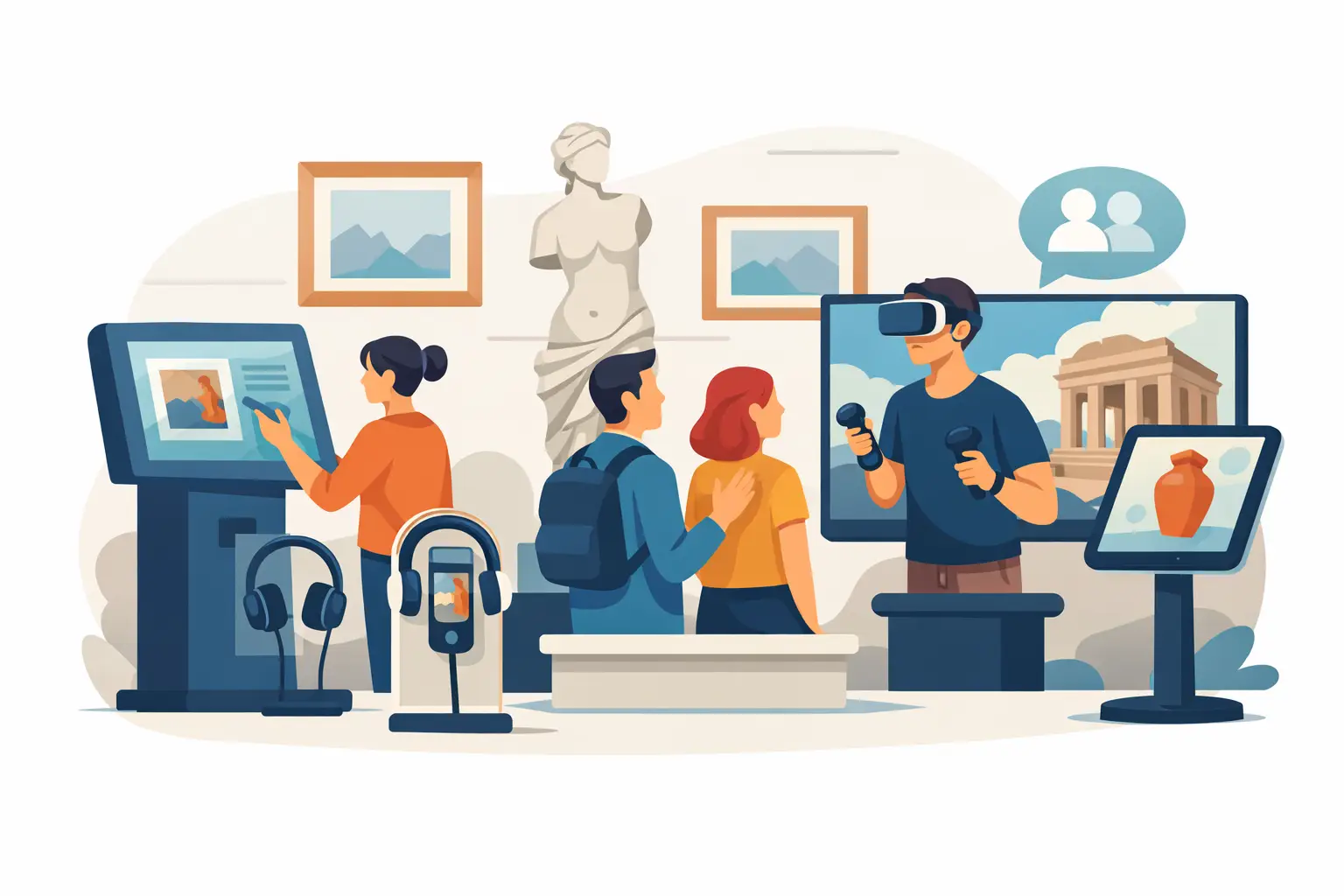
An audio guide that runs out of battery at 3 p.m., headsets that need to be disinfected between two groups, a tablet that cannot be found or a terminal that has become illegible: museum mediation equipment is never just a technical sheet. They determine the quality of the welcome, the fluidity of the routes and the time actually available for visitors. For a cultural structure, the right choice is the one that serves the mediation project without burdening daily operations.
Start from uses before choosing equipment
The first instinct is often to compare devices. However, the decisive question lies elsewhere: what experience does the museum wish to offer, to which audiences, in which spaces and with what human resources? A society museum welcoming families does not have the same needs as an open-air archaeological site or an artist's house open by reservation.
Relevant equipment must meet a concrete use. Do we want to provide guideposts, delve deeper into certain objects, offer a multilingual tour, facilitate access to audiences far removed from the written word, or accompany a tour outside the walls? The response can combine several formats, but it must remain readable. An accumulation of uncoordinated screens, sound devices and QR codes risks dispersing attention rather than strengthening understanding.
It is also necessary to examine the constraints of the location. The thickness of the walls, network coverage, brightness, ambient noise, visitor flows and the possible presence of stairs directly influence the choice. Effective technology in a contemporary gallery may prove unsuitable for a castle with narrow spaces or a heritage trail spread across a village.
The main mediation equipment in museums
Material tools retain their place in certain contexts. Their interest, however, depends on their real added value and the team's ability to maintain them over time.
Dedicated audio guides
The audio guide loaned to reception offers a supervised experience: the visitor receives a device already configured, with content immediately available. This format is particularly suitable when the public does not easily have a smartphone, when the loan is integrated into a ticket or when the institution wishes to fully control the consultation environment.
Its cost does not end with the purchase. It is necessary to plan for storage, recharging, checking that they are working correctly, cleaning, replacing headphones and managing losses. For a small team, these tasks can take up considerable time, particularly during busy periods. The obsolescence of devices must also be included in the forecast budget.
Terminals, screens and touch tables
Fixed devices can enrich an introductory space, present an interactive map or provide access to content that is impossible to display physically. They are particularly useful when they serve a specific purpose: comparing works, handling a reconstruction, consulting archives or preparing a visit.
On the other hand, a screen is not automatically a mediation tool. If it imposes a wait, suffers from glare, or requires frequent assistance, it can degrade the experience. Its scenographic integration, maintenance and physical accessibility must be considered from the start. An interface designed solely for an audience accustomed to digital technology excludes some visitors.
Sound and immersive devices
A soundscape, directional listening or a soundscape can give sensitive depth to a historical story. In a heritage place, sound often allows us to evoke a vanished use, an archive word or the memory of a territory without overloading the walls with text.
This solution requires great precision. In a shared space, sound can interfere with contemplation, cover the words of a mediator or create auditory fatigue. Individual helmets solve part of the problem, but reintroduce loan and hygiene constraints. We must therefore reserve immersion for content that really benefits from being heard.
The visitor's smartphone
The personal telephone avoids the need for dedicated equipment and offers great broadcasting flexibility. Thanks to a QR code, a visitor can launch a tour in a few seconds. With GPS, it can also be accompanied over a large site, in an old center or along a landscaped route.
This choice does not mean abandoning the visitor in front of their screen. Clear signage, simple instructions and access without unnecessary account creation are essential. Offline mode becomes decisive in places with poor coverage, while content must be light to load and pleasant to listen to. It is also necessary to provide an alternative for people without a smartphone, without a battery or who are not very comfortable with digital technology.
Guideius addresses every digital cultural mediation challenge
Create a multilingual smartphone audio guide that is easy to deploy, accessible and tailored to your museum, heritage site or destination.
Think of accessibility as a criterion of choice
Accessibility cannot be added at the end of the project as an option. It must guide the choice of museum mediation equipment from the design stage. An accessible system allows more people to build their own relationship with the collections, at the pace that suits them.
For audio content, this requires an intelligible voice, an appropriate flow rate and an editorial structure that helps you find your way around. For visual content, sufficient contrast, readable typography and easily identifiable controls make an immediate difference. Subtitles, transcriptions, versions in sign language, audio description or simplified routes meet varied needs, often useful well beyond the audiences directly concerned.
Accessibility is also a question of autonomy. A visitor shouldn't have to ask for help to understand how to launch content, adjust the volume, or find the next step. Testing the devices with people with diverse profiles is more informative than purely technical validation.
Evaluate the full cost, not just the purchase price
Equipment that is inexpensive to purchase can become expensive if it requires frequent interventions. Conversely, a smartphone solution can reduce hardware expenses while requiring an initial editorial investment: writing, recording, translation, iconography and route configuration.
The calculation must include the full cost over several years: purchase or subscription, installation, updates, maintenance, cleaning, insurance, storage, replacement, team support and content development. This approach makes it possible to avoid projects that are attractive on paper but difficult to bring to life after their launch.
Digital sobriety also matters. Increasing the number of terminals, renewing functional equipment or imposing heavy downloads is not always justified. A sober technology is one which mobilizes the necessary resources, without excess, and which remains useful over time.
Choose a solution that can be managed by the team
The quality of a course depends on its ability to evolve. A temporary exhibition, a change of circulation, a new translation or a historical correction should not require the systematic intervention of a technical service provider. Teams need an understandable administration tool, capable of giving them control over the content and stages of the journey.
Usage statistics can then guide adjustments. Knowing which steps are most viewed, in which language, at what point in the journey or for how long helps distinguish appreciated content from content that is simply visible. This data must be processed carefully, with respect for visitors and with particular attention to the structure's control of the data.
It is in this logic that solutions like Guideius offer audio and multimedia tours accessible by QR code or GPS, usable offline and administered without advanced technical skills. The challenge is not to replace human mediation: it is to enable teams to offer additional support, available when the visitor needs it.
Make a choice consistent with your cultural project
The best equipment is not necessarily the most spectacular. It is the one that makes the story clearer, better welcomes the public and remains sustainable for the teams. Before signing, it is useful to put the system to the test on a real day: opening, crowds, questions from visitors, technical incident, closing and preparation for the next day.
A successful mediation project leaves room for works, places and exchanges. Technology must take a back seat to the visiting experience, while giving everyone the means to listen, understand and look more attentively.
Would you like to apply these ideas to your site?
Guideius helps deploy multilingual audio tours with QR codes, GPS, offline mode, multimedia content and privacy-friendly analytics.