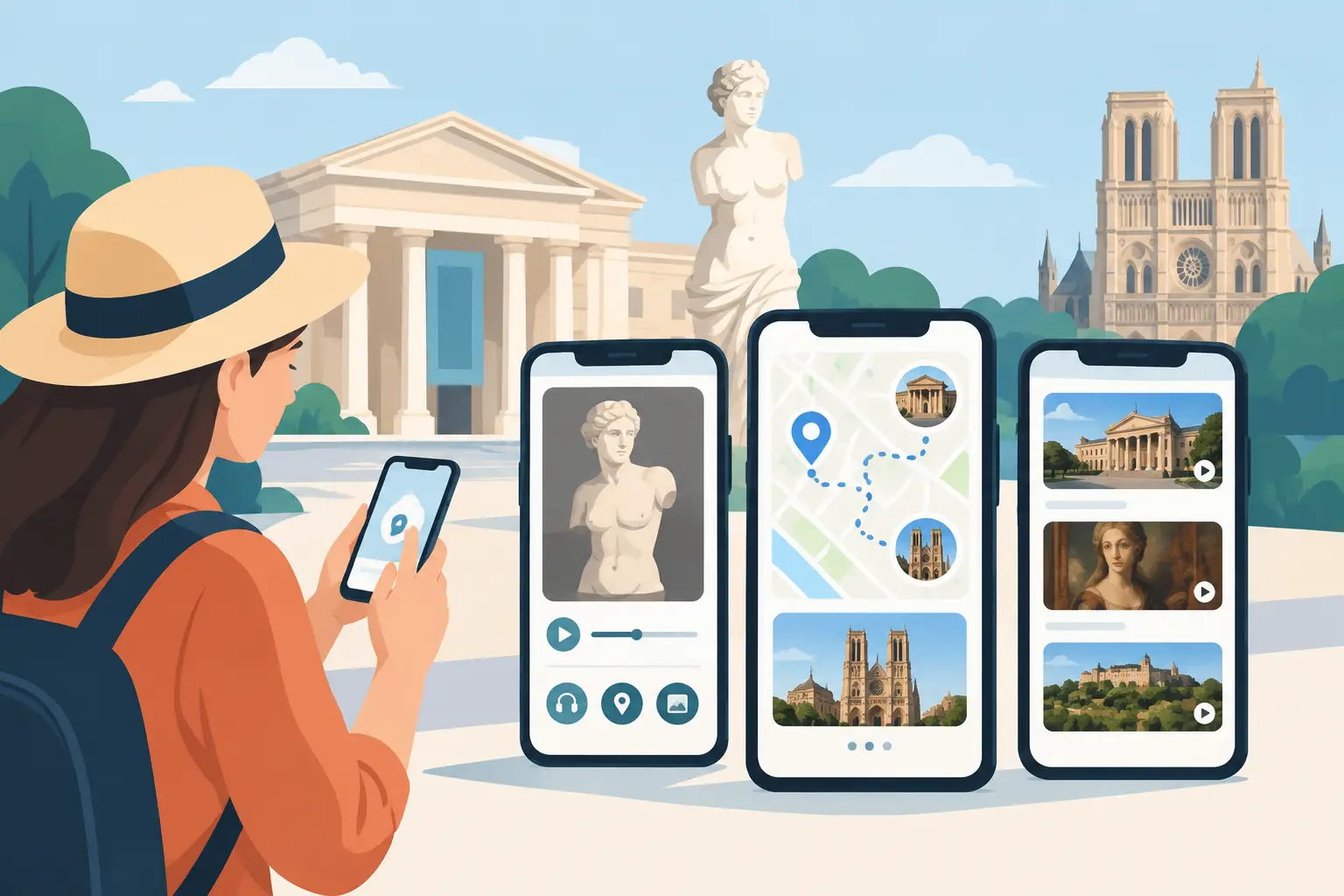
A visitor scans a QR code at the entrance, chooses their language and begins their journey in a few seconds. Behind this apparent simplicity lies a structuring choice for the establishment. This comparison of mobile cultural visit tools is therefore not about stacking functionalities: it helps to identify the solution that will really serve your mediation, your teams and your audiences.
For a museum, a monument, a tourist office or a community, the right tool must enrich the visit without burdening the welcome. It must also remain manageable by teams who do not necessarily have a dedicated digital service. The determining criterion is not to offer as much technology as possible, but to put technology at the service of transmission.
Comparison of mobile cultural visit tools: the main approaches
Mobile visit solutions are generally divided into four families. They may overlap, but their budgetary and operational implications are very different.
The audio guide on dedicated equipment
Dedicated hardware remains familiar in many sites. The establishment lends a preloaded device to the visitor, often with headphones. This formula gives direct control over the equipment and limits dependence on personal smartphones. It may be suitable for places welcoming poorly equipped audiences or for courses whose mediation relies on a specific device.
Its main setback is logistical. Purchase, renewal, recharging, cleaning, inventory, maintenance, breakdown management and storage take up time and a recurring budget. In high season, the distribution and collection of devices can also slow down reception flows. Dedicated hardware meets certain contexts, but it is not automatically the most inclusive or economical solution.
The mobile application to download
A native application often offers a polished visual experience and can take advantage of the phone's functions: geolocation, notifications, camera or downloaded content. It is relevant when the visit is part of a lasting relationship with the public, for example for a large establishment, a network of sites or a destination which wishes to unite a community.
On the other hand, requesting a download before or during the visit creates friction. Some visitors don't want to install an app they'll only use once, are short on storage space, or are in an area with weak connection. An application also involves regular updates, a presence on stores and, depending on the project, higher development costs.
The web app accessible by QR code
Accessible from the visitor's browser, the web app is generally launched by a QR code displayed at reception, on a panel or in a visitor support. It avoids downloading and facilitates independent startup. For small and medium-sized structures, this is often the most proportionate approach: deployment is rapid, content is updated without intervention on the visitor's phone and the team does not have any hardware to manage.
The quality of this experience, however, depends on two points. On the one hand, the interface must be designed for real mobile use, with clear instructions and legible routes. On the other hand, the solution must provide for offline mode or prior downloading of content when a site is poorly covered. A QR code alone does not guarantee a successful visit: it must provide a reliable and immediately understandable route.
Enriched mediation platforms
Some platforms combine audio, text, images, videos, quizzes, maps, GPS and accessibility content. They respond to projects where several audiences, several languages or several itineraries coexist. They are particularly suitable for historic centers, outdoor sites and routes spread over an area.
The risk is to transform the project into a catalog of functions. Each media must have a mediation intention. A video can shed light on a restoration gesture; a quiz can maintain the attention of a family audience; a map can guide you in a village. If they do not meet any specific need, these elements complicate production without improving the visit.
Guideius addresses every digital cultural mediation challenge
Create a multilingual smartphone audio guide that is easy to deploy, accessible and tailored to your museum, heritage site or destination.
The criteria that really matter for a cultural establishment
Comparing tools requires going beyond the technical sheet. The following questions allow you to distinguish a solution that is attractive on paper from a device that can be used on a daily basis.
Ease of access for visitors
The first screen counts. Access must be quick, without compulsory account creation or complex procedures. A multilingual route must allow the choice of language from the start and display simple benchmarks: duration, number of steps, starting point and listening method.
The personal smartphone reduces queues and handling equipment, but it should not exclude. Provide an alternative for people without a phone, without a battery or uncomfortable with digital technology: one-off loan, synthetic paper version, human support or scheduled mediation. Inclusion is not about imposing mobile on everyone, but about offering a consistent choice.
Triggering content in the field
The QR code is precise, simple and easy to deploy in a museum or monument. It leaves the visitor in control of the rhythm and allows each point of interest to be contextualized. GPS makes more sense outdoors, on trails, in a city center or between several sites. It can automatically offer nearby content, provided that the location accuracy is sufficient and the route remains understandable without constantly looking at the screen.
In many cases, the combination of the two is most relevant. The GPS provides general orientation, while the QR code secures access to content in front of a work, a facade or a specific stopping point.
Offline mode and visit continuity
Bad network coverage should never interrupt a story. In a crypt, a park, a rural site or an ancient building with thick walls, offline becomes a condition of quality, not a secondary option. Check the simplicity of downloading, the weight of the media, the retention of content on the phone and the instructions displayed to the visitor before departure.
Offline is also an issue of sobriety. Properly optimized content limits loading times and data consumption. It is not a question of reducing editorial ambition, but of favoring formats that are useful, accessible and adapted to real visiting conditions.
Accessibility thought from the design
Adding a transcription after uploading is not enough to make a course accessible. A serious solution must facilitate subtitles, transcriptions, readable contrasts, navigation compatible with screen readers and, depending on the project, sign languages, audio description or plain language content.
Accessibility often improves the experience of all visitors: a transcription helps in a noisy space, a well-organized text makes it easier to read in the sun, a simple interface reassures people unfamiliar with digital uses. It must be integrated into content specifications and budgets from the start.
Team autonomy and editorial sustainability
A cultural visit tool must not become dependent on a service provider each time a schedule is changed, a translation added or a label corrected. Ask who can create, edit, and publish the contents, what training is provided, and what level of technical skill is required.
The administration must make it possible to manage languages, media, stages and statistics without multiplying manipulations. Maintenance, upgrades and support are also part of the real cost. A slightly cheaper solution to purchase can become expensive if each adjustment requires an external service.
Data and digital ethics
Attendance data is useful for understanding the languages chosen, the most visited stages, the average listening time or route abandonments. They help to adjust the mediation and to objectify the use with funders. But they must be collected with measurement, transparency and in compliance with the regulatory framework.
Before choosing, clarify the ownership of the content, the conditions of reversibility, the hosting, the data collected and their retention period. For public and parapublic institutions, this vigilance is as much about the trust placed in visitors as it is about good management of the project.
How to choose according to your visit context
A small museum with a stable history will often favor a QR code web app, multilingual and easy to administer. An outdoor heritage site will need GPS, offline and clear mapping. A tourist office must be able to frequently evolve its circuits, integrate several municipalities and promote local stakeholders. A large institution with high international attendance will be able to justify a more personalized experience, or even a dedicated application, if it has the means to maintain it over time.
The level of customization is also worth evaluating. An interface in the colors of the site can reinforce the continuity of the experience, but it should not take precedence over readability. The white label offering, for example, makes sense when an organization has a strong destination identity or deploys several routes under the same banner.
Guideius is part of this logic of proportionality: offering cultural structures a complete solution, without dedicated hardware, which combines QR code, GPS, offline mode, multimedia content, accessibility and statistics, while remaining accessible to non-technical teams.
The best choice will be the one that your mediators, reception agents and visitors can make lasting use of. Before comparing prices, test the route in real visit conditions: with a limited connection, in full sun, in several languages and with the eyes of a person discovering the place. It is in the field that the quality of a mediation tool becomes tangible.
Would you like to apply these ideas to your site?
Guideius helps deploy multilingual audio tours with QR codes, GPS, offline mode, multimedia content and privacy-friendly analytics.