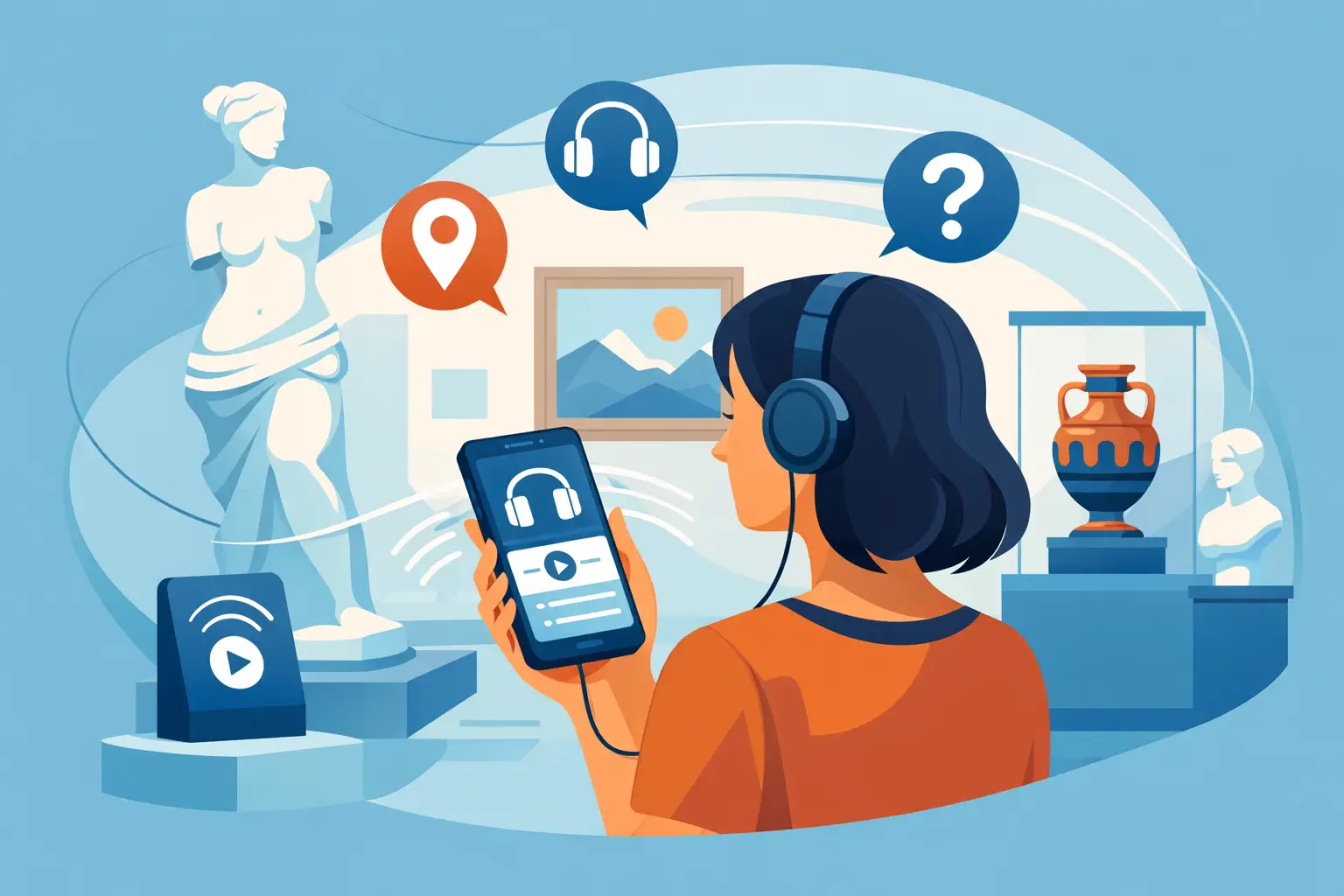
A visitor should not have to miss out on understanding an artwork because they did not collect a device at reception, because the museum is short-staffed on a busy day or because they do not speak French. A museum audio guide app addresses this practical reality by making content available on the visitor's smartphone, at their own pace, without adding to the team's workload.
However, not all solutions are equal. The difference between a simple web page with a few audio tracks and an app designed for cultural venues can be seen both in the visitor experience and in the time required to administer, support and update the tours. Choosing well is not about accumulating features, but about selecting those that genuinely serve your interpretation project.
Start with visitor needs, not technology
Before comparing tools, define what the tour needs to achieve. A fine arts museum, a writer's house, an archaeological site and an urban trail do not have the same spaces, audiences or connectivity constraints. The right app should adapt to this diversity rather than impose a standardised route.
The first question concerns the autonomy of the visitor. Would you like visitors to trigger the content themselves by scanning QR codes placed near the works? Should we offer a guided route in a park, a historic center or a large site, with GPS triggering? In many projects, the two approaches complement each other: the QR code ensures great precision in the galleries, while the GPS supports discovery outdoors.
You also need to consider the moments before the visit begins. Clear instructions at the entrance, legible signage and quick access to the tour often encourage adoption more effectively than a spectacular feature that is difficult to explain. If visitors have to create an account, download a large file or spend too long looking for the right content, some will give up. Easy access is already part of a good welcome.
Features that make a difference on site
A museum audio guide app is more than an audio player. It becomes a tool for interpretation, wayfinding and understanding visitor behaviour. Certain features deserve particular attention because they address recurring needs in cultural organisations.
Multilingual and offline mode
Offering several languages is not simply a matter of translating a text. International visitors, school groups and local residents do not always share the same references or level of knowledge. A solution should make it easy to organise and update language versions without rebuilding the entire tour.
Offline access is just as important. In old buildings, basements, gardens, rural sites or monuments with thick walls, network coverage may be unreliable. Visitors should be able to access downloaded content without their tour being interrupted midway through a sequence. It is an unobtrusive technical detail, but one that has a major impact on the perceived quality of the visit.
Content that makes you want to listen
Audio remains at the heart of the experience, but works best alongside other formats. A close-up image, archival photograph, map, quotation or short video can clarify the story without distracting from the collections. The challenge is to create a coherent editorial experience: concise content when visitors are standing in front of an artwork and more in-depth material when they pause or prepare for their visit.
Quizzes can also find their place, particularly in family and school tours. They must not transform the museum into a systematic treasure hunt. Used well, they encourage observation, check understanding or give children an additional reason to look carefully. Their interest therefore depends on the audience and the educational intention.
Accessibility by design
Accessibility should not be treated as an option added at the end of the project. Subtitles, transcription of tracks, adaptation of contrasts, readability of interfaces, content in sign language or audio description: depending on your audiences and your resources, several systems can be considered.
The key is to identify accessibility needs while writing the tours. A text transcribed afterwards is not always as effective as content designed to be read. Likewise, effective audio description must consider the artwork, its surroundings and the information needed to understand it. A well-designed app makes these formats easier to deliver, but the quality of accessibility depends primarily on the interpretation choices.
Guideius addresses every digital cultural mediation challenge
Create a multilingual smartphone audio guide that is easy to deploy, accessible and tailored to your museum, heritage site or destination.
Reduce operating constraints without impoverishing the visit
Dedicated audio-guide devices have long provided great service. They sometimes remain appropriate, for example when the use of a smartphone is impossible or the establishment wishes to equip a specific group. But their management represents an ongoing cost: purchase, charging, disinfection, maintenance, inventory, breakage, loss and delivery to the visitor.
A smartphone solution changes this model. Visitors use their own devices and headphones, while the team focuses on welcoming visitors, interpretation and content quality. For a small or medium-sized organisation, reducing this logistical burden can make a digital project viable where investing in a fleet of devices would not be.
This does not remove the need to anticipate practical situations. Some visitors will not have a smartphone, may run out of battery or may not feel comfortable with digital technology. Inclusive interpretation provides alternatives: enhanced gallery labels, a visitor booklet, occasional support at reception or a limited device-loan scheme, depending on the organisation's resources. Digital tools broaden access when they intelligently complement other forms of interpretation.
Evaluate the tool from the teams’ point of view
The best content becomes difficult to maintain if each modification requires the intervention of a service provider. A cultural team must be able to correct a schedule, add a step, update a translation or replace an image without having advanced technical skills. The administration interface, often less visible during a demonstration, therefore deserves careful evaluation.
Ask how tours are created, stops organised, files imported and languages managed. Also check what support is available when the tour goes live. An intuitive tool does not replace editorial work, but it prevents simple adjustments from becoming costly or causing delays.
Maintenance is just as important. Operating systems evolve, browsers change and security requirements become more demanding. A clear proposal should specify what is included, how updates are supported and under what conditions the solution can grow with your organisation.
Measure to improve, without monitoring visitors
Usage statistics can help you understand how visitors engage with a tour. The number of launches, selected languages, most-viewed stops and least-played sequences reveal actual behaviour. This data can be used, for example, to review signage, shorten an audio segment or give greater visibility to a less-visited room.
Measurement must remain proportionate and respectful. Cultural institutions have a particular responsibility when it comes to personal data. It is best to prioritise indicators that help improve interpretation, inform visitors transparently and avoid excessive data collection. A tour's performance cannot be reduced to a click-through rate: it is also reflected in understanding, enjoyment and the desire to return.
Choose a partner suited to your cultural project
Price should not be considered in isolation. A solution that seems inexpensive at first can consume a great deal of staff time, restrict future changes to tours or generate unexpected costs. Conversely, editorial support, included maintenance and scalable pricing provide predictability, which is particularly useful for organisations whose budgets are planned over several years.
It is also relevant to evaluate the degree of customization required. A distinctive visual identity, a dedicated domain name or a white-label app may be justified for a network of venues, a local authority or a tourist destination. For an organisation just getting started, a ready-to-deploy solution that is easy to administer may be more appropriate. The right level of customisation strengthens the visitor welcome without diverting resources from interpretation.
Guideius is part of this logic by offering cultural stakeholders a solution designed to combine team autonomy, content accessibility and control of operating costs.
The choice of an application does not replace either solid scientific information or the voice of mediators. It creates the conditions for these narratives to reach a wider audience, in several languages, on updatable tours and even in places where digital access remains imperfect. It is from this very concrete ambition of transmission that the project will find its right form.
Would you like to apply these ideas to your site?
Guideius helps deploy multilingual audio tours with QR codes, GPS, offline mode, multimedia content and privacy-friendly analytics.