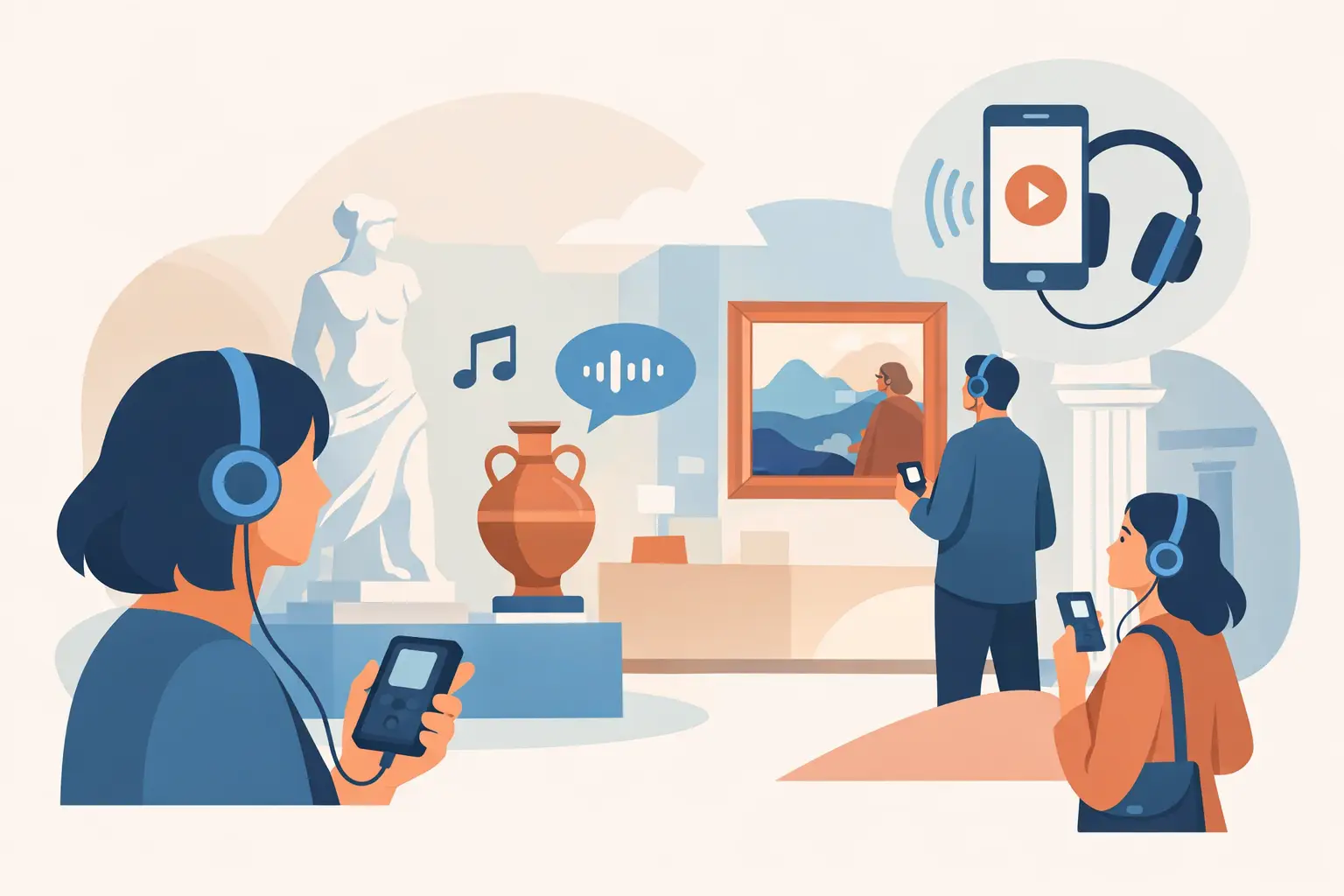
A visitor in front of a window, a vestige or a panorama is not waiting for a complex tool: he is looking for a reading key, at the right time. The term museum audio guide today covers much more than a commentary recorded on a box loaned to the reception. On a smartphone, it can become a flexible, multilingual and accessible mediation tool, capable of serving a small local museum as well as a heritage tour on a territorial scale.
For cultural teams, the challenge is not to digitize the visit to follow a trend. It is about better transmitting knowledge, without burdening daily operations or excluding audiences who do not master digital codes. The good audio guide must therefore respond to a reality on the ground: often small teams, measured budgets, variable attendance and evolving content.
Why the audio guide museum is changing its role
The traditional audio guide has long relied on a fleet of dedicated terminals. This formula retains advantages in certain contexts, notably when the public does not have a smartphone or when the venue wishes to fully control the equipment used. But it also imposes concrete constraints: purchase and renewal of equipment, recharging, distribution, inventory, disinfection, maintenance and loss management.
A digital audio guide on the visitor's phone shifts that charge. The visitor accesses the route from a QR code, a web page or an application, then listens to the content with their own device. For the structure, this reduces dependence on a stock of materials and facilitates the evolution of routes. A text modification, the addition of a language or the correction of content can be published without replacing dozens of physical media.
This change is not just about reducing costs. It allows us to think of the visit as a living editorial service. A temporary exhibition, a new acquisition, a local event or a restoration can enrich the route throughout the year. The museum audio guide then becomes a direct channel between the institution, its collections and its audiences.
A visitor experience that must remain evident
The quality of an audio tour is not measured by the number of features displayed. It plays out in the first few seconds: does the visitor understand how to get started? Can he easily find the comment that corresponds to the work or point of interest in front of him? Can he listen without fear of consuming too much mobile data?
The QR code responds effectively to indoor routes, exhibition rooms and places where the stages are clearly identified. GPS triggering is particularly useful for urban circuits, heritage trails or village visits. These two approaches are not opposed to each other: they can complement each other depending on the configuration of the site and the level of autonomy desired for the visitor.
Offline mode deserves special attention. In a crypt, an archaeological site, a steep-sided village or a monument with thick walls, the connection cannot be taken for granted. Planning to download the route or content before departure prevents a carefully thought-out mediation from being interrupted by a blank area.
Sound remains the heart of the experience, but audio benefits from being accompanied by useful media: archive photography, enlarged detail, map, illustration, transcription or visual cue. The goal is not to overcrowd the screen. It is to help the public to look more attentively, to situate themselves and to understand what they could not always perceive alone.
Write for listening, not for the brochure
A good audio commentary is not a cartel read aloud. It is aimed at a person standing, sometimes moving, surrounded by other visitors and visual requests. It needs a clear angle, breathable sentences and a duration adapted to the available attention.
A two-minute sequence can be more memorable than an eight-minute text if it offers a precise look: a craftsman's gesture, a facade detail, a local story or a question that invites observation. For more in-depth content, it is preferable to offer a complementary level that the visitor chooses to listen to. This logic respects very different visiting rhythms, without impoverishing the scientific subject.
Guideius addresses every digital cultural mediation challenge
Create a multilingual smartphone audio guide that is easy to deploy, accessible and tailored to your museum, heritage site or destination.
Design an inclusive journey from the start
Accessibility should not appear as an option added once the journey is completed. It improves the visit of many audiences: people with disabilities, families, non-French-speaking visitors, audiences far from the cultural offerings or people who simply prefer clearer content.
This begins with readable transcriptions of audio tracks, sufficient contrast, understandable navigation and structured content. Versions in sign language, subtitles for videos, audio descriptions or adapted routes can then meet specific needs. Each place will define its priorities according to its audiences, its resources and the constraints of its spaces.
Multilingualism also requires an editorial strategy. Translating a French comment word for word does not guarantee a quality experience. It is necessary to adapt the level of context, check cultural references and choose languages based on actual attendance. A structure can start with two well-developed languages, then gradually enrich its offer based on observed uses.
Inclusion also concerns material access. The personal smartphone makes it easier to use for a large proportion of visitors, but it should not become an implicit condition for understanding the visit. Clear signage, one-off loan solutions or a non-digital alternative remain relevant depending on the audiences welcomed. Digital mediation works all the better if it is part of an attentive welcome.
Simplify the work of cultural teams
For a small or medium-sized structure, an audio guide project cannot depend on a service provider for each modification. The administration tool should allow teams to create stages, import files, update a description, organize languages and publish a route without advanced technical skills.
This autonomy does not mean that teams must do everything alone. Creating a route requires editorial, scientific, graphic and technical know-how. Support can secure the first steps, in particular to define the narrative thread, calibrate the audio formats and organize the collection of media. Then, simple administration makes it possible to keep the project alive on a daily basis.
Usage statistics provide valuable insight, provided they are interpreted with discernment. They can indicate the most listened to stages, the average duration of journeys, the languages selected or the points where visitors stop their consultation. They do not replace exchanges with the public or on-site observation, but they help to adjust a route, reinforce signage or review content that is too long.
Data control is also a central subject for public and parapublic institutions. Transparent solutions should be favored regarding the information collected, its purpose, its conservation and its hosting. Measuring usage should not lead to tracking people. Ethical digital mediation seeks useful indicators for improvement, with a proportionate level of collection.
Choose a solution adapted to the site, not a technological showcase
Before comparing offers, it is helpful to ask a few simple questions: Where will the course be used? What digital autonomy do teams have? Is the network reliable? What languages are actually needed? What accessibility needs have been identified? How much time can be spent on production and updates?
The choice between native application and web app depends in particular on the expected experience and the level of customization sought. A web app accessible by QR code reduces friction at start-up, because the visitor does not necessarily have to install an application. An application may be relevant for an institution that wants a more lasting presence on the visitor's phone or a highly personalized experience. In both cases, offline, ease of access and quality of the interface are decisive.
Pricing must be looked at over time. A low entry cost can hide maintenance, update, hosting or support costs. Conversely, a solution including maintenance and support can give teams better budgetary visibility. For structures that have a strong brand identity, an offer in white label can also make it possible to maintain a coherent graphic universe while benefiting from proven technology.
Solutions such as Guideius respond precisely to this search for balance: deploy complete audio tours without dedicated hardware, while retaining concrete functions for the field, such as QR code, GPS, offline, multilingualism and accessibility.
Making digital an extension of reception
A relevant audio guide museum does not seek to occupy every minute of silence. It gives the visitor the freedom to look, discuss, stop or resume their journey. Its role is to open doors of understanding, not to transform the museum or the territory into a screen to be explored.
When designed with editorial standards, technical sobriety and attention to real uses, the audio guide on a smartphone becomes a lasting ally of mediation. It allows teams to transmit more, adapt their content and welcome more diverse audiences, while keeping the essential in its place: the meeting between a person, a place and a story.
Would you like to apply these ideas to your site?
Guideius helps deploy multilingual audio tours with QR codes, GPS, offline mode, multimedia content and privacy-friendly analytics.