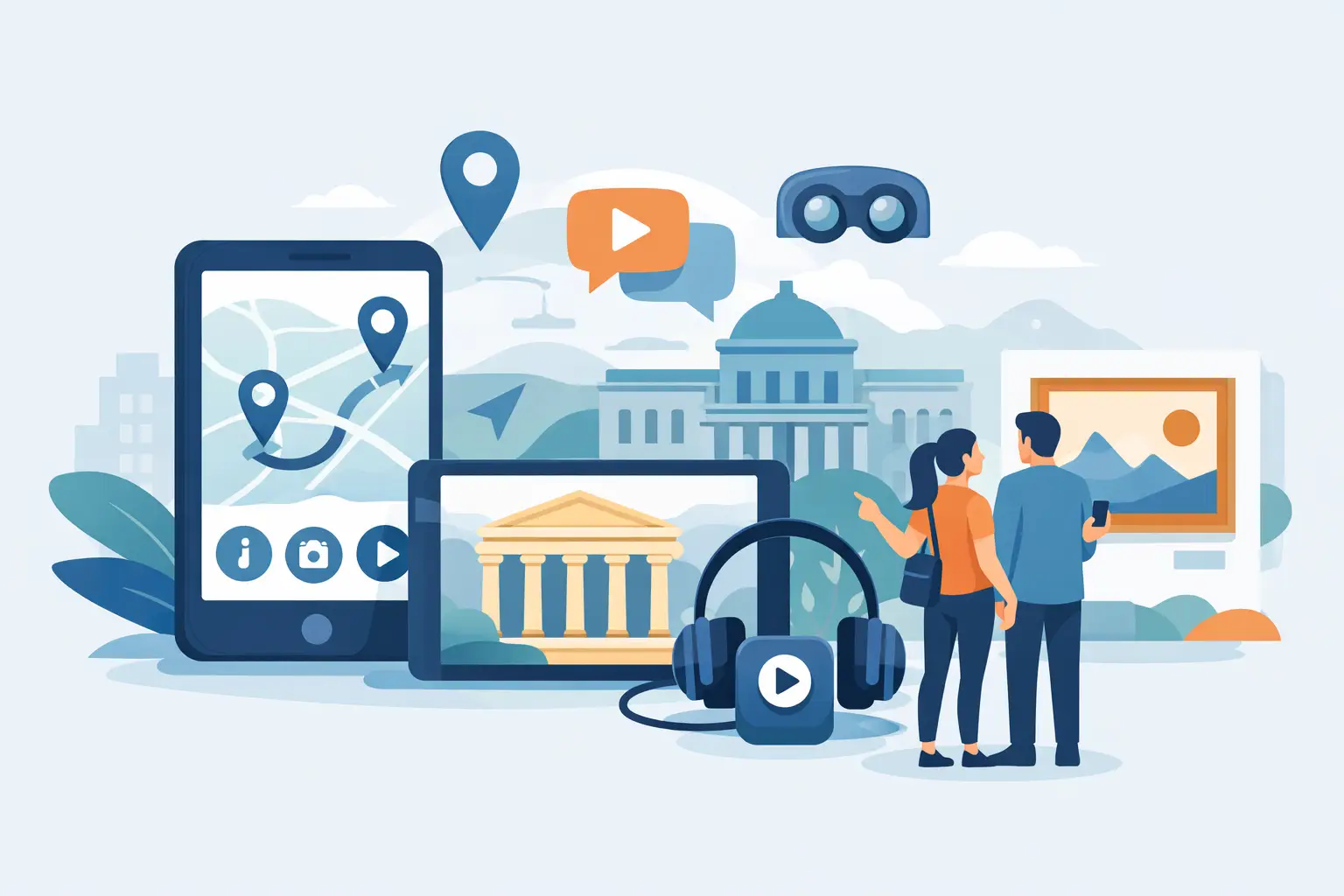
A visitor scans a QR code at the entrance to a museum, a heritage village or a trail. In a few seconds, he accesses a story in his language, moves at his own pace and keeps his phone as his only support. The essential functionalities of a visit application then determine the real quality of this experience, but also the workload it represents for the teams.
For a cultural or tourist structure, the subject does not consist of accumulating options. It’s about choosing functions that serve clear, inclusive and reliable mediation on the ground. An effective application must respect the constraints of connectivity, budget, internal skills and attendance, without distracting attention from the content and locations.
A simple entry into the course for all audiences
The first contact conditions the adoption. If the visitor has to create an account, download a heavy application or search for a long time, a part of the public gives up even before the first step. Access by QR code responds well to this reality: it can be installed on signage, a label, a leaflet or a terminal, then lead directly to the visit.
A web app also avoids the obstacles linked to application stores and allows immediate consultation on smartphone. This choice is particularly relevant for occasional visitors, passing groups and foreign tourists. A native application can, however, remain of interest when an institution wishes to offer recurring content or a more ongoing relationship with its audiences. The right format therefore depends on usage, not technical preference.
The interface must be readable from the home screen: title of the route, estimated duration, level of difficulty, available languages and practical instructions. This simple information allows the visitor to choose their experience with full knowledge of the facts and limits requests at reception.
The essential features of a field visit application
Triggering adapted to the location: QR code, GPS or free choice
Not all courses are visited in the same way. In a museum, the QR code placed near a work or a room remains precise and understandable. It also gives the visitor the freedom to create their own path. On an urban route, an extensive archaeological site or a nature route, GPS triggering facilitates orientation and can offer content at the right time, without multiplying physical supports.
These two modes are complementary. GPS is not always precise enough inside a building, on a narrow street or under plant cover. Conversely, the QR code requires clearly visible and maintained signage. Providing several entry points, as well as manual selection of stages, prevents a one-off problem from blocking the visit.
Offline mode, a requirement for reliability
In many heritage sites, the mobile network is irregular: buildings with thick walls, basements, rural areas, isolated paths or monuments. A visit that is interrupted due to lack of connection immediately degrades the perception of the service.
Downloading the contents beforehand or storing them when opening the route allows you to continue the visit without depending on the network. This function must be designed in a simple way: the visitor must know what has been downloaded, have clear information on the volume required and be able to launch the operation before leaving. For teams, offline reduces field hazards and requests for assistance.
Audio as a common thread, enriched with measure
Audio remains a central format for mobile mediation. It leaves the gaze available for the work, the landscape or the architecture, while creating a more embodied relationship with the story. Editorial quality matters as much as sound quality: a suitable voice, a lively rhythm and a controlled duration make listening more pleasant.
Images, short texts, archives, maps and videos can supplement the commentary. They are useful when they provide information that audio alone cannot transmit: detail of a work, before-and-after comparison, historical document or spatial landmark. On the other hand, too much media can weigh down the load, tire the user and distract their attention. Each element must have a specific mediation function.
Multilingualism, at the service of hospitality
Offering several languages is not about juxtaposing automatic translations. The content must be adapted to each audience, particularly when the route uses local references, puns or complex historical notions. A short version may also be relevant for groups in a hurry or visitors who discover the site without preparation.
The language should be able to be chosen from the start and then easily changed during the course. It's best to have the entire interface translated, not just the audio tracks. A safety instruction or orientation information left in a single language creates an avoidable break in the experience.
Guideius addresses every digital cultural mediation challenge
Create a multilingual smartphone audio guide that is easy to deploy, accessible and tailored to your museum, heritage site or destination.
Accessibility must be built into the design
A visit application fully participates in welcoming all audiences. Subtitles or transcriptions of audio content, sufficient contrast, adjustable character sizes, navigation compatible with screen readers and alternative descriptions of images are foundations. They benefit people with disabilities, but also families, seniors, non-French-speaking visitors or those who view the route in a noisy environment.
The content can also offer versions in sign language, audio descriptions or adapted routes. Their relevance depends on the means of the structure and the nature of the collections. The main thing is not to treat accessibility as an option added at the end of the project. It influences writing, design, media choice and user testing.
An administration designed for cultural teams
The best visitor tool loses its value if it requires the intervention of a service provider for each correction. A clear administration interface allows teams to modify text, add a step, update schedules or publish a new language without advanced technical skills.
Course management must remain structured: media library, organization by stages, preview on mobile, saving of drafts and access rights according to roles. These features protect editorial consistency, especially when multiple people contribute content. Maintenance and support also count: an affordable solution is only really affordable if it remains usable over time.
Guideius is part of this approach by giving structures the means to deploy and administer digital tours without managing a dedicated audio guide fleet. The time saved can be devoted to what is essential: the quality of the stories, the welcome and the promotion of heritage.
Measuring usage without renouncing ethics
Statistics help to manage a journey: number of starts, languages chosen, most viewed stages, average listening time or completion rate. These indicators can reveal that a step is difficult to find, that content is too long or that a language deserves to be better highlighted.
They do not replace field observation or exchanges with visitors, but usefully complement them. An increase in abandonments at a specific point can have a very concrete cause: erased signage, imprecise GPS or an area without a network.
Collection must remain proportionate and transparent. For public establishments, associations and heritage stakeholders, data control is a question of trust. Anonymized, understandable and useful statistics are better than excessive individual monitoring which does not serve the cultural project.
Choose according to your mediation project, not according to a list of options
Before comparing the solutions, it is useful to formulate some priorities: does the course take place indoors, outdoors or in both contexts? Do visitors have a reliable connection? What languages are actually needed? Does the team need to update content regularly? What accessibility needs must be covered upon opening?
The answer will naturally guide which features to prioritize. A small museum with frequent renewal will need autonomous administration and QR codes well integrated into the scenography. A rural area will rely more on GPS and offline. A very international location will make multilingualism and ease of access a priority.
A good tour app doesn't seek to impress with its complexity. It makes mediation more available, the process more welcoming and the work of the teams more manageable. It is on this condition that digital becomes a true extension of the place, serving what it has to transmit.
Would you like to apply these ideas to your site?
Guideius helps deploy multilingual audio tours with QR codes, GPS, offline mode, multimedia content and privacy-friendly analytics.