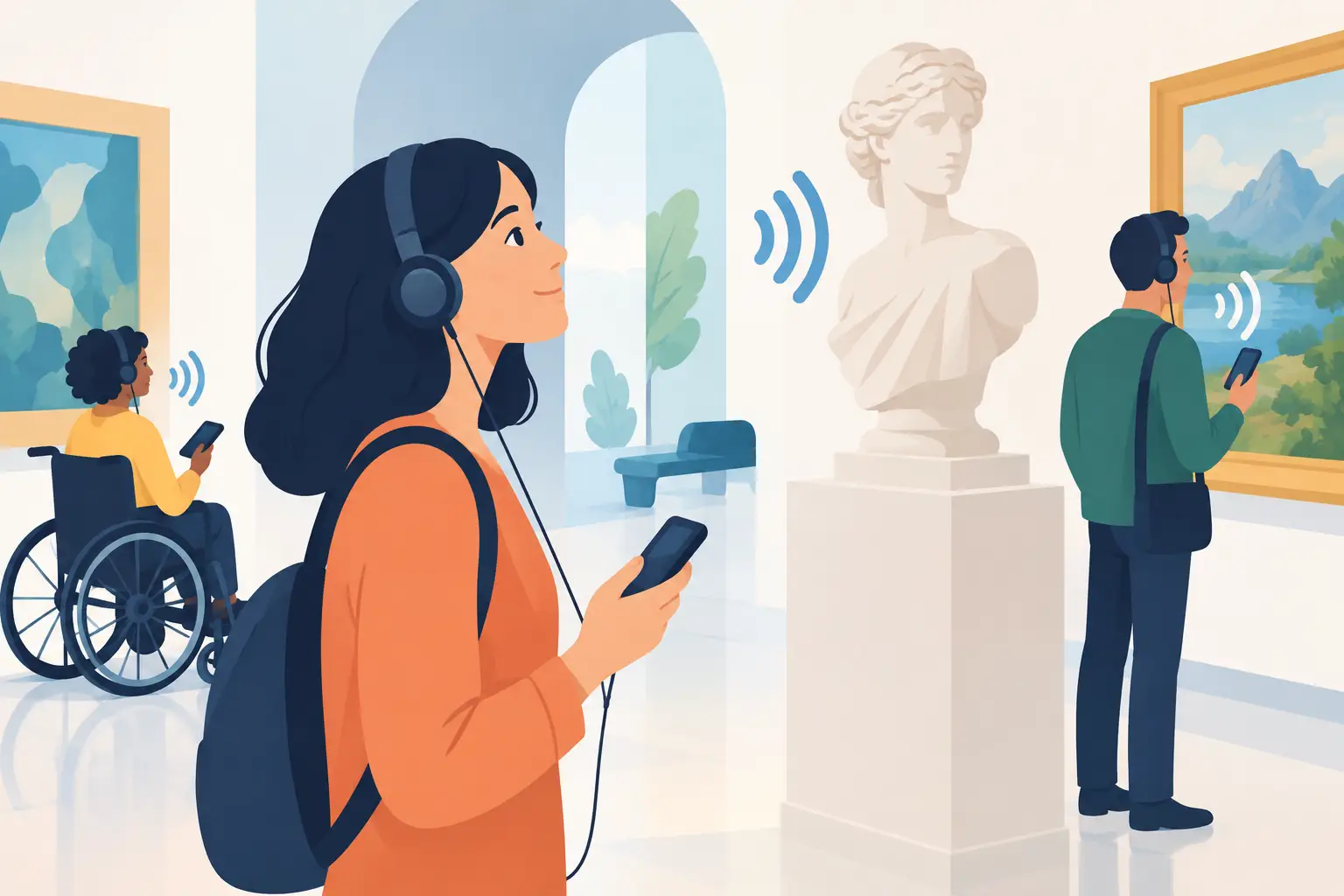
At the entrance to a museum, a simple QR code can open the door to a richer visit. But if the content cannot be read, understood, heard or used comfortably, the experience excludes some audiences. An accessible audio guide is therefore about more than offering audio commentary on a smartphone: it enables more people to build their own relationship with the works, places and stories.
For cultural teams, the challenge is practical. It means welcoming people with disabilities more effectively, but also older visitors, families, people who speak other languages, people who are less comfortable with digital technology and those visiting in a noisy environment. Accessibility improves interpretation for everyone when it is considered from the outset of the tour design.
Accessibility is not just about audio
The term may seem paradoxical: how can an audio guide meet the needs of a deaf or hard-of-hearing person? Precisely because a truly inclusive tour never relies on a single format. Audio remains an excellent way to convey an atmosphere, a curator’s voice, a testimony or a sensitive explanation. It should, however, be complemented by readable transcripts, relevant visual content and clear navigation.
This complementarity also benefits visitors who do not want to use headphones, who are visiting with young children or who are in a place where sound is difficult to hear. A well-structured transcript also makes the content easier to consult after the visit, share with a companion or use in an educational setting.
For blind or visually impaired people, an audio guide can become a genuine tool for autonomy when it does more than comment on a work. It should describe what is visible, explain how the space is organised and provide concrete reference points. Saying that a painting is “monumental” conveys little information. Describing its height, the figures represented, their positions, the dominant colours and significant details helps visitors form a mental image.
Cognitive accessibility deserves the same attention. Short sentences, explained vocabulary, a logical progression and the option to listen at one’s own pace make a tour more welcoming. The aim is not to oversimplify heritage, but to make its keys for understanding available. Content can remain demanding and clear.
Design an accessible audio guide from the outset
Accessibility should not be a correction added once the tour is finalised. When it is addressed too late, it often leads to additional costs and editorial compromises. Preparing for it from the start makes it possible to create more coherent content and set priorities more effectively.
Writing for listening and reading
A text written for listening is not always pleasant to read on a screen, and the opposite is also true. The right approach is to write content that flows when heard, then adapt it with readable formatting: short paragraphs, clear headings and essential information placed at the beginning.
Overly abstract directions should be avoided. In an exhibition room, “look to the left” does not help someone who enters from another doorway or cannot see the work. It is better to name the object, give its precise location and mention a recognisable feature. These reference points reinforce every visitor’s autonomy.
Specialist terms have their place in a heritage tour, provided they are explained. A short definition integrated naturally into the story avoids interrupting comprehension. At an archaeological site, for example, immediately explaining what a cardo or curtain wall is is more effective than piling up technical terms without context.
Offer several levels of discovery
Not all visitors expect the same thing from a visit. Some have twenty minutes, while others want to explore a subject in depth for more than an hour. Some prefer highly guided interpretation; others want to choose their stops freely.
An accessible audio guide should therefore offer choices: listen to a summary or a longer commentary, follow a complete route or select points of interest, skip a sequence, listen to it again, consult an image or read the transcript. This freedom is particularly useful for people experiencing cognitive fatigue, difficulty concentrating or a specific pace of movement.
Anticipate real visiting conditions
Accessibility also depends on conditions beyond the screen. An outdoor castle, a historic centre with narrow streets or a heritage park can create constraints related to network coverage, light and noise. A solution that constantly depends on a stable connection can leave visitors without content when they need it.
Offline mode provides a practical response. Downloading the route before departure limits service interruptions and gives reception teams confidence. QR-code activation is useful too, but it should be complemented by a simple search, a map or a list of stops. A QR code placed too high, poorly lit or with insufficient contrast should never be the only way to access information.
Guideius addresses every digital cultural mediation challenge
Create a multilingual smartphone audio guide that is easy to deploy, accessible and tailored to your museum, heritage site or destination.
A simple interface is already a form of inclusion
Editorial quality cannot compensate for an interface that is difficult to use. Buttons that are too small, ambiguous instructions, insufficient contrast or a succession of unnecessary screens can discourage visitors before they hear the first audio track.
For an accessible audio guide, the priority is to reduce unnecessary effort. The home page should clearly explain how to get started. Visitors should be able to return easily to the map, find the current stop and adjust playback without searching. Readable typography, comfortable text sizes and information that does not depend solely on colour improve the experience for everyone.
Compatibility with smartphone accessibility features is just as decisive. Assistive technologies, such as screen readers, only work properly when interface elements are named and structured carefully. This technical aspect should be tested on devices actually used by the public, not just on a mock-up.
Deploy without creating additional workload
For many organisations, the main obstacle is not a lack of interest in accessibility, but the fear of a complex project. It is possible to move forward in stages, provided you choose a manageable solution without advanced technical skills.
The right level of ambition depends on the location, its audiences and its resources. A small museum can start by systematically adding readable text to its audio content and improving its collection descriptions. A tourist office can prioritise geolocated routes that are available offline, with stops that are easy to find. A large site can develop specific versions, for example in French Sign Language or simplified language, with the support of specialist partners.
The key is not to confuse quantity with accessibility. Ten stops that are easy to understand, well described and simple to launch will often be more useful than a very long route with confusing navigation. A platform like Guideius allows teams to develop their content, languages and routes without relying on a dedicated hardware fleet, making incremental improvements easier.
Test with visitors before launch
No set of specifications can replace real-world use. Visitors who use accessibility features should be involved in evaluating the route, ideally before launch. Their feedback often reveals difficulties that teams do not notice: instructions that are too fast, an imprecise description, a stop that is impossible to locate or text that is too dense on mobile.
Local associations, social and healthcare organisations, disability support networks and mediators can become valuable partners. This approach takes time, but it produces concrete improvements and builds a relationship of trust with the local community.
Usage statistics complement this qualitative feedback. They help identify the most visited stops, frequent drop-offs and the most requested languages. They do not tell the whole story of the experience, but they help prioritise adjustments and justify investment to decision-makers.
An accessible audio guide is built over time. Every added transcript, improved description and tested route genuinely broadens access to heritage. The best first step is often to observe with visitors what would make a visit easier tomorrow.
Would you like to apply these ideas to your site?
Guideius helps deploy multilingual audio tours with QR codes, GPS, offline mode, multimedia content and privacy-friendly analytics.