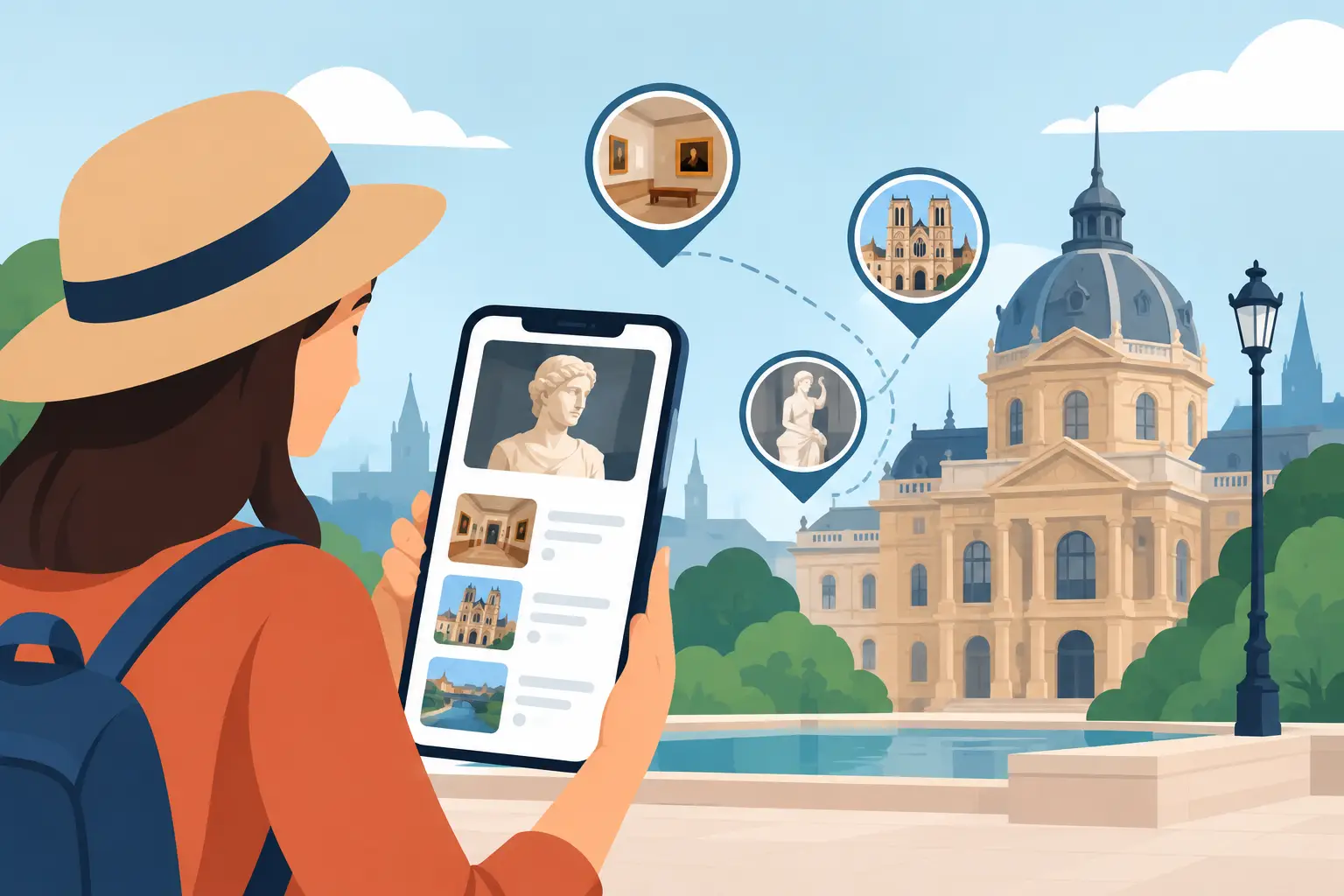
A poorly framed call for tenders can lead to an application that is attractive in demonstration, but difficult to administer, costly to develop or little used in the field. For structures preparing calls for tender for cultural or tourist visit applications, the challenge is not only to choose a technology. It is about building a mediation tool that will sustainably serve visitors, teams and the region.
A successful visitor application must make content more accessible without burdening daily operations. This principle seems simple, but it must guide each stage of the consultation, from the expression of the need to the analysis of the offers.
Start from uses before defining the solution
The first instinct is often to draw up a list of features: interactive map, audio guide, geolocation, quizzes, augmented reality, notifications. These functions may have their place, but they are no substitute for thinking about actual journeys.
Who are the targeted visitors? Does a municipal museum welcome families, schoolchildren, international tourists or restricted audiences? Can a city center tour be visited independently, on foot, over a short period of time or over several days? In an isolated site, is the network coverage sufficient? These answers determine essential choices: prior downloading of content, GPS or QR code triggering, languages offered, duration of audio tracks, level of accessibility or presence of a map.
The specifications benefit from describing concrete situations rather than a succession of technical options. For example: “a foreign visitor must be able to launch a tour in their language from their smartphone, including in areas without a network” is a more useful requirement than “the application must be multilingual and work offline”. It specifies the expected use and gives candidates the opportunity to propose a relevant response.
Distinguish the technical base, content and support
Clear consultation separates what concerns the platform, editorial production and deployment. This distinction avoids misleading comparisons between an offer comprising only one tool and another which includes writing, translation, recording, integration and training.
The mediation solution
The base generally includes access to an application or a web app, consultation of audio and multimedia content, triggering modes, course administration, statistics and maintenance. It is necessary to specify whether the structure expects a white label app, a presence in a shared environment or a web app accessible by QR code.
None of these options is consistently superior. A white label application reinforces the identity of a large facility or a structured destination, but it often requires a larger budget and governance. A web app limits downloading and speeds up deployment. In all cases, access must remain simple for the visitor, particularly when they discover the device on site.
Visit content
The audio guide is not just texts read aloud. Writing for listening, choice of voices, cultural rather than literal translation, iconographic selection, adaptation to young audiences or people with disabilities: the quality of mediation is at play here.
The market can provide a complete creation service, or entrust the content to the internal team, a guide-lecturer or an editorial agency. When several stakeholders are involved, it is essential to indicate who provides the texts, who validates the translations, who holds the rights to the media and who integrates the content into the solution.
Support for teams
For a small organization, a powerful but complex platform can become a burden. Candidates must therefore explain the level of training offered, the assistance included, the response times and the conditions for adding a new course.
The objective is not to transform mediators or reception agents into digital specialists. An administration interface must allow a non-technical team to correct a text, add a track, update a schedule or consult usage without systematically depending on a service provider.
Guideius addresses every digital cultural mediation challenge
Create a multilingual smartphone audio guide that is easy to deploy, accessible and tailored to your museum, heritage site or destination.
The essential criteria for calls for tenders for cultural or tourist visit applications
Price matters, particularly for communities and establishments with constrained budgets. But comparing only the first year's amount is risky. A very low offer may exclude hosting, updates, support, additional languages or developments necessary after launch.
The consultation regulations must favor a balanced assessment of technical value, quality of use and overall cost. In particular, he may ask candidates to detail the following elements:
- visitor access conditions, with or without downloading and with or without connection;
- accessibility features, such as transcription, sign language content, contrasts or compatibility with screen readers;
- the methods of data management, hosting and compliance with the GDPR;
- maintenance, security updates, support and service commitments;
- reversibility, that is to say the ability to recover content and data if the market ends;
- details of recurring costs and services billed additionally.
Demonstrations are also a good analysis tool. They must be based on an identical scenario for all candidates: create a step, modify a translation, launch an offline visit, consult the statistics of a route. This method makes it possible to evaluate real ergonomics, beyond a well-prepared commercial presentation.
Make accessibility a project requirement
Accessibility should not appear as an option placed at the end of the specifications. It concerns visitors with disabilities, but also elderly people, families, foreign visitors and all those who occasionally encounter difficulty reading, hearing, understanding or connecting.
Depending on the legal context of the structure, the applicable requirements may be strengthened, particularly for public bodies. Beyond compliance, it is useful to ask for concrete evidence: transcriptions associated with audio tracks, adjustment of character size, readable navigation, textual alternatives to visuals, subtitled videos, compatibility with assistive technologies and content adapted to different audiences.
An inclusive solution does not consist of increasing the number of separate pathways. It aims first of all to give everyone several ways to access the same heritage story. This approach improves the overall experience while affirming a cultural service mission.
Anticipate the realities on the ground: network, equipment and reception
In a castle, a church, a heritage garden or an ancient center, the mobile connection can vary greatly. Offline mode is then a condition for continuity of visit, and not a simple convenience. The specifications must specify how the content is downloaded, what space it takes up on the phone and how the visitor is supported if they do not have a mobile plan.
Choosing a personal smartphone reduces purchases, recharges, disinfection and loss of audio guidance equipment. However, it does not exempt you from an attentive welcome. Clear signage, well-placed QR codes, simple instructions and, when relevant, a few loaner devices ensure that unequipped visitors are not excluded.
The reception teams must also be able to explain the system in a few sentences. If getting started requires several steps or lengthy assistance, adoption will drop, even with excellent content.
Think beyond the launch
A living journey evolves: temporary exhibition, works, new language, modification of an itinerary, addition of content for young audiences. Calls for tenders must anticipate this lifespan. Request a realistic implementation schedule, including acceptance phases, training, content validation and on-site testing.
The usage statistics have real value here, provided they are understandable and proportionate. Number of launches, languages selected, stages listened to, average duration or completion rate can inform editorial decisions. They must not become an intrusive visitor tracking device. Data minimization and transparency are both ethical and reassuring choices.
Finally, question the sustainability of the relationship: do the contents remain the property of the structure? Can they be exported in a usable format? What happens to the journey in the event of a change of service provider? These questions are not secondary. They protect editorial work and investments made by the community or establishment.
Choose a partner who understands mediation
The right service provider does not just sell an application. He understands that a digital journey is part of a broader visit experience, with budgetary constraints, multi-skilled teams and responsibility for transmission. He knows how to explain his technical choices without jargon, point out the limits of a project and propose a system proportionate to the structure's resources.
It is in this balance that solutions like Guideius find their meaning: allowing cultural and tourist places to distribute multilingual, accessible and manageable audio guides without dedicated hardware or unnecessary complexity.
A well-prepared call for tenders creates the conditions for a lasting partnership. By formulating concrete needs, demanding real accessibility and looking at the cost over the entire duration of the project, each structure can make digital a mediation tool in the service of the stories it is responsible for transmitting.
Would you like to apply these ideas to your site?
Guideius helps deploy multilingual audio tours with QR codes, GPS, offline mode, multimedia content and privacy-friendly analytics.